
The disturbing question of whether domestic cats can eat their owners has resurfaced following a rare forensic case documented in Japan. The short answer is that cats do not normally attack or consume living owners. However, evidence shows that cats trapped with a person’s body may scavenge the remains after death, particularly when they are starving and have no way to escape or obtain food.
The Japanese case involved the remains of a woman in her 80s, discovered in a locked apartment in Tokyo in the spring of 2025. The woman had reportedly kept eight indoor cats and had not been seen for several months. Investigators described the residence as an extreme hoarding environment filled with rubbish and animal waste. All the doors and windows were locked from the inside, preventing the cats from leaving.
The woman’s skeleton was disarticulated, with bones scattered across the bedroom, living room and hallway. Many parts of the skeleton, including most of the vertebrae and several smaller bones, were missing. The skull and the ends of the long bones had also sustained extensive damage. DNA testing confirmed the woman’s identity, but advanced decomposition meant that investigators could not determine her cause of death. Importantly, there was no evidence that the cats had killed her.
Forensic specialists concluded that the damage occurred after death. They identified paired punctures, narrow grooves and jagged edges that were consistent with the size and shape of feline teeth. Researchers compared puncture marks found on one of the pelvic bones with the canine teeth of a cat skull and found that they closely corresponded. The absence of damage normally produced by dogs or rodents further supported the conclusion that cats were responsible.

The case was reported in the Journal of Forensic Sciences and first published online on August 27, 2025. The researchers described it as an extreme and unusually well-documented example of indoor postmortem scavenging. They estimated that the woman had been dead for between a few months and six months. Several cats were also found dead inside the apartment, suggesting that the surviving animals had experienced prolonged and severe starvation. The full forensic report describes the evidence of feline scavenging.
Cats usually prefer soft tissues and internal organs and rarely attempt to consume bones. In reported cases, they have tended to target exposed areas of the upper body, including the face, neck, arms and chest. The extensive skeletal destruction in the Tokyo case was therefore considered exceptional. Researchers believe the cats turned to harder tissues only after other accessible food sources had disappeared and their survival instincts became overwhelming.
Previous studies have established that such behaviour is possible but have not determined how frequently it occurs. In 2020, researchers documented two feral cats scavenging human remains at an outdoor forensic research facility in Colorado. Cameras showed the animals repeatedly returning to particular bodies and feeding mainly on soft tissue. The research demonstrated that cats can recognise and revisit a food source, but it did not show that pet cats routinely eat their owners. The Colorado findings were published in the Journal of Forensic Sciences.

A broader review of indoor forensic scenes found that postmortem scavenging by dogs is reported more frequently than scavenging by cats. Dogs are generally stronger, more dependent on owners for food and better able to damage large bones. Cat-related cases remain uncommon in the scientific literature, and no reliable statistics show what percentage of unattended deaths involve pets. Much of the available evidence comes from isolated case reports rather than large, long-term studies. A forensic review examined how cat and dog scavenging can be identified.
Experts stress that this behaviour should not be interpreted as betrayal or proof that cats do not love their owners. Once a person has died, stopped moving and begun producing decomposition odours, an animal no longer receives the familiar signals associated with its caregiver. Hunger, stress, confinement and the absence of another food source may eventually override normal social behaviour. It is a survival response, not an act of aggression or revenge.
The findings are important for forensic investigators because animal bites and scratches can resemble injuries caused before death. Scavenging may remove tissue, obscure existing wounds, scatter bones and make it more difficult to establish a cause or time of death. Recognising the characteristic marks left by cats can help investigators distinguish postmortem animal activity from violence.
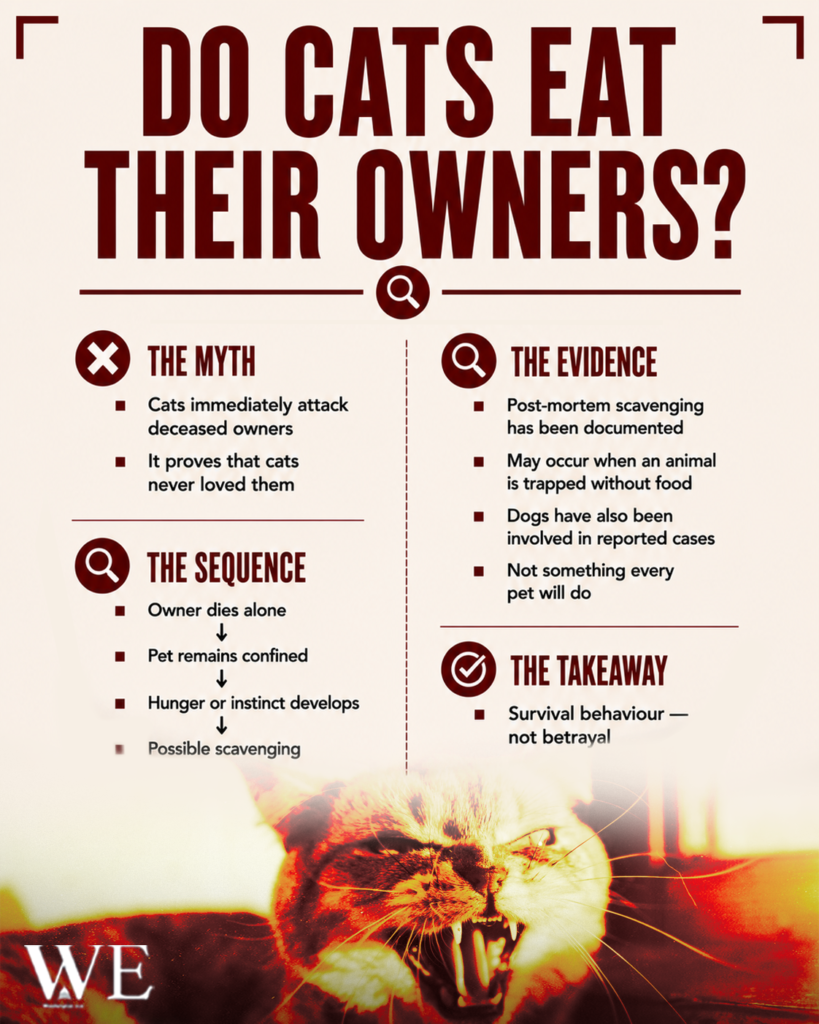
Therefore, while a cat can consume parts of a deceased owner under rare and extreme conditions, the sensational claim that cats are waiting to eat their humans is misleading. Domestic cats do not ordinarily view living owners as prey. The documented cases primarily involve unattended deaths, prolonged isolation and animals trapped without food. The greater concern is ensuring that people living alone have regular welfare checks and arrangements for someone to rescue and care for their pets during an emergency.