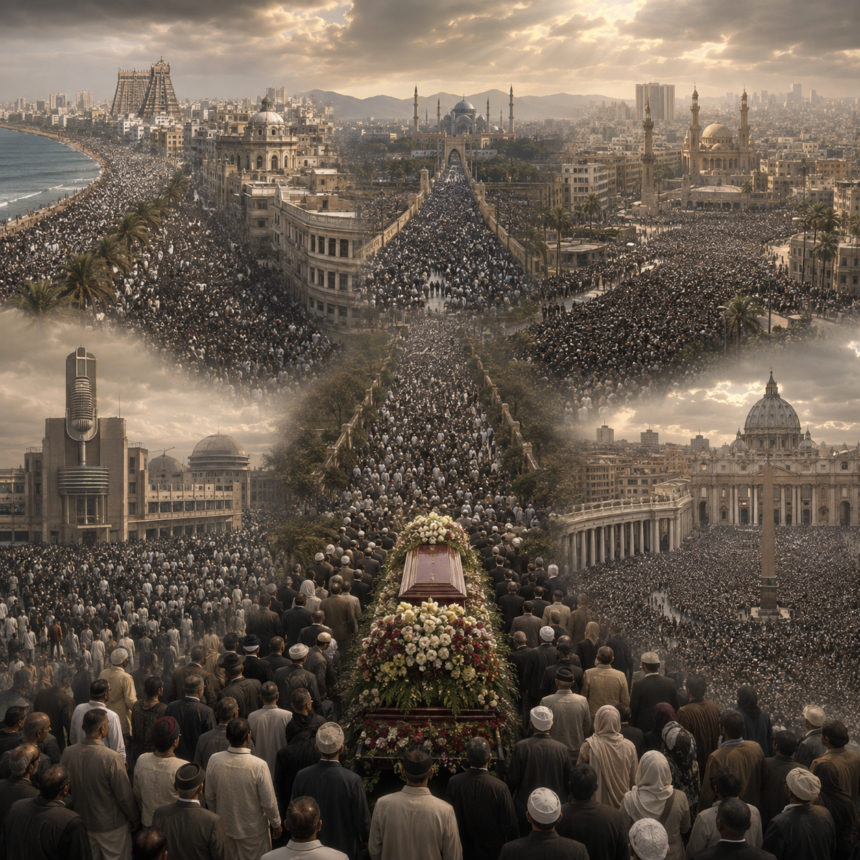
The deaths of influential political, religious and cultural figures have repeatedly drawn millions of people into public spaces, turning funerals into historic demonstrations of grief, identity and political loyalty. However, determining the world’s biggest funerals is difficult because crowd figures are usually estimates, and some totals include entire processions or several days of mourning rather than attendance at one ceremony. Based on widely reported physical attendance, five funerals stand out.
The largest recorded funeral gathering was held for Conjeevaram Natarajan Annadurai, popularly known as C.N. Annadurai or “Anna,” in Madras, now Chennai, India, in February 1969. Annadurai, the chief minister of Tamil Nadu and founder of the Dravida Munnetra Kazhagam political party, died from cancer on February 3 at the age of 59. His funeral the following day reportedly attracted approximately 15 million people, according to a police estimate recognised by Guinness World Records. Mourners filled roads, railway stations and surrounding areas as his body was taken towards Marina Beach for burial. His enormous popularity came from his Tamil nationalism, opposition to caste inequality, powerful speeches and promotion of regional language and identity.
Ayatollah Ruhollah Khomeini’s funeral in Tehran, Iran, in June 1989 was another extraordinary mass gathering. Khomeini, the religious leader who headed Iran’s 1979 Islamic Revolution and became the country’s first supreme leader, died on June 3 at the age of 86. An estimated 10.2 million people, roughly one-sixth of Iran’s population at the time, participated in the funeral events. Guinness recognised it as the largest proportion of a country’s population to attend a funeral. The procession descended into chaos when mourners overwhelmed security barriers and surrounded the coffin. Khomeini’s body fell from the open bier, forcing officials to remove it by helicopter and postpone the burial. Initial reporting said at least eight people died, while thousands were injured, treated for heat exposure or fainted.

Egyptian president Gamal Abdel Nasser was mourned by an estimated five million people in Cairo on October 1, 1970. Nasser had died three days earlier from a heart attack at the age of 52, shortly after hosting an Arab League summit. As president from 1956, he had become the leading symbol of pan-Arab nationalism, anti-colonialism and state-led modernisation. His nationalisation of the Suez Canal in 1956 made him a hero to millions, although his government was also authoritarian and Egypt’s defeat in the 1967 Arab-Israeli war damaged his reputation. During the funeral, the crowd repeatedly broke through security lines, surrounded the gun carriage and disrupted the carefully planned procession. Public mourning also spread across Arab cities, reflecting Nasser’s influence far beyond Egypt.

Cairo witnessed another enormous funeral five years later when legendary Egyptian singer Umm Kulthum died on February 3, 1975. Around four million people reportedly gathered for her funeral procession on February 5. Known as the “Star of the East” and the “Voice of Egypt,” Umm Kulthum had dominated Arabic music for decades. Her long monthly radio concerts were heard across the Middle East and North Africa, creating a shared cultural experience that crossed social and national boundaries. The crowd became so large that mourners took control of her coffin from its official bearers and redirected the procession towards Al-Azhar Mosque before allowing it to continue to her burial place. Contemporary reporting compared the scale and emotional intensity of the ceremony with Nasser’s funeral.
Pope John Paul II’s funeral on April 8, 2005, became one of the largest religious and diplomatic gatherings in modern history. The Polish pontiff died on April 2 after leading the Roman Catholic Church for more than 26 years. Approximately 300,000 people gathered in and around St Peter’s Square for the funeral Mass, while more than two million watched from other parts of Rome. Wider estimates suggest that as many as four million pilgrims travelled to Rome during the mourning and funeral period. The ceremony was attended by kings, presidents, prime ministers and religious representatives from around the world, while an estimated two billion people followed it through television coverage.
These funerals were large for different reasons. Annadurai represented regional identity, Khomeini revolutionary religion, Nasser Arab nationalism, Umm Kulthum shared culture and John Paul II global faith. Yet attendance figures should not be treated as perfectly comparable statistics. Governments, police, organisers and news organisations used different counting methods, and aerial measurement was limited during earlier events. What remains unquestionable is their social impact: each funeral transformed private death into collective history, revealing the extraordinary emotional and political connections that certain individuals created during their lives.