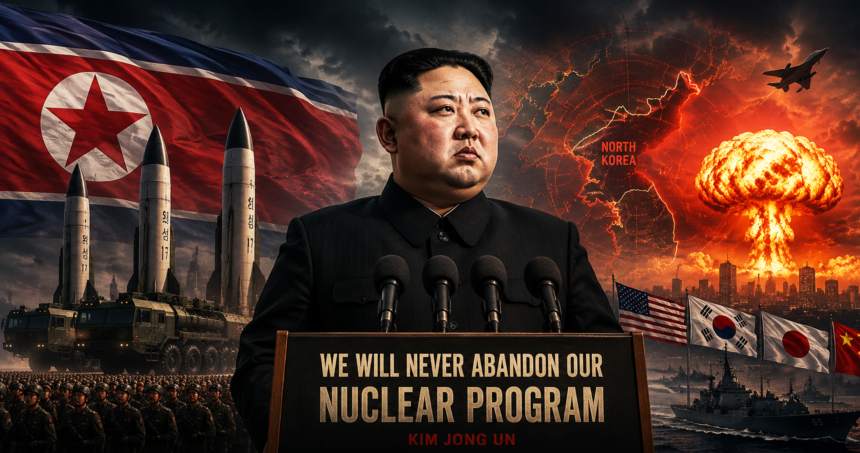
North Korean leader Kim Jong Un has declared that his country will “never” abandon its nuclear weapons program, reinforcing Pyongyang’s long-standing position that atomic weapons are essential for national survival and deterrence against what it calls hostile foreign powers. The remarks, delivered during recent speeches to North Korea’s parliament and ruling Workers’ Party gatherings in Pyongyang, signal that denuclearization talks with the United States and South Korea remain effectively frozen.
According to North Korean state media, Kim said the country’s status as a nuclear-armed state is “irreversible” and would continue to be strengthened in the years ahead. He emphasized that North Korea would permanently expand what he called its “self-defensive nuclear deterrent,” arguing that growing geopolitical instability and military pressure from Washington and its allies leave Pyongyang with no alternative.
Kim’s comments come amid heightened tensions on the Korean Peninsula, continued joint military drills between the United States and South Korea, and renewed global concerns over nuclear proliferation. Analysts say Pyongyang increasingly views nuclear weapons not only as a defense mechanism but also as a bargaining tool to secure international recognition and ensure regime survival.

During the address, Kim reportedly stated that whether foreign countries choose “confrontation or peaceful coexistence” is up to them, but North Korea is prepared for either outcome. He accused hostile powers of attempting to undermine his government and warned that Pyongyang would respond aggressively to any perceived threat. State media also quoted him as saying the country would maintain a “prompt and precise” nuclear response posture.

North Korea has spent decades developing nuclear weapons and ballistic missile systems despite heavy international sanctions. Under Kim Jong Un’s leadership, the country accelerated missile testing programs and conducted multiple nuclear tests, including intercontinental ballistic missile launches believed capable of reaching the United States mainland. Experts estimate that Pyongyang now possesses dozens of nuclear warheads along with increasingly sophisticated missile delivery systems.
The North Korean constitution was amended in recent years to formally enshrine the country’s nuclear status, making the policy central to the state’s ideology and security doctrine. Analysts say that move made it politically and strategically difficult for Pyongyang to ever fully dismantle its arsenal.
International reactions to Kim’s latest remarks were swift. Officials in Seoul reiterated that North Korea’s nuclear ambitions threaten regional stability and violate United Nations Security Council resolutions. South Korea has repeatedly called for dialogue but continues strengthening its military alliance with Washington in response to Pyongyang’s missile activities.

The United States has maintained that complete denuclearization of North Korea remains its official objective. However, many foreign policy experts increasingly believe that Pyongyang is unlikely to voluntarily surrender its nuclear arsenal. Some analysts now argue that future negotiations may shift from denuclearization toward arms-control agreements aimed at limiting risks and preventing escalation instead of fully eliminating nuclear weapons.
China and Russia, both key regional players, continue to call for stability and dialogue while opposing actions that could trigger military conflict on the peninsula. Beijing, in particular, remains concerned about instability near its border and the potential collapse of the North Korean regime, even as it publicly supports non-proliferation efforts.
Security experts say global events such as the wars in Ukraine and the Middle East may have further strengthened North Korea’s belief that nuclear weapons are the ultimate guarantee of sovereignty. Observers point out that Pyongyang frequently cites foreign military interventions as evidence that states without nuclear deterrents are vulnerable to outside pressure or regime change.
At the same time, North Korea has continued expanding its conventional and strategic military capabilities. Recent reports from state media showed Kim inspecting munitions factories and overseeing missile and naval weapons programs, underscoring the regime’s commitment to military modernization despite economic hardships and international sanctions.
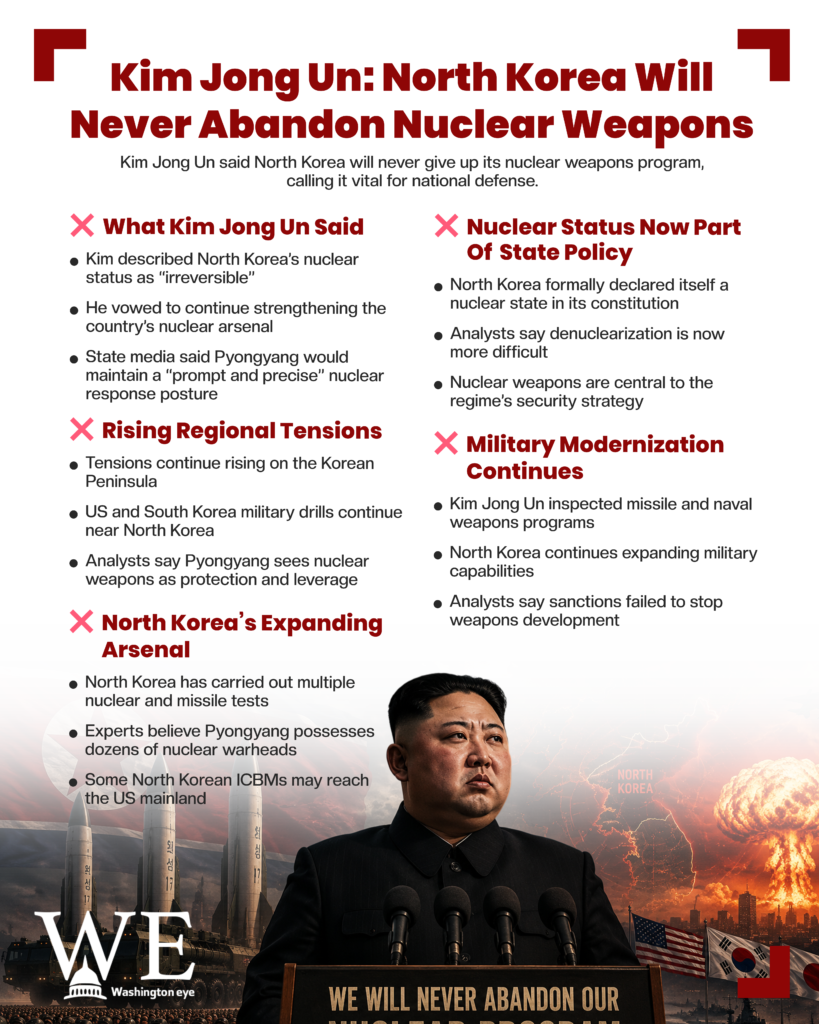
The latest statement from Kim Jong Un further dims hopes for a return to diplomacy similar to the high-profile summits held between Pyongyang and Washington several years ago. With North Korea insisting its nuclear status is permanent and the United States refusing to formally recognize it as a nuclear power, analysts believe the standoff could continue for years, raising the risk of future military and diplomatic crises in East Asia.