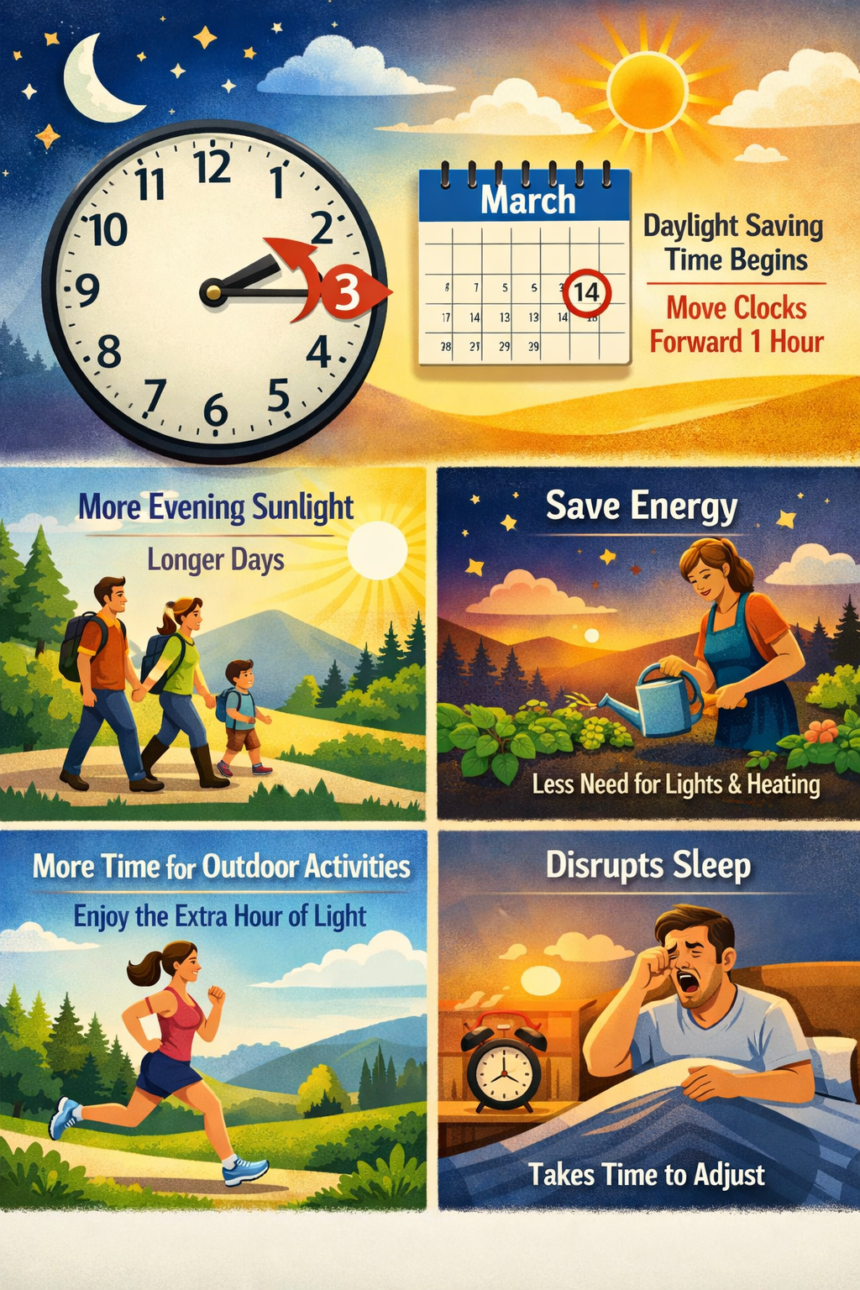
Each March, millions of people across parts of the world set their clocks forward by one hour, marking the start of what is commonly known as Daylight Saving Time (DST). The shift, often summed up as “spring forward,” typically occurs on the last Sunday of March in Europe and on the second Sunday of March in countries like the United States and Canada. While it may seem like a simple adjustment, the practice has deep historical roots, varying global adoption, and ongoing debates about its relevance in the modern world.
The concept of adjusting clocks to make better use of daylight dates back to the late 19th and early 20th centuries. Although often loosely attributed to Benjamin Franklin, who humorously suggested earlier waking hours to save candles, the modern system was first seriously proposed by George Vernon Hudson in 1895. However, it was during World War I that DST was first widely implemented, as countries such as Germany and the United Kingdom sought to conserve fuel by reducing the need for artificial lighting. The practice later spread to other parts of the world, including North America.
Today, DST is observed in many regions, including most of Europe under the coordination of the European Union, where clocks are set forward one hour at 1:00 UTC on the last Sunday of March. In the United States, the system is governed by the Uniform Time Act, which standardized DST across states beginning in 1966, though some states like Hawaii and most of Arizona do not observe it. Countries such as Pakistan, India, and China do not currently follow DST, while others have adopted and later abandoned it due to mixed results.
The primary rationale behind DST is to make better use of natural daylight during the longer days of spring and summer. By shifting an hour of daylight from the early morning, when many people are still asleep—to the evening, proponents argue that it reduces energy consumption, encourages outdoor activities, and can even boost economic activity in sectors such as retail and tourism. Longer daylight hours after work are also associated with improved mood and increased opportunities for exercise.

However, the benefits of DST have increasingly been questioned. Modern studies suggest that energy savings are minimal in an era dominated by digital devices and climate control systems. Moreover, the abrupt change in time has been linked to short-term health effects, including sleep disruption, fatigue, and even a temporary increase in heart-related issues and workplace accidents in the days following the shift. Critics also argue that DST creates unnecessary confusion, particularly in global business operations, travel schedules, and digital systems that rely on precise time coordination.
The confusion is especially evident in countries that do not observe DST but interact frequently with those that do. For instance, in Pakistan, international meetings, flight schedules, and financial markets may temporarily shift by an hour relative to DST-observing countries, leading to missed appointments or scheduling errors. Airlines, tech companies, and financial institutions often need to update systems carefully to avoid disruptions during these transitions.
Public opinion on DST is divided. While some appreciate the extended evening daylight, others question whether the disruption is worth it. In recent years, there have been growing calls to abolish the practice altogether. The European Union, for example, has debated ending seasonal clock changes, though no final agreement has been implemented due to coordination challenges among member states. Similarly, several U.S. states have proposed legislation to adopt permanent daylight saving time, but federal approval remains a barrier.

As the world becomes increasingly interconnected, the debate over DST reflects broader questions about how societies manage time in a globalized, digital age. Whether the tradition will continue or be phased out remains uncertain, but for now, the ritual of moving clocks forward each March continues to mark the seasonal transition into longer, brighter days.