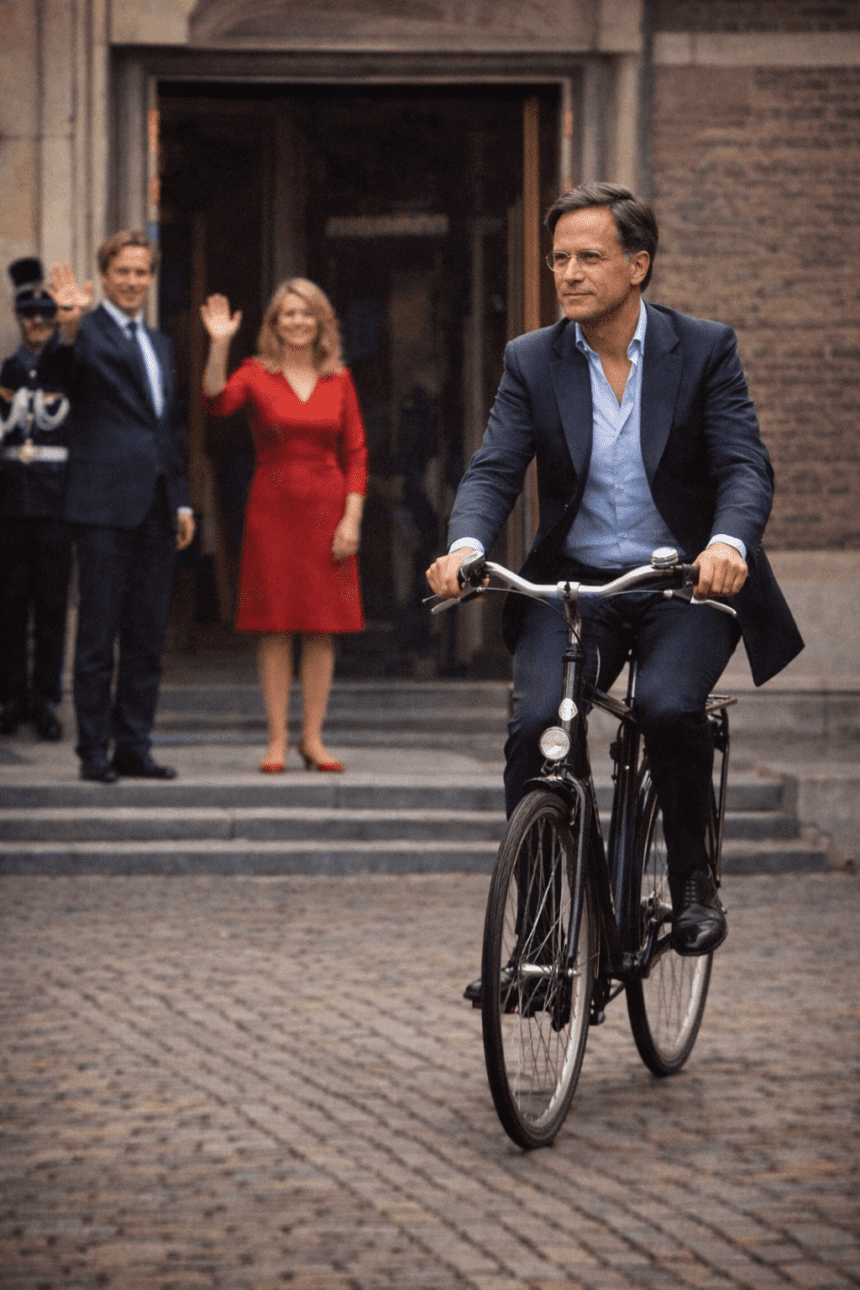
In a symbolic and characteristically modest farewell, former Dutch Prime Minister Mark Rutte formally handed over power and departed the Dutch government headquarters on his bicycle, drawing global attention to a moment that reflected both personal humility and the political culture of the Netherlands. The transition took place in The Hague, where Rutte submitted his resignation and completed the transfer of leadership following months of political negotiations and national elections.
Rutte, leader of the People’s Party for Freedom and Democracy (VVD), had been one of Europe’s longest-serving leaders, holding office since 2010. His departure comes after the collapse of his coalition government in 2023 over disagreements on immigration policy, particularly asylum regulations. Following the breakdown, early elections were called, setting in motion a prolonged process of coalition-building in the Netherlands’ traditionally fragmented political system.
The general elections saw significant shifts in the Dutch political landscape, with the Party for Freedom (PVV), led by Geert Wilders, emerging as the largest party in parliament. The PVV secured a notable share of votes, capitalizing on public concerns over immigration, cost of living, and national identity. However, despite its electoral success, forming a coalition government proved complex due to ideological divides among parties. Negotiations involved multiple parties, including the VVD, centrist groups, and new political entrants, reflecting the Netherlands’ consensus-driven political tradition.
After months of deliberation, a new governing coalition was finalized, paving the way for a new prime minister to take office. While Rutte remained in a caretaker capacity during this transitional period, his final day in office was marked not by grand ceremonies but by a quiet and distinctly Dutch gesture, cycling away from his office at the Binnenhof. Images of the outgoing prime minister riding his bicycle, carrying his belongings, quickly went viral, symbolizing both the accessibility of Dutch leadership and Rutte’s personal style throughout his tenure.
Rutte’s time in office was defined by economic stability, pragmatic governance, and his ability to navigate complex coalition politics. He played a key role in European Union decision-making, including responses to the eurozone crisis, Brexit negotiations, and the COVID-19 pandemic. Despite facing criticism over issues such as the childcare benefits scandal, which led to the resignation of his government in 2021, Rutte maintained political resilience and was re-elected multiple times.
Reactions to his departure poured in from across the political spectrum. Supporters praised his down-to-earth demeanor and steady leadership, highlighting how his bicycle exit epitomized his connection with ordinary citizens. Critics, however, pointed to unresolved domestic issues and questioned aspects of his long tenure. International leaders and observers also weighed in, with many noting the contrast between Rutte’s modest exit and more elaborate transitions of power seen in other countries.
The incoming leadership now faces a challenging political environment, with pressing issues including immigration reform, climate policy, housing shortages, and economic pressures. The rise of populist forces, as evidenced by the PVV’s electoral gains, signals a shift in voter priorities that the new government will need to address carefully. Coalition partners have emphasized the importance of stability and compromise, core elements of Dutch governance.
Rutte himself has indicated that he will step away from Dutch politics, though speculation remains about potential roles in international institutions, given his extensive experience and reputation within the European Union. His departure marks the end of a significant chapter in Dutch politics, closing nearly 14 years of leadership.
The image of a prime minister leaving office on a bicycle has resonated far beyond the Netherlands, sparking conversations about political culture, leadership humility, and public service. In an era often characterized by political polarization and spectacle, Rutte’s understated exit offered a contrasting narrative, one rooted in simplicity and civic normalcy. As the Netherlands enters a new political phase, the legacy of Mark Rutte’s leadership and his symbolic farewell will remain a defining moment in the country’s modern political history.