

The fate of the Sudeten Germans remains one of the most controversial and consequential population transfers in modern European history. Once numbering more than three million people in the border regions of former Czechoslovakia, the Sudeten Germans went from being a powerful ethnic minority to becoming one of the largest displaced populations in post-World War II Europe.
The Sudeten Germans were ethnic Germans who lived primarily in the borderlands of Bohemia, Moravia, and Czech Silesia, regions collectively known as the Sudetenland. Their presence in these territories dated back centuries, with German-speaking communities settling there during the medieval period. By the early 20th century, they formed a significant minority within the newly established state of Czechoslovakia. According to interwar census data, around three million ethnic Germans lived in the country, making them one of the largest German-speaking populations outside Germany.
Tensions between the Czech majority and Sudeten Germans intensified during the 1930s. Many Sudeten Germans supported greater autonomy, while some nationalist groups aligned themselves with Nazi Germany. In 1938, following the Munich Agreement, Nazi leader Adolf Hitler annexed the Sudetenland, arguing that Germany was protecting ethnic Germans living outside its borders. The occupation became a crucial step in Germany’s expansion before the outbreak of World War II.

When Nazi Germany was defeated in 1945, the political situation changed dramatically. The restored Czechoslovak government blamed much of the Sudeten German population for supporting Hitler’s annexation and occupation policies. Czech leaders, backed by growing anti-German sentiment after years of war and oppression, sought to remove the German minority from the country. The idea gained support among the Allied powers as Europe attempted to redraw borders and reduce ethnic conflicts.

In the chaotic months immediately after the war, thousands of Sudeten Germans were forced from their homes in what became known as the “wild expulsions.” Between May and August 1945, local militias, revolutionary guards, and authorities organized forced marches and removals. Numerous incidents of violence occurred, including attacks, killings, and property seizures. Historians estimate that tens of thousands died from violence, disease, malnutrition, or harsh conditions during this period, though exact figures remain disputed.
The expulsions were later formalized through decisions endorsed at the Potsdam Conference in August 1945. Allied leaders agreed that German populations in Central and Eastern Europe could be transferred to Germany in an “orderly and humane” manner. From early 1946 onward, organized deportations moved approximately 2.4 million Sudeten Germans to the American and Soviet occupation zones of Germany, which later became West and East Germany. Around three million Germans in total were expelled from Czechoslovakia.
The expulsions transformed the demographic landscape of Czechoslovakia. Entire towns and villages that had been predominantly German-speaking for centuries were suddenly emptied. The former Sudetenland was subsequently resettled by Czechs, Slovaks, and other groups. Only a small number of Germans, including anti-Nazi activists, skilled workers, and individuals with special exemptions, were allowed to remain. By 1950, only a fraction of the pre-war German population still lived in the region.

For many expelled families, the loss extended beyond property. Homes, businesses, churches, cemeteries, and cultural institutions were abandoned or confiscated. In Germany and Austria, Sudeten German refugees had to rebuild their lives from scratch. Organizations representing expellees emerged after the war, preserving memories of their former homeland and advocating for recognition of their suffering.
Today, the expulsion of the Sudeten Germans remains a sensitive topic in Czech-German relations. While modern Czech and German governments have largely reconciled and acknowledged the suffering experienced on all sides, historians continue to debate the morality, legality, and consequences of the expulsions. Recent efforts in the Czech Republic to preserve neglected Sudeten German cemeteries and historical sites reflect a broader willingness to confront this complex past.
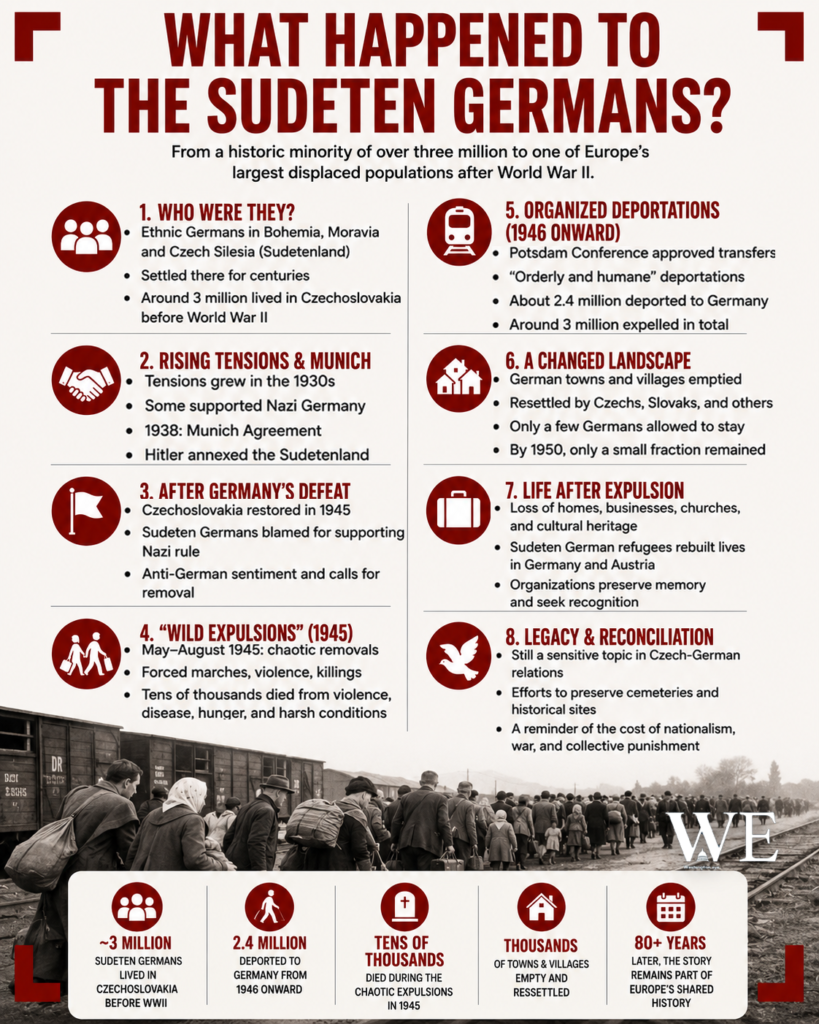
More than 80 years after World War II, the story of the Sudeten Germans serves as a reminder of how nationalism, war, and collective punishment can reshape entire societies. Their displacement remains one of the largest forced migrations in European history and continues to influence discussions about memory, justice, and reconciliation across the continent.