
Japan’s economy has defied expectations by posting stronger-than-forecast growth despite mounting concerns over the ongoing Iran conflict and its impact on global energy markets, offering a rare sign of resilience at a time when many economies are struggling with geopolitical uncertainty.
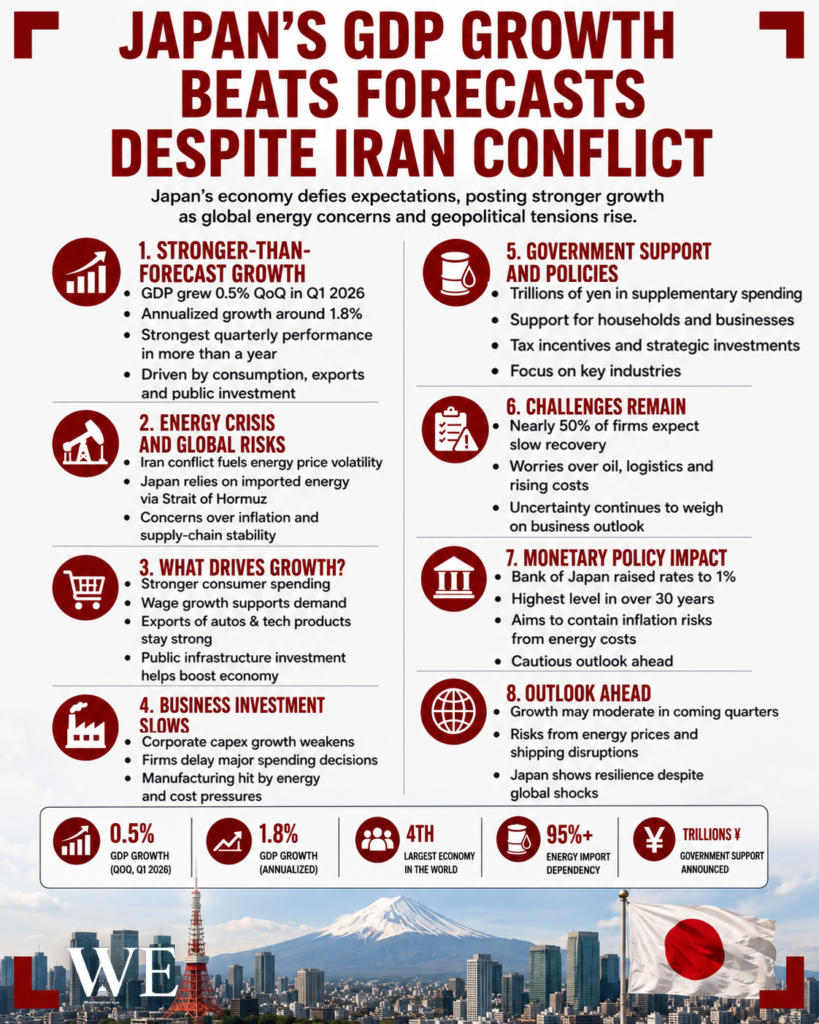
Data released in June showed that Japan’s gross domestic product (GDP) expanded faster than economists had anticipated during the first quarter of 2026. Revised figures indicated that the world’s fourth-largest economy grew by 0.5% quarter-on-quarter, surpassing market expectations and marking its strongest quarterly performance in more than a year. On an annualized basis, growth reached around 1.8%, supported by stronger consumer spending, exports, and public investment.
The stronger-than-expected performance comes at a challenging time for Japan. Since the outbreak of conflict involving Iran earlier this year, global markets have faced heightened volatility, particularly in energy prices. Japan remains heavily dependent on imported energy, with a significant share of its crude oil supplies passing through the strategically vital Strait of Hormuz. Any disruption in the region immediately raises concerns about fuel costs, inflation, and supply-chain stability for Japanese businesses.

Economists had initially feared that rising oil prices and uncertainty surrounding shipping routes in the Middle East would significantly slow Japan’s economic recovery. The country has long been vulnerable to external energy shocks due to its limited domestic energy resources. Historical comparisons were drawn to the oil crises of the 1970s, which had profound effects on Japan’s industrial production and economic growth.

However, recent GDP figures suggest that the Japanese economy entered the period of heightened geopolitical tension with stronger momentum than expected. Private consumption, which accounts for more than half of Japan’s economic output, improved as wage growth and easing domestic inflation supported household spending. Public infrastructure investment also contributed positively, while exports benefited from continued demand for automobiles and technology products in overseas markets.
Government policies have also played a role in cushioning the economy. Tokyo approved supplementary spending measures worth trillions of yen to help households and businesses cope with higher energy costs linked to the Middle East crisis. Tax incentives and strategic investments in sectors such as semiconductors, shipbuilding, and advanced manufacturing have further supported economic activity.
Despite the encouraging GDP figures, economists caution that significant challenges remain. Surveys of Japanese companies reveal widespread concern about the long-term consequences of the Iran conflict. Nearly half of firms surveyed expect business conditions to take more than six months to normalize after the conflict subsides, reflecting concerns over oil procurement, logistics disruptions, and rising production costs.

The conflict’s influence has already been felt in Japan’s monetary policy. Earlier this month, the Bank of Japan raised its benchmark interest rate to 1%, the highest level in more than three decades. Policymakers cited concerns that higher energy costs could fuel broader inflationary pressures across the economy. While lower oil prices following tentative diplomatic progress have eased some concerns, the central bank remains cautious about future risks.
Business investment remains one area of weakness. Corporate capital expenditure growth has slowed sharply as firms postpone major spending decisions amid uncertainty. Analysts note that manufacturers, particularly in sectors dependent on imported raw materials and energy, are closely monitoring developments in the Middle East before committing to large-scale investments.
Looking ahead, economists expect Japan’s growth to moderate in the coming quarters as the full effects of the Iran conflict continue to filter through global markets. Forecasts suggest that economic expansion may remain modest for the rest of 2026, especially if energy prices rise again or shipping disruptions return. Nevertheless, the latest GDP data indicates that Japan has so far managed to withstand external shocks better than many analysts anticipated.
For policymakers in Tokyo, the challenge now will be maintaining economic momentum while protecting households and businesses from future energy-related disruptions. As geopolitical tensions continue to shape the global economy, Japan’s recent growth performance offers a reminder that resilience, strategic planning, and diversified economic activity can help cushion even the most energy-dependent nations from international crises.