
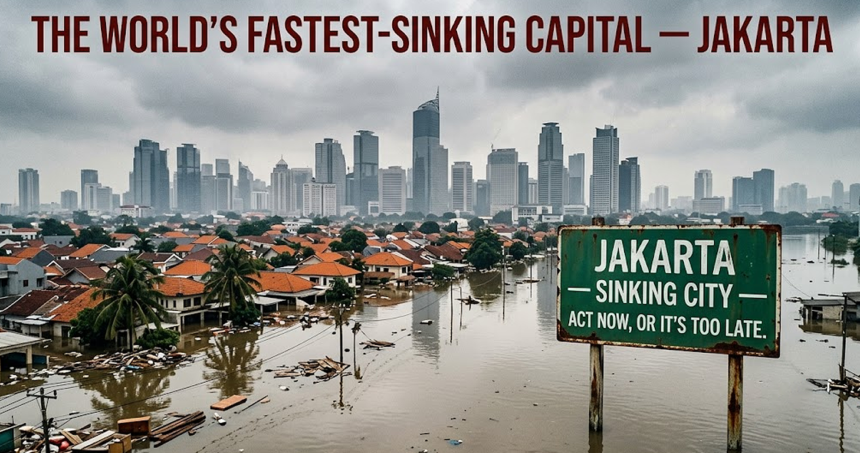
Jakarta, the sprawling capital of Indonesia and home to more than 10 million people, is sinking at an alarming rate, earning the title of one of the world’s fastest-sinking cities. Environmental experts warn that if urgent measures are not taken, large parts of the coastal megacity could face severe flooding and long-term inundation in the coming decades, posing a major threat to millions of residents and billions of dollars worth of infrastructure.
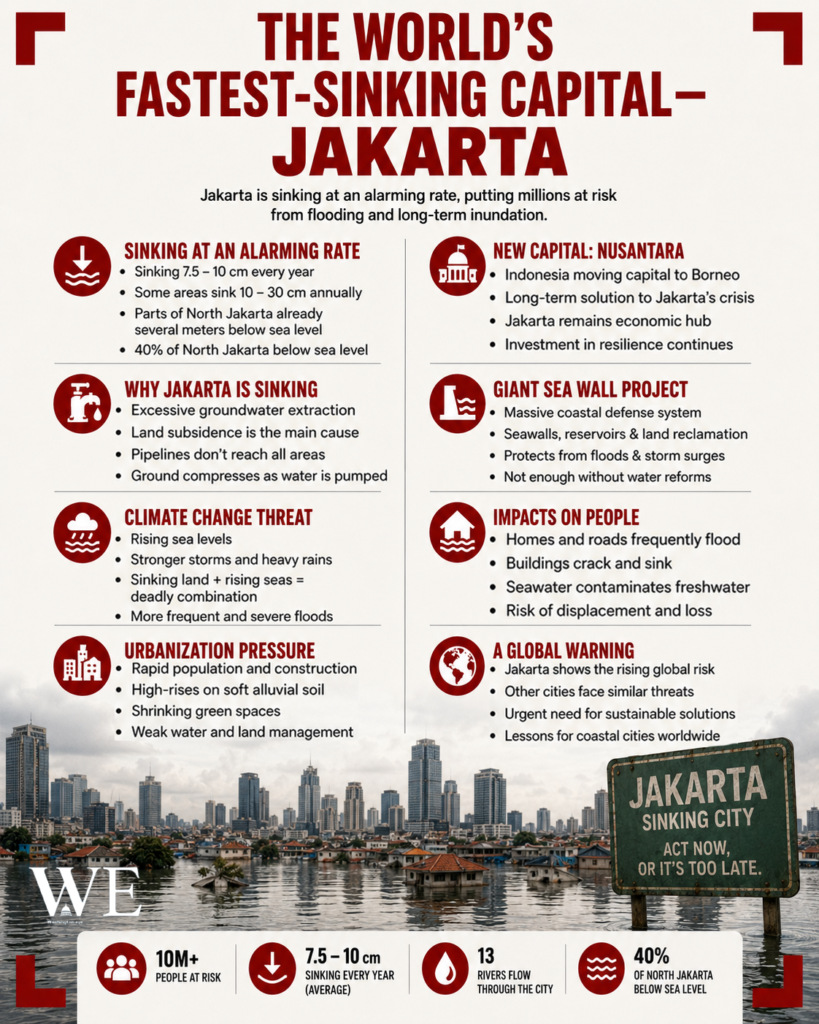
Located on the northwest coast of Java Island, Jakarta has long battled flooding due to its low-lying geography. Thirteen rivers flow through the city before reaching the Java Sea, making it particularly vulnerable to rising waters. However, experts say the city’s sinking problem is driven less by sea-level rise and more by rapid land subsidence caused by excessive groundwater extraction. Many households, businesses, factories, and high-rise buildings rely on underground aquifers because piped water coverage remains insufficient in several parts of the city. As water is pumped out faster than nature can replenish it, the ground beneath Jakarta gradually compresses and sinks.
Research indicates that some areas of Jakarta are sinking by as much as 10 to 30 centimeters annually, while the average subsidence rate in many parts of the city ranges between 7.5 and 10 centimeters per year. In northern districts, the situation is even more severe, with certain neighborhoods having sunk several meters over recent decades. Approximately 40 percent of North Jakarta already lies below sea level, leaving residents increasingly dependent on seawalls, pumps, and flood-control infrastructure.
The crisis is compounded by climate change. Rising global temperatures are causing sea levels to increase, while stronger storms and heavier rainfall events are becoming more frequent. The combination of sinking land and rising seas creates a dangerous double threat. During high tides and monsoon seasons, floodwaters can easily breach coastal defenses, inundating homes, roads, schools, and businesses. Millions of people living in coastal communities face growing risks of displacement and economic hardship.
Jakarta’s rapid urbanization has further intensified the challenge. As Indonesia’s economic and political hub, the city has experienced decades of population growth and construction. Skyscrapers, shopping malls, residential developments, and industrial zones have increased pressure on the soft alluvial soils beneath the city. Environmental researchers argue that uncontrolled development, shrinking green spaces, and inadequate water management have accelerated the rate of subsidence.
Recognizing the scale of the threat, the Indonesian government announced plans several years ago to relocate the country’s capital from Jakarta to a new purpose-built city called Nusantara on the island of Borneo. Former President Joko Widodo described the move as a long-term solution to Jakarta’s environmental and infrastructural challenges. While government institutions are gradually shifting to Nusantara, authorities insist that Jakarta will remain Indonesia’s commercial and financial center and will continue receiving significant investment for flood prevention and urban resilience projects.
Among the most ambitious initiatives is the Giant Sea Wall project, a massive coastal defense system designed to protect Jakarta from flooding and storm surges. The project includes seawalls, reservoirs, and land reclamation efforts aimed at shielding vulnerable coastal districts from the encroaching sea. However, critics argue that seawalls alone cannot solve the problem if groundwater extraction continues unchecked. Environmental experts stress that expanding access to piped water, enforcing groundwater regulations, restoring wetlands, and improving urban planning are equally important.
The social consequences of Jakarta’s sinking are already visible. In some neighborhoods, residents have repeatedly raised the floors of their homes to stay above floodwaters. Roads have cracked, buildings have tilted, and seawater intrusion has contaminated freshwater sources. Communities living near the coast face the constant threat of losing their homes and livelihoods. For many residents, the crisis is not a future possibility but a present-day reality.
Urban planners around the world are closely watching Jakarta as a warning of what can happen when rapid urban growth, inadequate water management, and climate change collide. Experts note that other major cities, including Bangkok, Ho Chi Minh City, and Manila, face similar risks, though Jakarta remains among the most extreme examples. Its experience highlights the urgent need for sustainable groundwater management and climate adaptation strategies in rapidly growing coastal cities.
For now, Jakarta continues its race against time. Whether through engineering projects, environmental reforms, or the relocation of government functions, Indonesia faces one of the most complex urban challenges of the 21st century. The outcome will not only determine the future of Jakarta but could also provide crucial lessons for coastal cities worldwide confronting the realities of a changing climate.