
Sri Lanka has deployed military drones to locate hidden mosquito-breeding sites as the country battles one of its most serious dengue outbreaks in nearly a decade, with more than 94,000 infections reported nationwide during 2026.
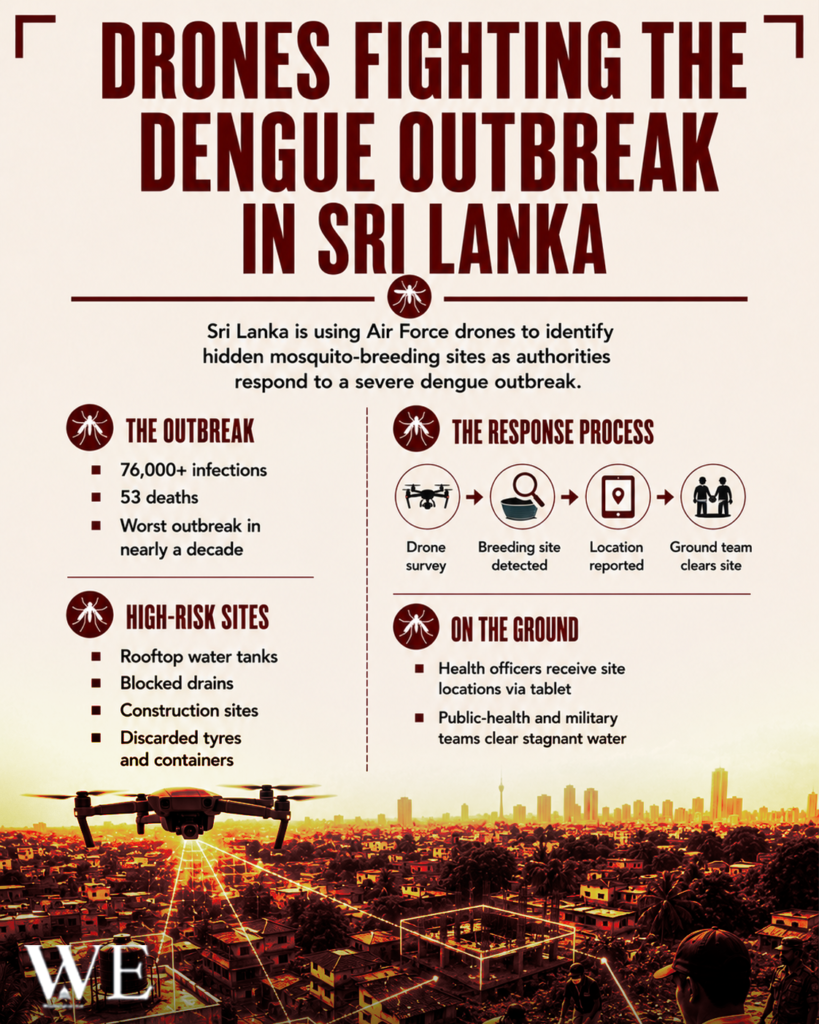
The Sri Lankan Air Force is using remotely piloted aircraft to inspect rooftops, construction sites and other areas that are difficult or dangerous for public-health workers to reach. The drones capture images of stagnant water left by monsoon rainfall, enabling health inspectors and cleanup teams to identify places where dengue-carrying mosquitoes may be breeding.
Sri Lanka’s National Dengue Control Unit listed 94,292 notified cases in its latest national total, with 76 high-risk health divisions under intensified surveillance. The World Health Organization reported more than 65 dengue-related deaths by early August and said 2026 was on course to become the country’s largest outbreak since the record epidemic of 2017.

The drone operation became a prominent part of the government’s emergency response in July, when hospitals experienced a sudden rise in admissions. Air Force drones were sent over densely populated neighbourhoods to search for water collecting on flat roofs, gutters, abandoned structures and tall buildings. Once suspicious locations are identified, public-health inspectors can visit the premises and order the removal or treatment of the water.

The drones are primarily surveillance tools; they do not treat dengue patients or eliminate the need for ground inspections. Their main advantage is speed. A drone can survey a large urban area and examine rooftops that would otherwise require ladders, building access or lengthy door-to-door searches. Images can also help authorities prioritise the most dangerous locations instead of deploying limited staff across every property.
The outbreak intensified following heavy monsoon rainfall and the destruction caused by Cyclone Ditwah in November 2025. The storm damaged buildings, health facilities and other infrastructure while leaving behind debris capable of collecting rainwater. Unplanned urbanisation, crowded neighbourhoods, inadequate waste disposal and uncovered water-storage containers have created additional breeding opportunities.
Health officials said approximately 75 per cent of infections detected during the initial surge were linked to DENV-2, one of four dengue virus serotypes. Changes in the dominant serotype can increase transmission and disease severity because people previously exposed to another type may not have adequate protection.

The Western Province, including Colombo and the heavily populated Gampaha district, has recorded a large share of infections. Negombo, approximately 35 kilometres north of Colombo, was among the worst-affected locations. Its district hospital treated nearly 1,800 dengue patients in less than two months from June, compared with around 1,050 during the whole of 2025.
Hospitals added beds, converted general wards into dengue-treatment areas and extended working hours as more than 18,000 cases were reported during the first two weeks of July. June alone recorded more than 21,500 infections, over twice the total reported in May. Doctors and nurses were described as being stretched to their limits by the speed and severity of the increase.
Sri Lanka has also mobilised the army, police and other government agencies. Teams have inspected homes, schools, religious institutions, public buildings and construction sites. Nearly 11,000 mosquito-breeding locations were cleared during one July campaign, while fines were imposed on more than 4,000 premises where breeding sites were discovered, according to Reuters.
Dengue is transmitted mainly through the bite of infected female Aedes aegypti mosquitoes, which are particularly active during the daytime. These mosquitoes can reproduce in small quantities of clean, stagnant water found in flowerpots, discarded tyres, plastic containers, blocked gutters, coconut shells and uncovered tanks. Eggs can survive dry conditions and hatch when water becomes available again.
Common symptoms include high fever, severe headache, pain behind the eyes, muscle and joint pain, nausea and rash. Most patients recover within one or two weeks, but some develop severe dengue. Warning signs such as intense abdominal pain, persistent vomiting, breathing difficulty, unusual bleeding, extreme weakness or cold and pale skin require urgent medical assessment. The WHO says there is no specific antiviral treatment, although early diagnosis, fluid management and timely hospital care can greatly reduce deaths.
Drones offer a valuable new layer of surveillance, but public-health specialists caution that technology cannot replace community participation. Aerial cameras may detect rooftop pools but can miss breeding sites inside homes, underneath vegetation or within small containers. Households must regularly empty and clean water containers, dispose of waste and protect themselves from daytime mosquito bites.
Sri Lanka’s worst recorded dengue epidemic occurred in 2017, when 186,101 cases and 440 deaths were reported. The country subsequently improved clinical management, surveillance and public awareness, helping to reduce the fatality rate. Nevertheless, recurring outbreaks show that dengue remains deeply established across all provinces.
At a national review held from August 11 to 13, 2026, health officials and WHO experts called for stronger forecasting, integrated mosquito control, rapid local responses and better coordination among government agencies. The WHO review concluded that drones and other innovations can strengthen the response, but long-term success will depend on sustained public-health investment and communities removing breeding sites before the next monsoon.