
Germany is intensifying efforts to bring the Olympic and Paralympic Games back to the country for the first time in more than five decades, with several major cities competing to become the nation’s official candidate for a future Summer Olympics. The bid process, led by the German Olympic Sports Confederation (DOSB), is focused on hosting either the 2036, 2040, or 2044 Olympic Games, as Germany seeks to re-establish itself as a global sporting destination while promoting sustainability, urban development, and international cooperation.
Germany’s renewed Olympic ambition comes amid growing competition among nations seeking to host future editions of the Games. According to the DOSB, four concepts initially entered the national selection process: Berlin, Hamburg, Munich, and the Rhine-Ruhr metropolitan region. Recent developments, however, have narrowed the race after Hamburg voters rejected the city’s Olympic ambitions in a referendum, leaving Berlin, Munich, and Rhine-Ruhr as the remaining contenders.
The final German candidate is expected to be selected by autumn 2026 following an evaluation process that considers international competitiveness, sustainability, economic feasibility, and public support. Germany plans to enter formal discussions with the International Olympic Committee through its “continuous dialogue” process, a modernized bidding system designed to reduce costly bidding wars and encourage long-term planning.

Germany has a long and complex Olympic history. The country hosted the Summer Olympics twice before—first in Berlin in 1936 and later in Munich in 1972. The Berlin Games remain controversial because they were used by the Nazi regime of Adolf Hitler as a propaganda platform. The 1972 Munich Olympics, meanwhile, are remembered both for their modern vision and the tragic terrorist attack that claimed the lives of 11 Israeli athletes and coaches. Despite these historical challenges, many German sports officials believe hosting a future Olympics would symbolize a modern, democratic, and inclusive Germany.

One of the most debated aspects of Germany’s Olympic aspirations concerns the year 2036. Hosting the Games in that year would mark exactly 100 years since the controversial Berlin Olympics under Nazi rule. German President Frank-Walter Steinmeier has expressed reservations about the symbolism of staging the Games during such an anniversary. Nevertheless, DOSB officials insist that all potential years, 2036, 2040, and 2044, remain under consideration, depending on decisions made by the IOC and broader international bidding dynamics.
Supporters argue that hosting the Olympics would bring substantial benefits to Germany. These include investment in sports infrastructure, urban regeneration projects, tourism growth, and increased participation in grassroots sports. Organizers also point to the success of recent Games, such as the Paris 2024 Olympics, where millions attended events and significant investments were made in transport, housing, and sporting facilities. German planners emphasize that any future bid would rely heavily on existing venues to minimize costs and environmental impact.
Berlin’s proposal, for example, claims that nearly all required venues already exist, reducing the need for expensive construction projects. Munich is promoting its extensive sporting heritage and infrastructure developed since the 1972 Olympics, while the Rhine-Ruhr region is highlighting its dense network of cities, stadiums, and transportation links capable of supporting a multi-city Olympic model.

Germany is not alone in pursuing future Olympic hosting rights. Several countries and regions have expressed interest in staging the 2036 or 2040 Games, including India, Qatar, South Africa, Turkey, Hungary, and Saudi Arabia. This competition reflects the continued prestige associated with hosting the world’s largest sporting event despite concerns about costs and long-term economic returns.
For Germany, the Olympic bid is about more than sports. Officials see it as an opportunity to showcase innovation, sustainability, and democratic values on a global stage. Supporters believe the Games could inspire a new generation of athletes, strengthen community engagement, and enhance Germany’s international image. Critics, however, remain concerned about costs, public spending, and whether the resources required for an Olympic bid could be better invested in grassroots sports and social programs.
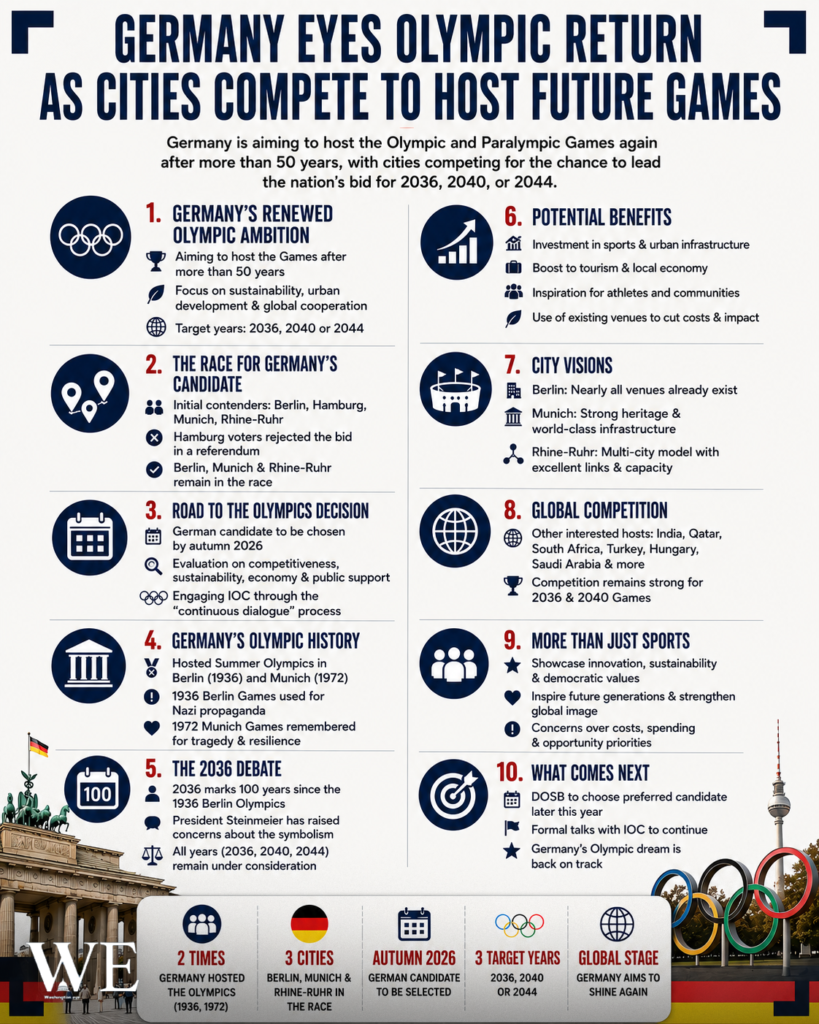
As the DOSB prepares to choose its preferred candidate later this year, the debate over Germany’s Olympic future continues. Whether the Games ultimately return in 2036, 2040, or 2044, the country’s renewed ambition signals its desire to once again place itself at the center of the global sporting stage.