
More than half of the countries where the United States maintains diplomatic relations currently do not have a Senate-confirmed American ambassador, a situation that foreign policy experts describe as one of the most significant diplomatic staffing gaps in recent decades. The vacancies come at a time when global tensions are rising across Europe, the Middle East, Africa and the Indo-Pacific, prompting concerns about Washington’s ability to effectively project influence and respond to international crises.
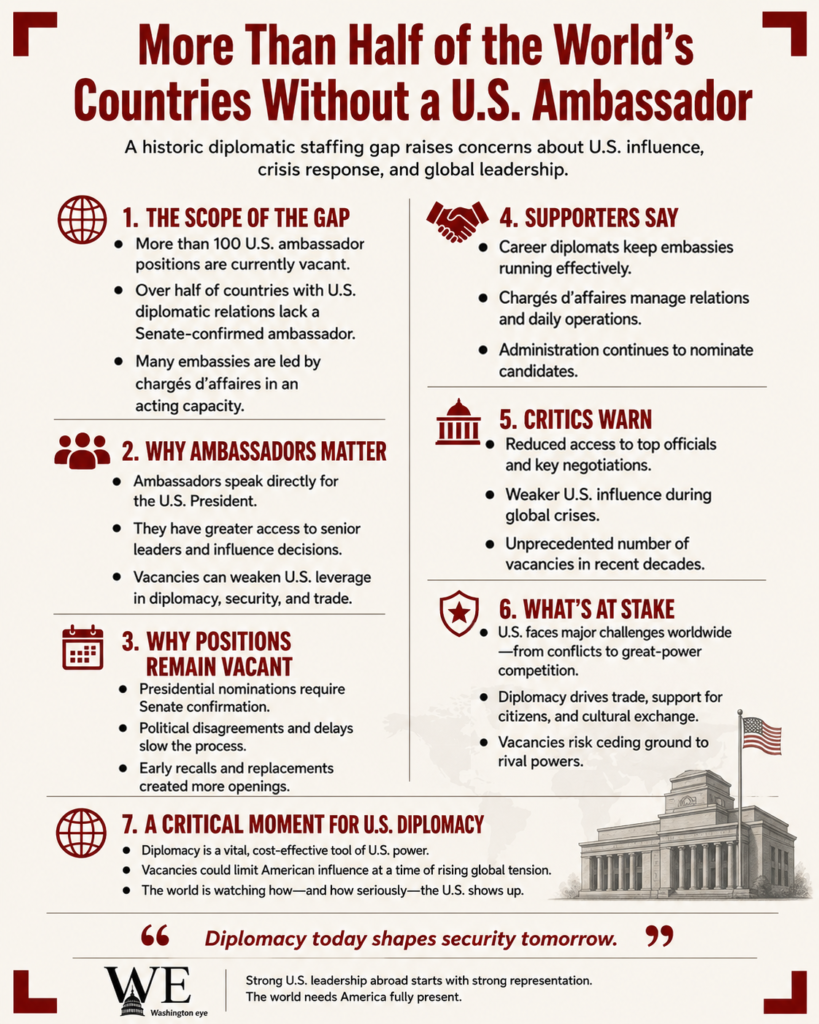
According to diplomatic tracking data and recent reports, more than 100 U.S. ambassadorial positions remain vacant around the world. Many embassies are being led by chargés d’affaires, career diplomats serving in an acting capacity, rather than presidentially appointed ambassadors who traditionally represent the highest level of U.S. diplomatic authority abroad.
The issue has gained attention during President Donald Trump’s second term, as critics argue that the pace of ambassadorial nominations and confirmations has not kept up with the number of vacant posts. Although dozens of ambassadors have been confirmed since January 2025, vacancies remain widespread. The American Foreign Service Association’s ambassador tracker shows that many key diplomatic positions are still awaiting nominations or Senate confirmation.

Among the countries still awaiting confirmed U.S. ambassadors are several strategically important partners, including nations in Asia, Africa, Latin America and Europe. Some posts are awaiting Senate action despite nominees already being identified, while others have yet to receive official nominations. Recent Senate records indicate that ambassadorial nominees for countries such as South Korea, Vietnam, the Philippines, Iceland, Slovenia and Sri Lanka remain in various stages of the confirmation process.
The reasons behind the vacancies are complex. First, ambassadors in the United States are nominated by the president and must be confirmed by the Senate, a process that can take months. Political disagreements, procedural delays and legislative priorities often slow confirmations. Additionally, the Trump administration’s decision to recall or replace numerous ambassadors early in the administration created a larger number of openings than usual.
Supporters of the administration argue that diplomatic missions continue to function effectively under experienced career diplomats. They note that chargés d’affaires can manage embassies, oversee bilateral relations and coordinate with host governments while awaiting ambassadorial appointments. They also emphasize that the administration has continued to nominate candidates and that confirmation delays are not solely the responsibility of the White House.
However, many former diplomats and foreign policy analysts disagree. They argue that ambassadors carry unique political authority because they speak directly on behalf of the U.S. president. Their absence can reduce American influence in negotiations, security discussions and economic diplomacy. In many countries, an ambassador’s rank grants access to senior government officials that acting diplomats may not always enjoy.

The timing of the vacancies is particularly significant. The United States is navigating multiple international challenges, including ongoing conflicts in the Middle East, heightened competition with China, Russia’s continued geopolitical influence, and evolving security concerns in the Indo-Pacific region. Analysts warn that diplomatic leadership gaps could limit Washington’s ability to shape events or respond quickly during emergencies.
Some observers point to historical comparisons. Ambassadorial vacancies are not new, and previous administrations have also faced confirmation delays. Yet several recent assessments suggest that the current number of open posts is unusually high compared with modern diplomatic practice. Reports describe the situation as lacking precedent in recent decades, particularly given the number of countries affected simultaneously.
The consequences extend beyond politics and security. U.S. ambassadors often play a critical role in promoting trade, supporting American businesses abroad, assisting citizens overseas and advancing educational and cultural exchanges. Vacancies can therefore affect both strategic interests and people-to-people relations. Foreign governments may also interpret prolonged absences as a sign that bilateral relationships are not receiving sufficient attention from Washington.
A critical view of the situation suggests that diplomatic engagement remains one of the most cost-effective tools of American foreign policy. While military and economic power remain important, diplomacy often serves as the first line of engagement during crises. Critics argue that leaving ambassadorial posts vacant risks weakening U.S. influence precisely when global competition and geopolitical uncertainty are intensifying. At the same time, supporters contend that administrative reforms and the increased use of career diplomats can maintain continuity until permanent appointments are finalized.
As nominations continue to move through the Senate, the debate over America’s diplomatic representation is likely to remain a significant foreign policy issue. For now, more than half of the countries where the United States seeks to maintain influence are operating without a confirmed American ambassador, leaving questions about how effectively Washington can advance its interests on the world stage.