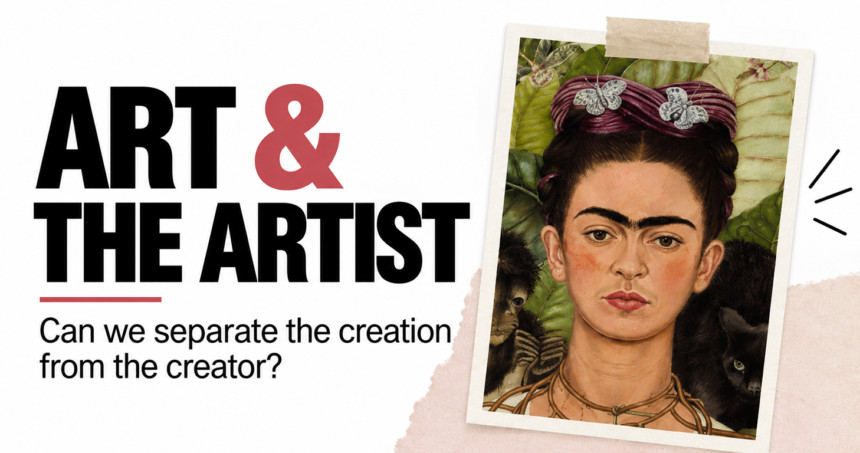
A painting hanging silently in a museum may appear to have a life entirely of its own. A song can travel across continents long after its composer is gone, while a novel can influence generations who know almost nothing about its author. Yet behind every work stands a person, with ideas, experiences, beliefs, flaws and, sometimes, controversies. The relationship between art and the artist has become an increasingly prominent cultural debate, raising a deceptively simple question: Can we truly understand, appreciate or judge art without considering the person who created it?
The question is centuries old, but it has gained fresh relevance in the social-media age, when artists’ private lives, political opinions and past behaviour are more visible than ever. In 2026, the debate has again surfaced across film, music, fashion and visual art, including controversy surrounding fashion designer John Galliano and plans connected with New York’s Metropolitan Museum of Art.
What Is Art and Who Is the Artist?

Art has never been limited to paintings hanging on gallery walls. It takes countless forms, including painting, sculpture, drawing, photography, architecture, literature, music, theatre, dance, cinema, fashion, performance and, increasingly, digital and AI-assisted work. What connects these forms is the human desire to create, communicate and interpret experience. Artists may use their work to document reality, challenge society, express emotion, preserve culture or simply create beauty.
Throughout history, some artists have become almost inseparable from their creations. Leonardo da Vinci’s Mona Lisa, Vincent van Gogh’s Starry Night, Michelangelo’s David and Pablo Picasso’s Guernica are not merely famous objects; they are also connected to stories about the people who produced them. An artist’s own identity can itself become the subject of art. Self-portraiture has provided creators with a way of examining how they see themselves and how they want the world to see them.

From Rembrandt and Frida Kahlo to Vincent van Gogh and contemporary photographers and digital creators, the self has remained one of art’s most enduring subjects. Yet a self-portrait does not have to be a literal picture of a face. Personal memories, trauma, relationships, politics, nationality and imagination can all enter an artist’s work, making art a form of autobiography even when the artist never appears in it.
Can Art Be Separated From the Artist?
This is where the modern debate becomes more complicated. In early September 2026, controversy surrounding John Galliano again brought the issue into public discussion. Galliano, regarded as one of fashion’s most influential designers, has also faced longstanding criticism over antisemitic remarks he made in 2011. Debate over plans involving him and the Metropolitan Museum of Art revived a larger question: when institutions celebrate important creative work, are they also celebrating the person behind it?

There is no universal answer. One argument holds that once an artwork enters the world, it acquires an existence independent of its creator. A novel can mean something to a reader that its author never intended; a song may become attached to somebody else’s memories; and a painting can be interpreted differently across generations. Under this view, appreciating a work does not necessarily mean approving of everything its creator has said or done.
The opposing argument says such separation is artificial. Knowing an artist’s life, values and behaviour can fundamentally change how audiences understand the work. Cultural institutions also face a different question from individual audiences: exhibiting, promoting or financially supporting a living artist can carry implications beyond simply viewing the art. The debate has surrounded figures ranging from Picasso to contemporary musicians, filmmakers and fashion designers. In each case, audiences must navigate the uncomfortable territory between cultural significance and personal accountability.
Art as an Idea, a Mirror and a Legacy
Art has always been more than decoration. It can function as protest, historical evidence, personal confession or social criticism. Picasso’s Guernica became an enduring image of the horrors of war, while Frida Kahlo transformed physical suffering, identity and personal experience into deeply autobiographical paintings. Van Gogh’s turbulent life has similarly shaped how generations have interpreted his vivid landscapes and self-portraits.
Technology is now adding another dimension. Digital art, social-media illustration, immersive installations and artificial intelligence are challenging traditional ideas about authorship. If software contributes significantly to an image, who is the artist, the person who conceived the idea, the person who entered the instructions, the developers who built the system, or some combination of them?
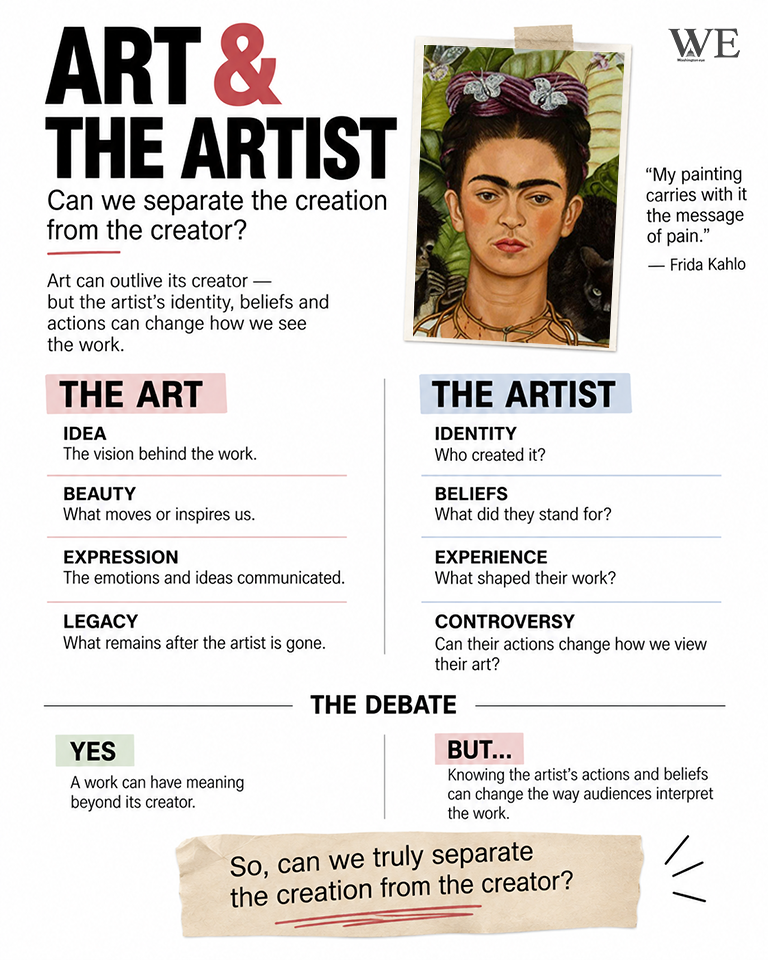
Despite changing tools, the fundamental relationship remains. An artist gives a work its beginning, but audiences continually give it new meanings. Art may outlive its maker, cross borders and survive the circumstances in which it was created. Yet knowledge about the creator can continue to alter how that work is viewed. Perhaps that is why the question of art and the artist has never disappeared. Art can stand on its own, but the shadow, story and self of the person who created it are rarely far away.