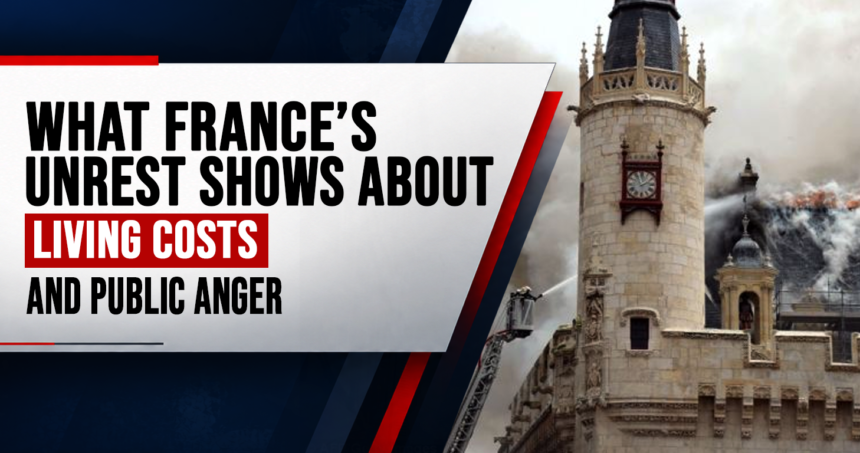
France is confronting one of its most serious waves of civil unrest in years after nationwide demonstrations against rising living costs, deteriorating public services and education shortages turned violent on Saturday, October 17. At least one demonstrator died, hundreds of police officers were injured and approximately 1,800 people were arrested as clashes, arson and looting spread across several major cities, placing President Emmanuel Macron’s government under mounting pressure.
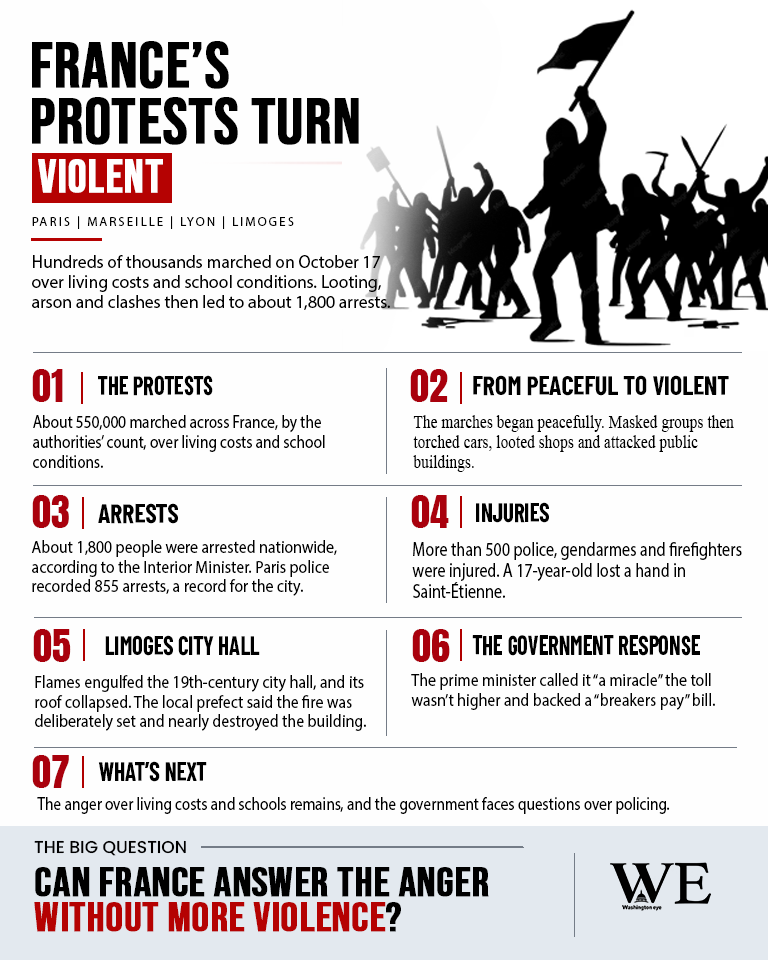
The demonstrations, which attracted an estimated 550,000 participants nationwide, began largely peacefully before escalating into violent confrontations between police and smaller groups of rioters. Paris, Marseille, Bordeaux, Lyon and Limoges were among the cities affected, with damaged businesses, burning vehicles and attacks on public buildings leaving extensive destruction.
The unrest originated in September when secondary school students in working-class suburbs of Paris began protesting against teacher shortages, overcrowded classrooms, deteriorating school facilities and an education system they believed was failing them. Students organised school blockades, boycotts and street demonstrations, demanding greater government investment in public education.
What began as a student-led movement soon developed into a broader national protest as trade unions, workers and other citizens joined demonstrations over rising household expenses, fuel prices, inequality and proposed public spending cuts. France’s General Confederation of Labour supported the mobilisation, calling for higher wages, improved pensions and measures to reduce living costs. The movement also attracted supporters of the Yellow Vest protests, which began in 2018 over fuel taxes and subsequently expanded into a wider campaign against economic inequality.
Tensions reached a critical point on October 17 when hundreds of thousands of demonstrators gathered across the country. Although most participants remained peaceful, masked individuals and other violent groups reportedly attacked police officers, vandalised buildings, looted shops and set fire to public property. In Paris, clashes intensified as demonstrators erected barricades and police attempted to disperse violent crowds. Officers used tear gas and other crowd-control measures while fires broke out in several areas.
Luxury boutiques, supermarkets and public infrastructure were among the targets of vandalism and looting. One demonstrator died after suffering cardiac arrest during the Paris protests. The precise circumstances surrounding the death have not been fully established in the reports reviewed, and authorities have not confirmed that it resulted directly from police action.
Police initially reported approximately 1,800 arrests nationwide, including 855 in Paris, while more than 500 officers were reported injured. Subsequent accounts have cited higher figures as authorities continued assessing the disturbances. The destruction extended well beyond the capital. In Limoges, the historic city hall, built more than 140 years ago, was severely damaged in an arson attack. In Bordeaux, officials reported extensive looting of commercial premises, while authorities in Marseille announced emergency financial assistance for affected businesses.

President Macron condemned the violence and promised that those responsible for attacks on public institutions and private property would face prosecution. However, he also acknowledged the distinction between citizens exercising their right to protest peacefully and individuals engaging in criminal acts.
Prime Minister Sébastien Lecornu defended the government’s response and subsequently announced limited, localised curfews to contain further disturbances. Interior Minister Laurent Nuñez attributed some of the violence to far-left groups and criminal opportunists, although the identities and motivations of all those involved remain under investigation.
The scale of the unrest has also raised questions about the preparedness of French security services. According to reporting by Le Monde, intelligence assessments had anticipated a maximum turnout of approximately 200,000 demonstrators, significantly below the estimated 550,000 who participated. Criticism intensified after reports that police forces had been insufficiently deployed in several cities, leaving officers struggling to contain simultaneous outbreaks of violence. Macron subsequently ordered a review of intelligence and security shortcomings while declining to accept his interior minister’s offer to resign.
The crisis comes at a politically sensitive moment for France, with the next presidential election scheduled for April 2027. Macron, who is approaching the end of his second term, faces a fragmented parliament, strained public finances and growing demands for government spending. Political analysts argue that the unrest reflects deeper frustration with economic inequality, declining confidence in public institutions and the perceived inability of successive governments to address social problems.
The government has promised additional substitute teachers and abandoned some proposed university fee increases, but these concessions have not resolved the broader grievances. The protests have also revived debate over France’s longstanding tradition of public demonstrations. Supporters regard collective action as an essential democratic mechanism for holding governments accountable, while authorities face pressure to protect public safety and prevent violence without restricting legitimate protest.
As France begins repairing damaged streets, public buildings and businesses, the government faces two immediate challenges: restoring public order and responding to the economic and educational concerns that brought hundreds of thousands of people onto the streets. The events of October 17 demonstrate how a protest movement that began over classroom conditions developed into a nationwide confrontation over living standards, public services and political accountability, leaving France facing difficult questions about its social and political future.