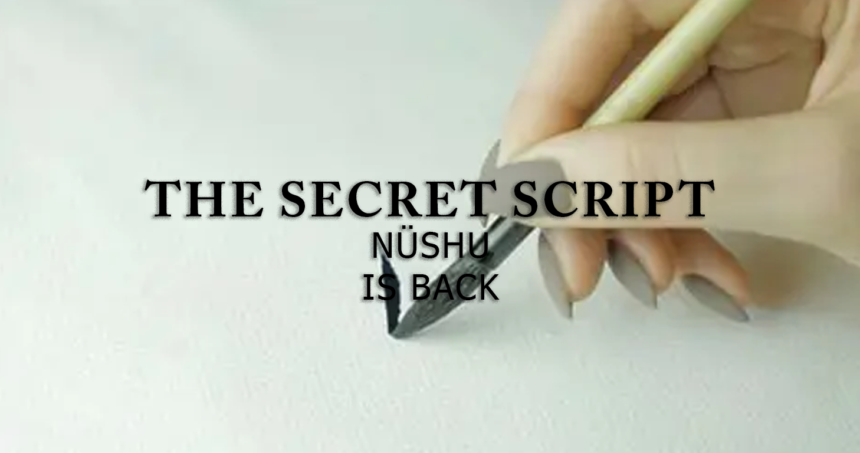
An extraordinary writing system developed and traditionally used by women in rural China is attracting renewed international interest, as researchers, cultural organisations and younger generations work to preserve a centuries-old tradition that once provided women with a rare means of personal expression. Known as Nüshu, meaning “women’s writing”, the distinctive script originated in Jiangyong County in China’s central Hunan province and is widely regarded as one of the world’s most unusual examples of gender-associated written communication.
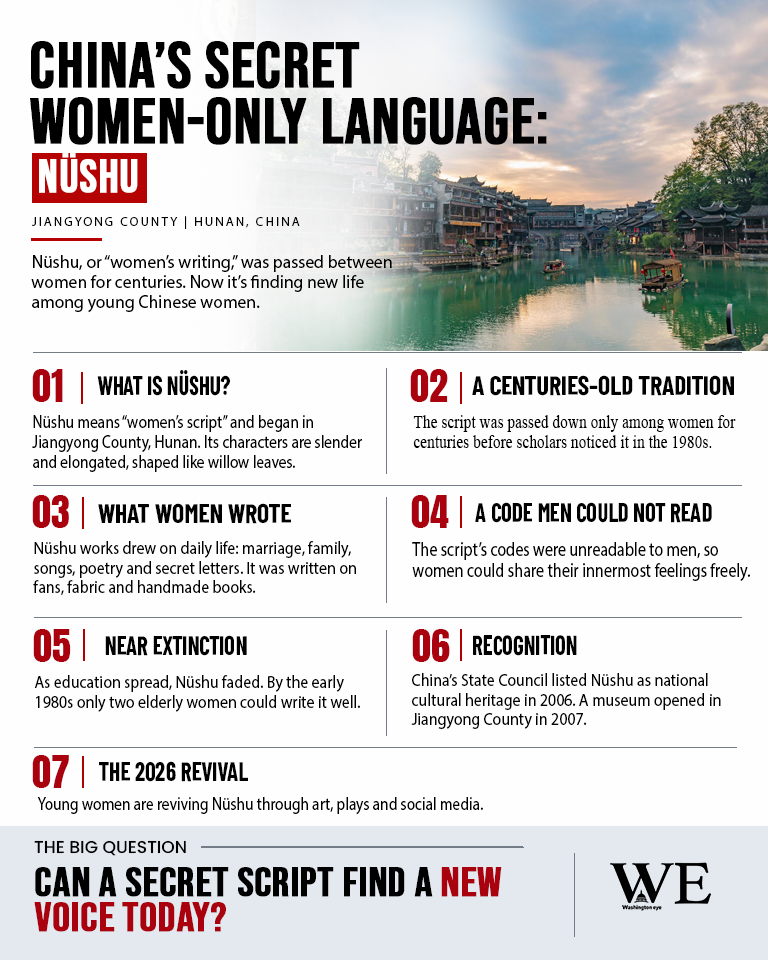
Unlike conventional Chinese characters, Nüshu features slender, elongated symbols that resemble delicate diagonal strokes, diamonds and flowing patterns. The script was traditionally used by women to write letters, poems, songs and personal reflections, often expressing experiences of marriage, separation, friendship and hardship. Although commonly described as a women-only language, Nüshu is more accurately understood as a writing system used to record a local Chinese variety spoken by both men and women.
The tradition developed in communities where many women historically had limited access to formal education. While men were more likely to learn standard Chinese characters through schooling, women created and maintained their own literary practices, passing knowledge of Nüshu between mothers, daughters, relatives and close friends. The script became an important part of women’s social relationships and offered a means of documenting emotions and experiences that were often overlooked in formal historical records.

One of Nüshu’s most distinctive uses was in the creation of sanzhaoshu, or “third-day books”, traditionally presented to brides shortly after marriage. These handmade booklets contained poems, songs and messages from female relatives and friends, expressing affection, encouragement and sorrow over separation. The books often included blank pages for brides to record their own thoughts and experiences, creating deeply personal documents of women’s lives.

Nüshu was also associated with sworn sisterhoods, in which women formed close bonds outside their biological families. Through written messages, embroidered textiles and shared songs, these relationships provided emotional support and strengthened community connections. The script was sometimes inscribed on fans or incorporated into decorative objects, combining literary expression with traditional craftsmanship.
Although the precise origins of Nüshu remain uncertain, scholars have traced surviving examples to the nineteenth and twentieth centuries. Some local traditions suggest that the writing system developed much earlier, but there is insufficient historical evidence to establish an exact date. Academic interest increased during the 1980s, when researchers began systematically documenting the script and interviewing women who had learned it through traditional community practices.
The decline of Nüshu accelerated during the twentieth century as educational opportunities expanded and younger women increasingly learned standard Chinese writing. Social and economic changes also weakened the close-knit rural networks through which the tradition had been transmitted. By the early twenty-first century, only a small number of elderly women remained who had acquired the script through its original social environment.

The death of Yang Huanyi in 2004, widely described as one of the last traditional practitioners of Nüshu, became a significant moment in the history of the script’s preservation. Her writings and recordings helped researchers document a tradition that might otherwise have disappeared. However, Nüshu itself has not vanished, as cultural educators, scholars and enthusiasts continue to study and teach it.
In 2006, Nüshu customs were included in China’s first national list of intangible cultural heritage, strengthening efforts to protect surviving manuscripts and promote public awareness. Museums, research institutions and cultural centres in Jiangyong have since organised exhibitions, educational activities and demonstrations of traditional writing and embroidery.
The script has also found new audiences through social media, contemporary art, fashion and digital design. Younger artists have incorporated Nüshu characters into jewellery, clothing and visual installations, while researchers have worked to improve digital access to historical documents. Its inclusion in the Unicode Standard has further supported efforts to represent the script in modern digital communication.
Nevertheless, preservation efforts face important challenges. Specialists have warned that commercialising Nüshu primarily as a decorative symbol could weaken public understanding of its original cultural significance. The script’s importance extends beyond its unusual appearance, reflecting the relationships, literary creativity and social experiences of generations of rural Chinese women.
Today, Nüshu offers a rare historical perspective on women’s lives in traditional Chinese society. Its survival demonstrates how communities excluded from formal institutions developed distinctive ways of preserving knowledge, expressing emotion and maintaining social connections. As interest in women’s history and endangered writing traditions grows internationally, the continuing revival of Nüshu highlights the importance of safeguarding cultural heritage. More than a collection of beautiful symbols, the script remains a testament to generations of women who found ways to record their voices and experiences through writing.