

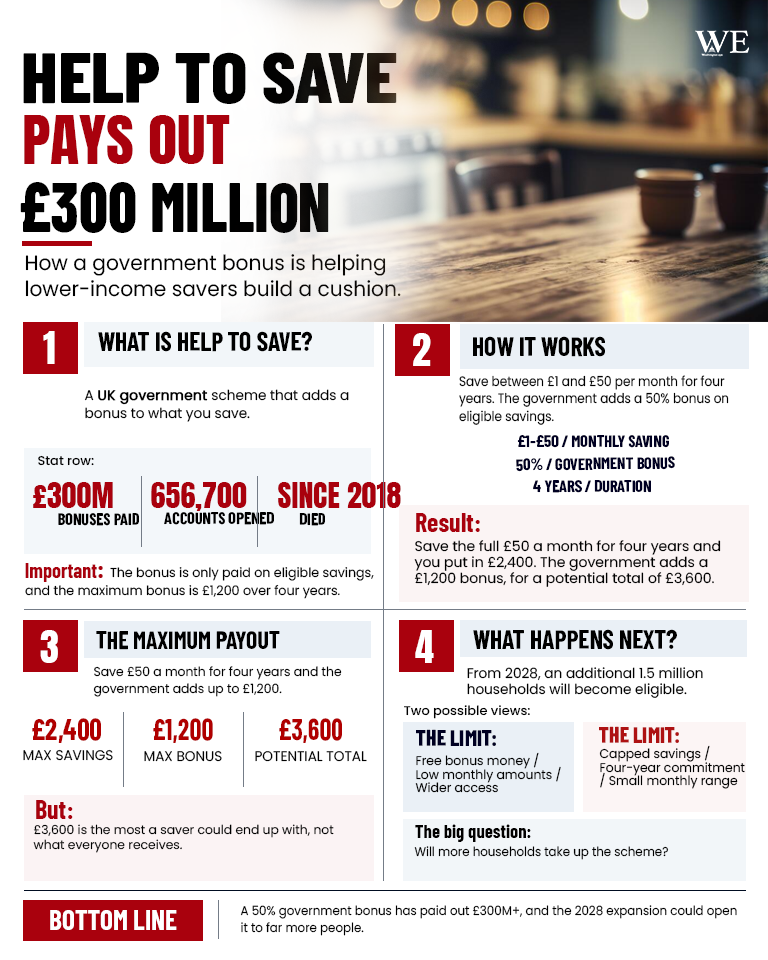
The United Kingdom government has paid more than £300 million in bonuses to low-income households through its Help to Save scheme, as authorities prepare to expand the programme to an additional 1.5 million households from 2028. The initiative, designed to encourage regular saving among people receiving government benefits, offers a 50% bonus on eligible savings, helping financially vulnerable families build emergency funds amid continuing cost-of-living pressures.
According to figures released by HM Revenue and Customs (HMRC) on September 21, 2026, more than 656,700 Help to Save accounts have been opened since the programme was introduced in September 2018. Participants have collectively deposited approximately £676.7 million, demonstrating the scheme’s role in encouraging savings among households that may otherwise struggle to put money aside.
The Help to Save programme allows eligible individuals to deposit between £1 and £50 each month into a government-backed savings account. For every £1 saved, participants can receive an additional 50 pence from the government, providing a financial incentive that exceeds the returns typically available through conventional savings accounts. Accounts remain active for four years, during which participants can save a maximum of £2,400. Those who consistently deposit the maximum £50 each month can receive up to £1,200 in government bonuses, bringing their combined savings and rewards to £3,600.
Unlike traditional savings products, bonuses are not paid monthly. Under the existing arrangement, the first payment is made after two years and calculated as 50% of the highest account balance achieved during that period. A second bonus is paid after four years, based on the increase between the highest balances recorded in the first and final two-year periods. The payments are transferred directly into participants’ bank accounts.

The latest government figures reveal that approximately 94% of account holders save the maximum permitted amount of £50 each month. Officials believe this demonstrates the effectiveness of financial incentives in encouraging regular saving, particularly among individuals facing limited disposable incomes.
The programme was initially available to a narrower group of benefit recipients. However, eligibility was expanded in April 2025 to include all working Universal Credit claimants earning at least £1 per month. The change made approximately 550,000 additional people eligible to participate, reflecting the government’s efforts to improve financial inclusion.
Further reforms are scheduled for April 2028, when eligibility will extend to Universal Credit households with children or caring responsibilities, including those who do not meet the current earnings requirement. The government estimates that an additional 1.5 million households could qualify, significantly increasing the programme’s potential reach.

The expansion forms part of a wider government strategy to address financial insecurity and strengthen household resilience. Many low-income families struggle to accumulate emergency savings, leaving them vulnerable to unexpected expenses such as household repairs, medical costs or temporary reductions in income.
Economic Secretary to the Treasury Lucy Rigby encouraged eligible households to take advantage of the programme, highlighting the government’s contribution of 50 pence for every pound saved. HMRC has also promoted the scheme through UK Savings Week, encouraging people to check their eligibility and open accounts online. In addition to widening eligibility, the government plans to make Help to Save a permanent feature of the UK’s financial system. Originally scheduled to close to new applicants in September 2023, the programme received several extensions before ministers confirmed its long-term continuation.
A major proposed reform involves allowing banks, building societies and credit unions to offer Help to Save accounts directly to eligible customers. Currently, the scheme operates through a centralised government-backed arrangement. The new multi-provider model is intended to increase accessibility, raise public awareness and encourage more eligible households to participate.
The government is also developing changes to the bonus structure, including more frequent payments every six months under the reformed programme. These changes are intended to simplify the savings process and provide participants with more regular financial rewards. Despite its achievements, officials acknowledge that participation remains relatively low compared with the number of people potentially eligible. Limited awareness, competing household expenses and difficulties maintaining regular savings have been identified as barriers preventing wider adoption.
Participants can withdraw money from their accounts when necessary, although withdrawals may reduce their eventual bonus payments. Applications can be completed through the official GOV.UK website or HMRC mobile application, where users can also monitor their deposits and rewards. As Britain continues to confront household financial pressures, the Help to Save programme represents an effort to encourage long-term financial security through government-supported savings. With more than £300 million already distributed and eligibility set to expand, the initiative is expected to reach more families seeking greater financial stability in the coming years.