The 2026 Nobel Prizes have recognised ten distinguished individuals for their contributions to science, literature, economics and international peace, highlighting achievements ranging from revolutionary neuroscience research to the exploration of the universe and the advancement of international justice. Announced between October 5 and 12 in Sweden and Norway, this year’s awards celebrate discoveries and accomplishments that have significantly influenced humanity’s understanding of the world.
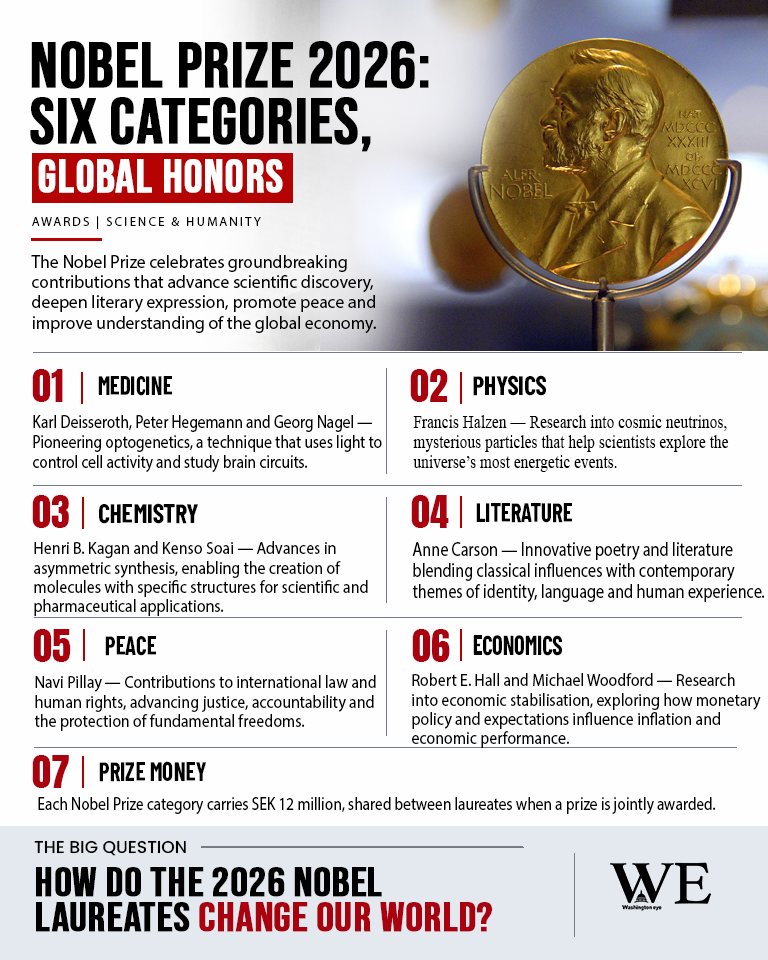
The prestigious prizes were announced across six categories: Physiology or Medicine, Physics, Chemistry, Literature, Peace and Economic Sciences. The 2026 laureates include researchers from the United States, Germany, Belgium, France and Japan, alongside a Canadian literary figure and a South African human rights advocate. Each full prize carries a cash award of 12 million Swedish kronor, approximately $1.2 million, marking an increase of one million kronor compared with previous years.
The announcements began on October 5 with the Nobel Prize in Physiology or Medicine, jointly awarded to American scientist Karl Deisseroth and German researchers Peter Hegemann and Georg Nagel for their discoveries involving light-gated ion channels and optogenetics. Their work has transformed neuroscience by allowing scientists to control the activity of specific nerve cells using light, providing powerful tools for investigating brain function and neurological disorders. The discoveries have opened new avenues for understanding conditions such as Parkinson’s disease, epilepsy and depression, although many potential clinical applications remain under investigation.

On October 6, the Nobel Prize in Physics was awarded to Belgian-born physicist Francis Halzen for his contributions to the IceCube Neutrino Observatory and the discovery of high-energy neutrinos originating from astrophysical sources. Located deep beneath the Antarctic ice, the observatory detects elusive subatomic particles travelling across enormous cosmic distances. Halzen’s research has helped establish neutrino astronomy as a new way of studying some of the universe’s most energetic phenomena, including distant cosmic accelerators.

The Nobel Prize in Chemistry followed on October 7, recognising French chemist Henri B. Kagan and Japanese scientist Kenso Soai for discoveries involving nonlinear effects and autocatalysis in asymmetric organic synthesis. Their research advanced scientists’ understanding of how chemical reactions can preferentially produce molecules with a particular three-dimensional orientation. Such processes are especially important in pharmaceutical development, where different mirror-image forms of the same molecule can have significantly different biological effects.
Canadian poet, essayist and classical scholar Anne Carson received the Nobel Prize in Literature on October 8. The Swedish Academy recognised her inventive literary work and distinctive engagement with classical traditions. Known for combining poetry, essays, translation and experimental storytelling, Carson has developed an influential body of writing that challenges conventional literary boundaries. Her recognition highlights the continuing importance of creative experimentation and the reinterpretation of ancient ideas in contemporary literature.
The Nobel Peace Prize, announced in Oslo on October 9, was awarded to South African jurist and human rights advocate Navanethem “Navi” Pillay for her efforts to promote peace and international law. Pillay, who previously served as United Nations High Commissioner for Human Rights and as a judge at international criminal tribunals, has spent decades advocating accountability for war crimes, crimes against humanity and genocide. The Norwegian Nobel Committee highlighted her role in strengthening international legal institutions and advancing justice for victims of serious human rights violations.

The final announcement came on October 12, when American economists Robert E. Hall and Michael Woodford jointly received the Sveriges Riksbank Prize in Economic Sciences in Memory of Alfred Nobel. Their work on the microeconomic foundations of macroeconomic stabilisation has contributed to modern understanding of economic fluctuations and the role of monetary policy. Their research has influenced how economists analyse inflation, interest rates and government responses to economic instability.
Established through the will of Swedish inventor and industrialist Alfred Nobel, the prizes were first awarded in 1901. The Economic Sciences Prize was introduced separately in 1968 by Sweden’s central bank in Nobel’s memory. Over more than a century, the awards have become internationally recognised symbols of intellectual achievement, scientific innovation and humanitarian service.
The 2026 laureates will be formally honoured on December 10, the anniversary of Alfred Nobel’s death, during ceremonies in Stockholm and Oslo. The Nobel Peace Prize will be presented in the Norwegian capital, while the remaining prizes will be awarded in Sweden. This year’s Nobel selections underline the importance of scientific discovery, artistic expression, economic research and international cooperation at a time of complex global challenges. From uncovering the mysteries of the brain and universe to defending human rights, the laureates’ contributions demonstrate the continuing role of knowledge and innovation in shaping humanity’s future.