
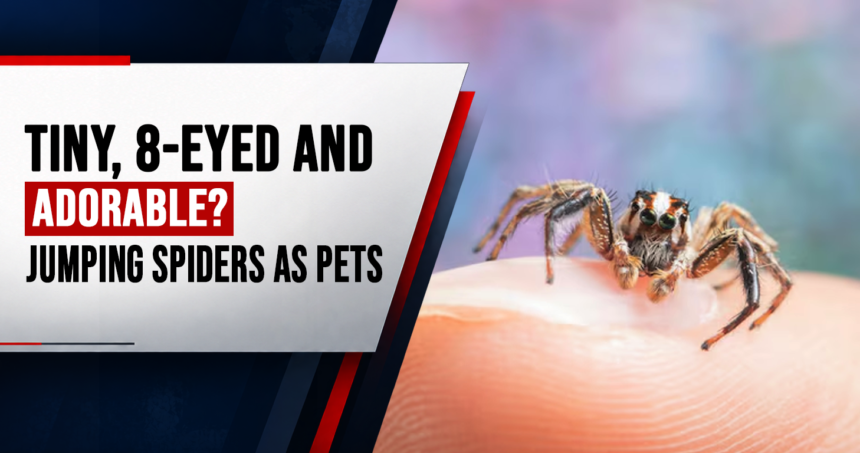
Forget cats, dogs and hamsters. An unlikely eight-legged creature is becoming a favourite among exotic pet enthusiasts, as jumping spiders gain popularity in households across the United States and attract growing attention worldwide. With their tiny bodies, expressive eyes and curious behaviour, these miniature arachnids are challenging traditional ideas of what makes an appealing household companion.
The trend has gathered momentum throughout 2025 and 2026, largely driven by viral videos on TikTok and Instagram showing jumping spiders exploring miniature houses, interacting with their owners and displaying behaviours that viewers often describe as surprisingly adorable. Nicknamed “web puppies” and “spoods” by their admirers, the spiders have developed dedicated online communities, transforming creatures commonly associated with fear into unlikely social media celebrities.
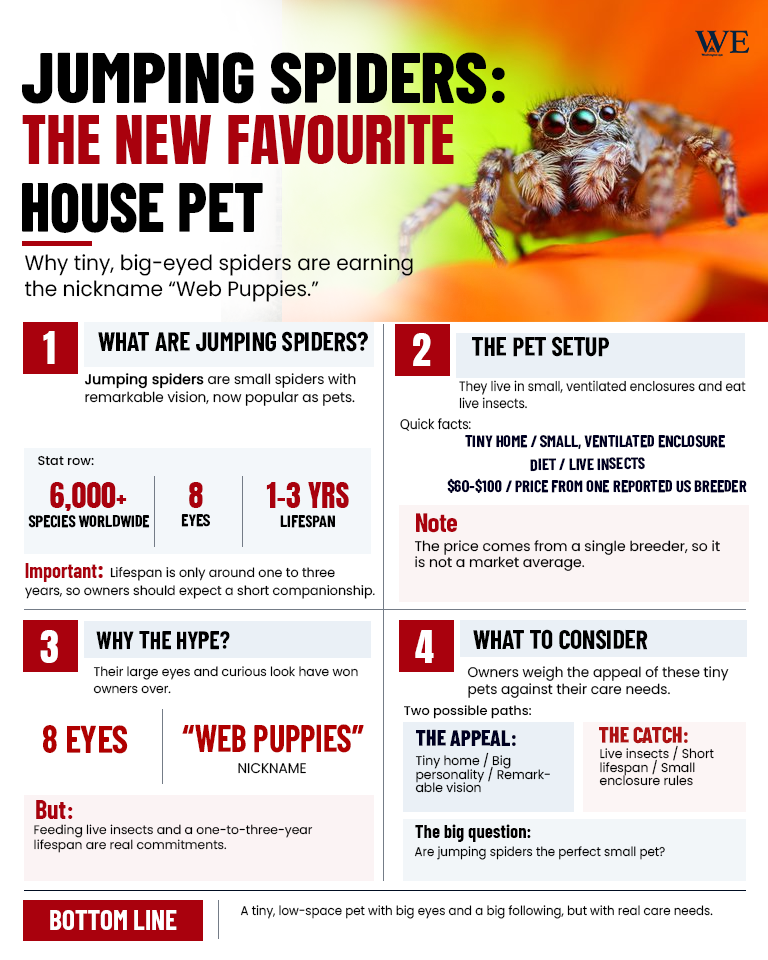
Jumping spiders belong to the Salticidae family, which includes more than 6,000 species found across the world, except Antarctica. Unlike many spiders that depend on webs to capture insects, jumping spiders actively hunt their prey using exceptional eyesight and remarkable jumping abilities. Their large forward-facing eyes, furry appearance and distinctive movements have contributed to their growing appeal among animal lovers.

The rising demand is particularly noticeable in the United States, where breeders have reported increasing sales and interest from first-time spider owners. According to an August 2026 report by The New York Times, Lauren Taylor, a graphic designer and spider breeder based in Reno, Nevada, keeps approximately 2,000 jumping spiders and had sold around 600 during the year. Individual spiders from her business, Spider Stuff, typically sell for between $60 and $100, depending on the variety.

The popularity is not limited to specialist breeders. Major American pet retailers have also entered the market. PetSmart began selling jumping spiders in August 2025 and reportedly sold tens of thousands within its first year, reflecting substantial commercial interest in these unconventional companions. However, comprehensive global ownership figures remain unavailable, making it difficult to determine how widespread the trend has become.
Social media has played a central role in changing public perceptions. Videos featuring spiders with names such as Violet, Opal and Flower have attracted considerable attention, with some clips receiving millions of views. Their movements, including tilting their bodies, raising their front legs and leaping between fingers, have encouraged viewers to associate them with the playful behaviour of much larger pets.
Interestingly, some of the strongest enthusiasts are former arachnophobes. A National Public Radio report highlighted several American owners who initially feared spiders but developed an appreciation for them after encountering videos online. Some eventually became breeders themselves, suggesting that increased exposure to the creatures may help challenge longstanding negative perceptions.

Scientists also point to the spiders’ unusual cognitive abilities. Nathan Morehouse, an ecologist at the University of Cincinnati who studies jumping spiders, has explained that their sophisticated vision and hunting strategies enable complex behaviours despite their extremely small brains. Their ability to observe movement and respond to their surroundings makes them particularly fascinating to watch.
Practical considerations have also contributed to their appeal. Unlike conventional pets, jumping spiders require relatively little space and can be housed in small, properly ventilated enclosures. They do not need outdoor walks and generally have lower ongoing costs than larger animals. Their diet, however, consists of live insects, including fruit flies, crickets and mealworms, while their typical lifespan ranges from approximately one to three years.
Despite their popularity, animal welfare organisations have raised concerns about treating spiders as entertainment. People for the Ethical Treatment of Animals (PETA) has criticised the trend, arguing that jumping spiders are naturally solitary creatures and may experience stress from excessive handling or unsuitable captivity. The organisation has also questioned the ethics of commercial breeding and selling spiders primarily for social media attention.
Specialists emphasise that prospective owners should understand the animals’ specific needs, including appropriate feeding, secure housing and minimal handling. Jumping spiders are generally not considered dangerous to humans, although they can bite when threatened.
While jumping spiders remain far from replacing traditional household pets, their emergence as online favourites reflects changing attitudes towards unconventional animals. What began as a niche interest among arachnid enthusiasts has evolved into a growing pet-keeping trend, demonstrating how social media can transform even the smallest and most misunderstood creatures into objects of fascination.