
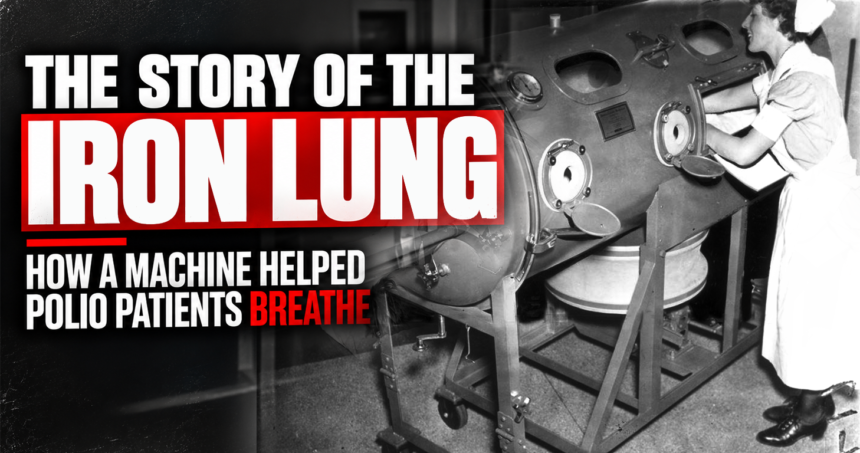
Long before modern intensive care units and compact mechanical ventilators, a huge metal cylinder known as the “iron lung” kept thousands of people alive when their own muscles could no longer make them breathe. Closely associated with the devastating poliomyelitis epidemics of the 20th century, the machine became both a symbol of the terror of polio and one of the most important milestones in the history of mechanical ventilation.
The best-known practical iron lung was developed at Harvard University in the late 1920s by engineer Philip Drinker and physiologist Louis Agassiz Shaw Jr. Their electrically powered tank respirator was introduced in 1928 and reported medically in 1929. However, the concept of using changes in external pressure to assist breathing was much older.
Experimental negative-pressure devices had existed for centuries, while Scottish physician John Dalziel constructed an early tank-type respirator in the 19th century. What Drinker and Shaw achieved was to turn the principle into a practical electrically powered machine that could sustain people suffering from respiratory paralysis.

What Was an Iron Lung and How Did It Work?
Despite its name, the iron lung was not placed inside the body. It was a large airtight metal chamber into which a patient was placed horizontally, with only the head and neck remaining outside. A tight seal around the neck separated the air inside the tank from the surrounding atmosphere. The machine used negative-pressure ventilation.

When the pressure inside the chamber was lowered below atmospheric pressure, the patient’s chest expanded. That expansion caused air to enter through the nose and mouth and fill the lungs, essentially producing an inhalation. When pressure inside the chamber increased again, the chest recoiled and air moved out of the lungs.
The machine repeated this pressure cycle continuously, effectively performing the mechanical work normally produced by the diaphragm and other respiratory muscles. Unlike most modern ventilators, which use positive pressure to push air into the lungs, the iron lung helped draw air into them by creating negative pressure around the chest and abdomen.
This became lifesaving in paralytic poliomyelitis. Polio is caused by poliovirus. Most infections do not cause paralysis, but in severe cases the virus can damage motor neurons. When the nerves controlling the diaphragm and other respiratory muscles are affected, patients may become unable to breathe adequately on their own. Before reliable respiratory support existed, such respiratory paralysis could be fatal.

The First Famous Patient
One of the landmark clinical uses of the Drinker respirator occurred at Boston Children’s Hospital in 1928, involving a young girl suffering from respiratory paralysis due to polio. The machine enclosed her body while leaving her head outside and mechanically assisted her breathing through alternating pressure. The early clinical success demonstrated that mechanical respiratory support could keep a person alive when respiratory muscles failed and helped generate international interest in the technology. The Drinker-Shaw design subsequently became the model most closely associated with the term “iron lung.”
Other negative-pressure respirators had preceded it, however, meaning the history of the iron lung cannot be attributed to a single invention. Later historical research documented multiple earlier designs, while engineer John Haven Emerson subsequently developed a simpler and less expensive iron lung in the early 1930s. Emerson’s machines became widely used during the polio era and helped make negative-pressure ventilation more accessible.
Polio Epidemics Turn the Iron Lung Into an Icon
The iron lung became most famous during the major polio epidemics of the 1930s, 1940s and particularly the early 1950s. Polio disproportionately affected children, and outbreaks created enormous public fear. While most patients recovered without requiring an iron lung, those who developed respiratory muscle paralysis could need immediate mechanical ventilation.
Hospitals established specialised respiratory centres, sometimes containing rows of iron lungs with children’s heads emerging from the ends of large metal cylinders. These units were among the predecessors of modern respiratory and intensive-care units. Patients could remain inside the machines for days, weeks or months while damaged nerves and muscles recovered.
Some never regained sufficient respiratory function. For these survivors, the iron lung became part of everyday life for years or even decades. Medical staff could reach patients through access ports along the machine, but nursing care was complicated because most of the body remained enclosed. Eating, washing, physical examination and other routine activities could become difficult. The machines were also enormous, expensive, noisy and difficult to transport. Yet for patients who otherwise could not breathe, they provided something far more important: time and survival.
From Iron Lung to Modern Intensive Care
A major turning point occurred during the 1952 Copenhagen polio epidemic. Doctors faced large numbers of patients with respiratory paralysis and insufficient negative-pressure ventilators. Danish anaesthetist Bjørn Ibsen advocated tracheostomy and positive-pressure ventilation, in which air was pushed directly into patients’ lungs. Medical students and other personnel initially provided ventilation manually using bags around the clock.
The approach dramatically changed the management of respiratory failure and contributed to the development of modern intensive-care medicine. Positive-pressure ventilators eventually became smaller, more sophisticated and much easier for clinicians to use while accessing the patient.
At roughly the same time, medicine was attacking the underlying reason so many children needed iron lungs in the first place: polio itself. The introduction of effective polio vaccines during the 1950s, beginning with the Salk vaccine, led to dramatic reductions in poliomyelitis in countries where vaccination became widespread.
As polio cases declined and positive-pressure ventilation advanced, hospital wards filled with iron lungs gradually disappeared. By the 1960s, medicine was moving decisively away from full-body negative-pressure tank ventilators.
The Man Who Lived With an Iron Lung for More Than 70 Years
Perhaps no individual became more closely associated with the iron lung than Paul Alexander of Dallas, Texas. Alexander contracted polio in 1952 when he was six years old during a major outbreak. The disease left him paralysed and unable to breathe normally, and he was placed inside an iron lung. He survived.
Over time, Alexander learned a technique sometimes called “frog breathing,” or glossopharyngeal breathing, which allowed him to spend periods outside the machine by using muscles of his mouth and throat to move air into his lungs.
His disability did not prevent him from pursuing an education. Alexander eventually attended university, earned a law degree and worked as a lawyer. But the iron lung remained essential to his life, particularly for sleeping and later as his respiratory needs increased. Guinness World Records recognised Alexander for the longest time living with an iron lung, more than 70 years. He died in March 2024 at the age of 78, after having relied on the technology since 1952. His story brought renewed international attention to a machine that many younger people had previously encountered only in museums or old photographs.
Do Iron Lungs Still Exist Today?
Traditional full-size iron lungs have virtually disappeared from routine modern medicine. Today’s intensive-care ventilators generally use positive pressure, delivering air through an endotracheal tube, tracheostomy or non-invasive mask depending on the patient’s condition.
Modern ventilators can precisely control variables such as respiratory rate, pressure, volume and oxygen concentration while allowing healthcare professionals far better access to the patient. But the scientific principle behind the iron lung has not completely disappeared.
Modern forms of negative-pressure ventilation exist, including devices that surround only the chest rather than enclosing the entire body. Such technology has occasionally been used in selected patients with neuromuscular or respiratory disorders. The iron lung therefore occupies an extraordinary place in medical history.
It was cumbersome, frightening to look at and extraordinarily restrictive for those who depended on it. Yet during an era when medicine had few alternatives for respiratory paralysis, it transformed an inability to breathe from an almost certain catastrophe into a condition that some patients could survive.
Its legacy reaches far beyond polio. The specialised respiratory centres created for critically ill patients, the development of increasingly sophisticated artificial ventilation and the lessons learned during the polio epidemics all contributed to the evolution of modern mechanical ventilation and intensive-care medicine.
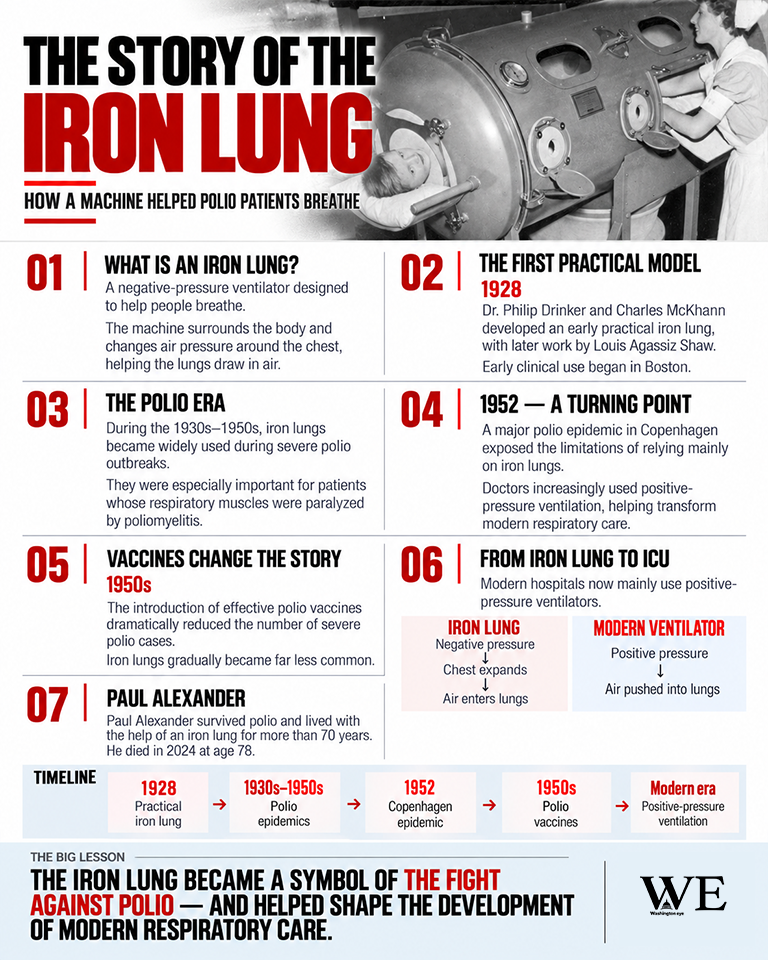
The iron lung may now largely belong in museums, but its story represents one of medicine’s most striking transitions: from a giant steel cylinder mechanically breathing for paralysed children to today’s highly sophisticated life-support systems used in intensive-care units around the world.