
In homes, hospitals, schools, offices and diplomatic meetings, experts are calling renewed attention to an ability that appears simple but is increasingly difficult to practise: listening. As smartphones compete for attention, political conversations become more divided and artificial-intelligence companions enter personal relationships, listening is being reconsidered as an essential social and professional skill rather than a passive act.
The subject gained urgency after the World Health Organization published a major report on social connection in June 2025. It found that approximately one in six people worldwide experiences loneliness, with adolescents and people in lower-income countries reporting particularly high levels. Loneliness was associated with an estimated 871,000 deaths annually between 2014 and 2019. Although listening alone cannot solve social isolation, the WHO report argued that stronger relationships and community connections can improve health and reduce the risk of premature death.
Listening is different from merely hearing. Hearing is the physical process of receiving sound, while active listening requires attention, interpretation and an appropriate response. A listener may maintain comfortable eye contact, avoid interruption, observe tone and body language, ask open questions and summarise what has been said. The purpose is not to prepare a quick reply but to understand the speaker’s meaning, feelings and concerns.

The modern concept developed from counselling research led by American psychologist Carl Rogers and his colleagues during the 1940s and 1950s. Rogers and Richard Farson popularised the term “active listening” in 1957. Their approach required listeners to offer empathy, reflect meaning and create a non-threatening environment in which speakers could examine their own thoughts. What began as a therapeutic method later entered education, management, mediation, medicine and family counselling.

Healthcare is one of the places where listening can have immediate consequences. Patients do not always present their symptoms in an orderly way, and their central fear may remain hidden unless a doctor allows them time to speak. Active listening can help clinicians identify concerns, check whether instructions have been understood and involve patients in decisions. A 2025 critical review examined the harmful effects of patients feeling unheard, including emotional distress, reduced engagement and weakened trust in healthcare professionals.
Time pressure, however, makes careful listening difficult. Doctors may have crowded clinics, teachers may manage large classes and customer-service workers may be judged by how quickly they complete calls. In such settings, organisations sometimes demand empathy while giving employees neither sufficient time nor authority to address what they hear. Researchers therefore argue that listening must be supported by working conditions and institutional action; it cannot simply be added to a checklist.
The workplace has become another important testing ground. Employers increasingly describe listening as a leadership skill because workers who feel heard may be more willing to report problems, question unsafe decisions and suggest new ideas. The University of California, Berkeley’s executive-education programme describes active listening as a strategic practice that can build trust, reduce conflict and create psychological safety. Its guidance recommends putting away devices, withholding judgement, clarifying unclear statements and reflecting important points before responding. The approach treats listening as deliberate work rather than silence.

Listening is also being used in conflict resolution. In September 2025, a United Nations youth campaign promoted “Peace Circles,” bringing young people and older participants into structured conversations. These gatherings aimed to create inclusive spaces where participants could describe their experiences before discussing action. Such methods may not immediately resolve political disagreements, but they can reveal fears and grievances that formal speeches or online arguments often conceal. The UN guidance presents listening as a starting point for cooperation rather than an alternative to decision-making.
Digital life presents the greatest modern challenge. Notifications, short videos and simultaneous screens encourage people to divide their attention. Someone may appear to be listening while reading messages or planning a response. The American Psychological Association has examined how constant digital interruption and task-switching affect concentration and increase stress. ts discussion of attention research suggests that people can improve focus by limiting interruptions and giving one activity their full attention.
AI chatbots complicate the picture further. They can respond at any hour, remember details and imitate empathy, making them attractive to people who feel lonely or fear judgement. Yet psychologists have warned that some systems are overly agreeable and may encourage dependence by continuously validating users. APA reporting in 2026 highlighted both the possible emotional support and the risks of replacing difficult human relationships with artificial companionship.
A critical view is therefore necessary. Listening does not require agreement, and empathy should not prevent the examination of false, abusive or discriminatory claims. Techniques such as repeating a speaker’s words can also feel artificial when used mechanically. Eye contact, silence and emotional expression vary between cultures, so there is no universal performance that proves attention.
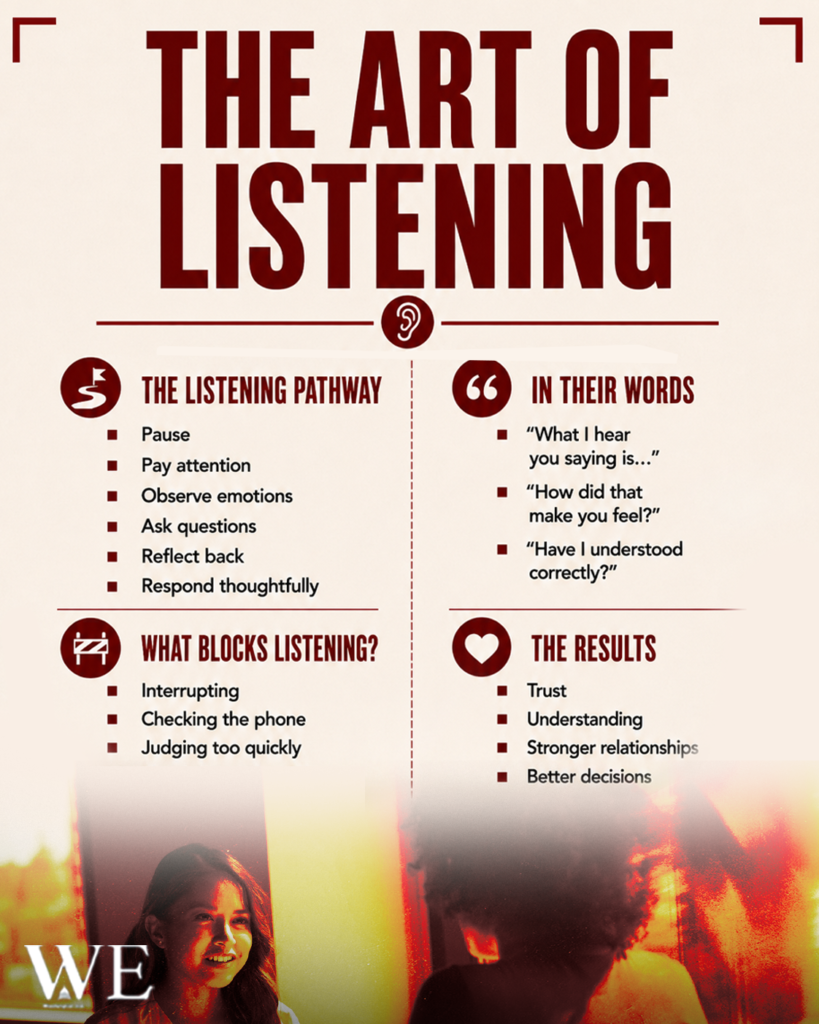
The art of listening ultimately combines patience, curiosity and judgement. Its value lies not only in allowing someone to speak, but in accurately understanding what has been communicated and deciding what responsible action should follow. In a world with more channels for expression than ever before, the deeper shortage may not be voices, but people prepared to hear them.