
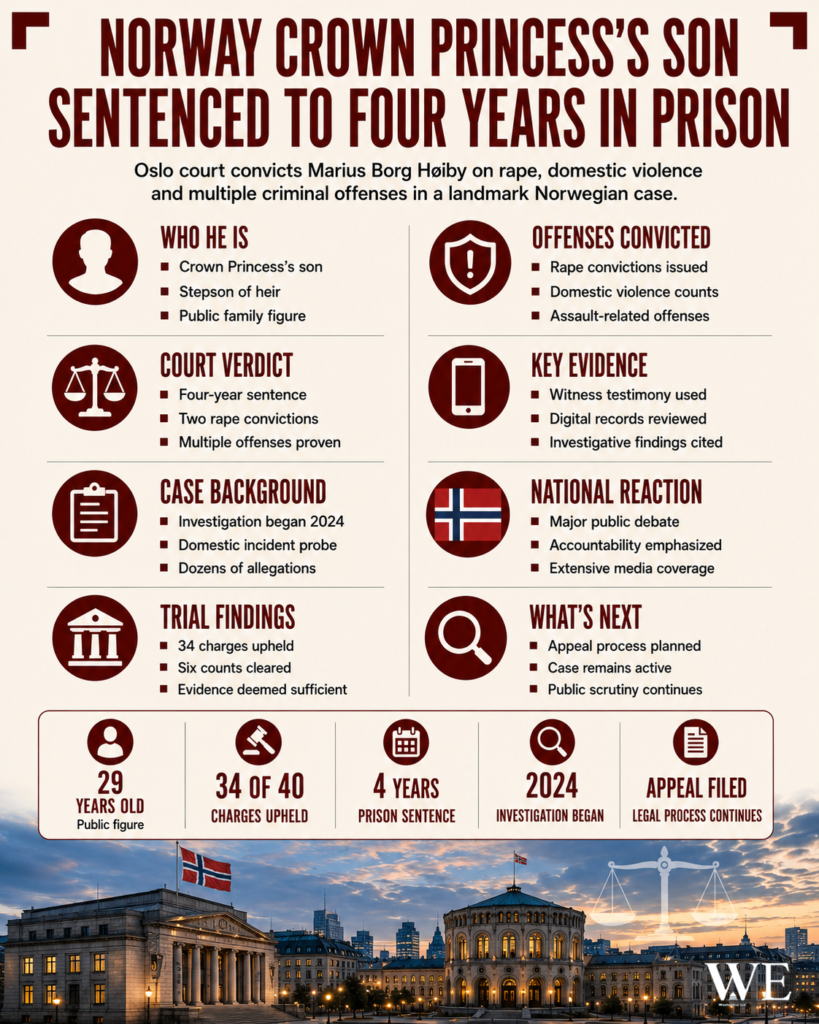
Marius Borg Høiby, the eldest son of Norway’s Crown Princess Mette-Marit and stepson of Crown Prince Haakon, has been sentenced to four years in prison after an Oslo court found him guilty of rape, domestic violence and a series of other criminal offenses in one of the most closely watched legal cases in modern Norwegian history. The verdict, delivered by the Oslo District Court on June 15, has sent shockwaves through Norway and intensified scrutiny of the country’s royal family.
Høiby, 29, is not in the line of succession to the Norwegian throne, but he has long been a familiar public figure due to his connection to the royal household. He became part of Norway’s extended royal family in 2001 when his mother, Crown Princess Mette-Marit, married Crown Prince Haakon, the heir apparent to the throne. Although he has participated in public events alongside the royal family over the years, he does not hold an official royal title.
The case stems from a series of allegations that emerged after police responded to a domestic disturbance in Oslo in 2024. Investigators subsequently uncovered multiple accusations involving sexual violence, physical abuse, threats, drug-related offenses and violations of restraining orders. Prosecutors eventually brought dozens of charges against Høiby, making the case one of the most extensive criminal proceedings involving a person linked to a European royal family in recent years.

Following a lengthy trial that lasted several weeks, the court found Høiby guilty on two counts of rape as well as numerous other offenses, including domestic violence and assault. According to the court, the rape victims were in vulnerable or incapacitated conditions at the time of the assaults. One of the incidents reportedly took place in the basement of the Crown Prince’s official residence, adding further sensitivity to the case because of its connection to the royal household.

The court convicted Høiby on 34 of the 40 charges brought against him. However, he was acquitted of two additional rape allegations and several other counts. Prosecutors had sought a prison sentence of more than seven years, arguing that the seriousness and scope of the offenses warranted a tougher punishment. Defense lawyers, meanwhile, requested a significantly lighter sentence and argued that some allegations had not been sufficiently proven.
Throughout the proceedings, Høiby denied the rape allegations but admitted responsibility for some lesser offenses, including drug-related violations and reckless behavior. The court nevertheless concluded that evidence presented during the trial, including witness testimony, digital material and investigative findings, was sufficient to establish guilt on the most serious charges. His legal team has already announced plans to appeal the verdict.
The case has generated intense media coverage across Scandinavia and beyond, partly because of Høiby’s family connections and partly because it has reignited broader debates about consent, sexual violence and accountability. Legal experts and advocacy organizations in Norway have pointed to the case as a reminder that sexual violence remains a significant social issue despite the country’s reputation for gender equality. The verdict has also fueled discussions about how digital evidence, social media and changing attitudes toward consent are influencing modern criminal investigations and prosecutions.

Public reaction in Norway has been mixed. Victims and advocacy groups welcomed the conviction as a sign that no individual is above the law, regardless of social status or family background. Others noted the personal tragedy for the royal family, which has already been facing challenges. The verdict came just days before reports that Crown Princess Mette-Marit underwent a lung transplant following complications from pulmonary fibrosis, a chronic illness she has battled for years.
The Norwegian Royal Court has largely refrained from commenting on the legal proceedings, emphasizing the independence of the judicial system. Crown Prince Haakon previously stated that his stepson should be treated like any other citizen under Norwegian law. No members of the royal family attended the trial, and officials avoided public statements while the case was underway.
Analysts say the scandal has damaged the image of the Norwegian monarchy, an institution that traditionally enjoys high levels of public trust. Recent opinion surveys have indicated a decline in support for the royal family, with the Høiby case cited as one of several factors contributing to that trend. Nevertheless, observers note that the verdict may also reinforce confidence in Norway’s legal system by demonstrating that justice can be pursued regardless of a defendant’s social standing.
As appeals proceedings begin, the case is expected to remain in the public spotlight. For now, the four-year prison sentence marks a significant legal and personal turning point for Marius Borg Høiby and represents one of the most consequential criminal convictions ever involving a figure connected to the Norwegian royal family.