
Fishing has long been viewed as an economic activity that sustains coastal communities and supplies food across Europe. However, European governments, intelligence agencies, and security experts are increasingly warning that fishing is no longer only about fish. From cod-rich Arctic waters to the Baltic Sea, fishing has become entangled with geopolitical tensions, espionage concerns, critical infrastructure protection, and national security debates, transforming what was once a commercial issue into a strategic challenge for Europe.
The growing concern is particularly visible in northern Europe, where the world’s largest cod stocks are found in the Barents Sea between Norway and Russia. For decades, the two countries cooperated in managing cod fisheries despite political disagreements. The Arctic cod industry generates billions of euros annually and supports thousands of jobs in Norway, Iceland, and other European states. Yet the same waters that host valuable fish stocks also contain critical undersea infrastructure, including internet cables, energy pipelines, and military communication networks. Recent security assessments suggest that fishing vessels operating in these regions could potentially be used for intelligence gathering or surveillance activities, bringing commercial fishing into the broader security conversation.
European concerns intensified after a series of incidents involving damaged undersea cables and energy infrastructure in the Baltic Sea. Several communication cables connecting Nordic and Baltic countries were severed or disrupted between 2023 and 2025, prompting investigations and fears of sabotage. NATO and European governments have increasingly focused on protecting undersea infrastructure because more than 95 percent of global internet traffic travels through submarine cables. Damage to these systems can disrupt communications, financial transactions, and national security operations.

Fishing activity enters the discussion because trawlers and fishing vessels operate in many of the same areas where critical infrastructure is located. Historically, fishing nets and trawling equipment have accidentally damaged undersea cables. Security experts note that distinguishing between accidental damage and deliberate interference is often difficult, especially in busy maritime regions. Analysts argue that hostile actors could exploit fishing operations as cover for intelligence collection or sabotage activities, creating what is known as a “hybrid threat.”
The issue has become particularly sensitive because of deteriorating relations between Europe and Russia following the war in Ukraine. Several European countries have imposed sanctions on Russian fishing companies accused of links to intelligence activities. Norway, while maintaining some fisheries cooperation with Russia due to shared cod stocks, has faced pressure from allies to strengthen monitoring of Russian fishing vessels entering European ports. Reports from northern Norway indicate that some Russian vessels continue to dock in selected ports, raising questions about security oversight in strategically important Arctic regions.
Security officials also point to the historical use of fishing fleets for intelligence purposes during the Cold War. Both Western and Soviet intelligence services were known to use civilian maritime vessels to collect information on naval activities and underwater infrastructure. Today, advances in technology mean that even ordinary vessels can carry sophisticated sensors capable of mapping seabed installations, monitoring naval movements, or gathering electronic intelligence. This has heightened concerns among NATO members about maritime activity near critical infrastructure.
Another dimension of the threat comes from illegal, unreported, and unregulated (IUU) fishing. European authorities view illegal fishing networks as more than environmental crimes. Such activities are increasingly linked to smuggling, document fraud, labor exploitation, and transnational criminal networks. Security experts warn that illicit maritime activities can create vulnerabilities that hostile states or organized crime groups may exploit. Recent research has highlighted the growing complexity of illegal fishing operations and their impact on governance, economic stability, and maritime security.

At the same time, experts caution against exaggerating every maritime incident as sabotage. Finland’s security service has noted that fishing activity and heavy maritime traffic have caused accidental cable damage for decades. Investigators stress that evidence must guide conclusions and that not every broken cable is proof of hostile action. Nevertheless, the increasing number of incidents in strategically sensitive waters has prompted governments to adopt a more cautious approach.
In response, NATO and European nations have expanded maritime surveillance operations, increased naval patrols, and invested in technologies capable of detecting suspicious seabed activity. The alliance’s Baltic Sentry mission and national monitoring systems aim to protect critical infrastructure and deter potential sabotage. Security planners argue that safeguarding Europe’s digital and energy lifelines is now as important as protecting territorial borders.
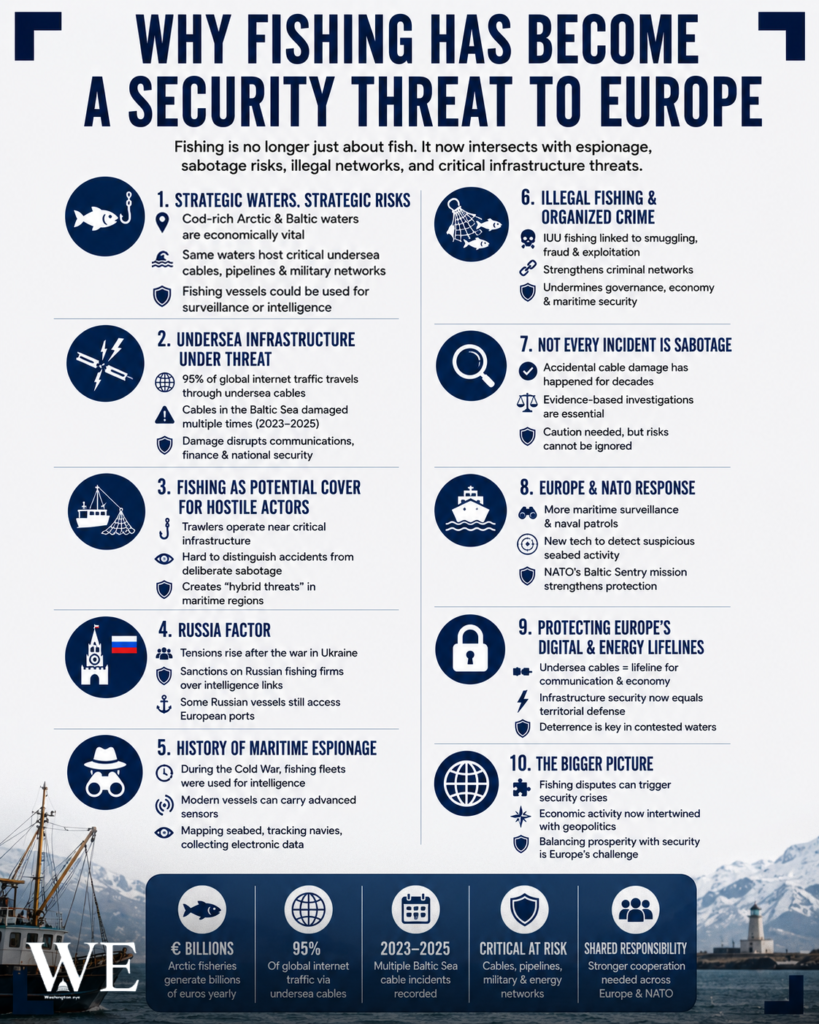
As geopolitical competition intensifies in the Arctic and Baltic regions, fishing is becoming a symbol of a broader reality: economic activities can no longer be separated from security concerns. What begins as a dispute over cod stocks, fishing rights, or maritime access can quickly intersect with questions of espionage, infrastructure protection, and national defense. For Europe, the challenge is balancing the economic importance of fishing with the need to secure increasingly contested waters in an era of hybrid threats and strategic rivalry.