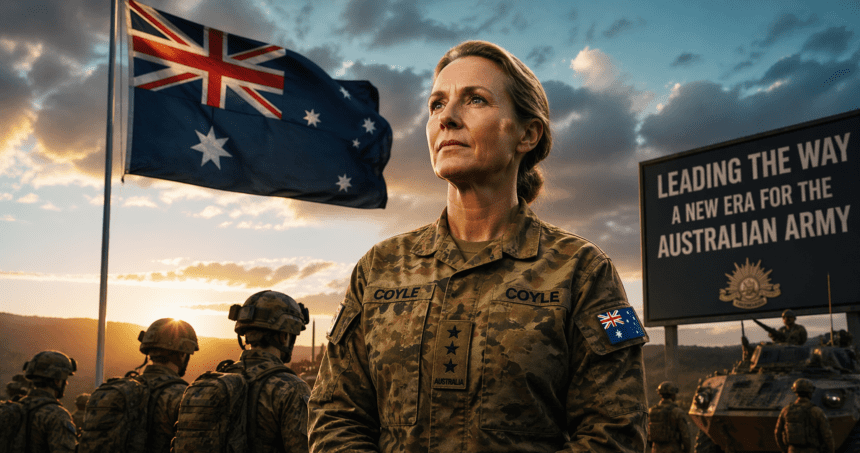
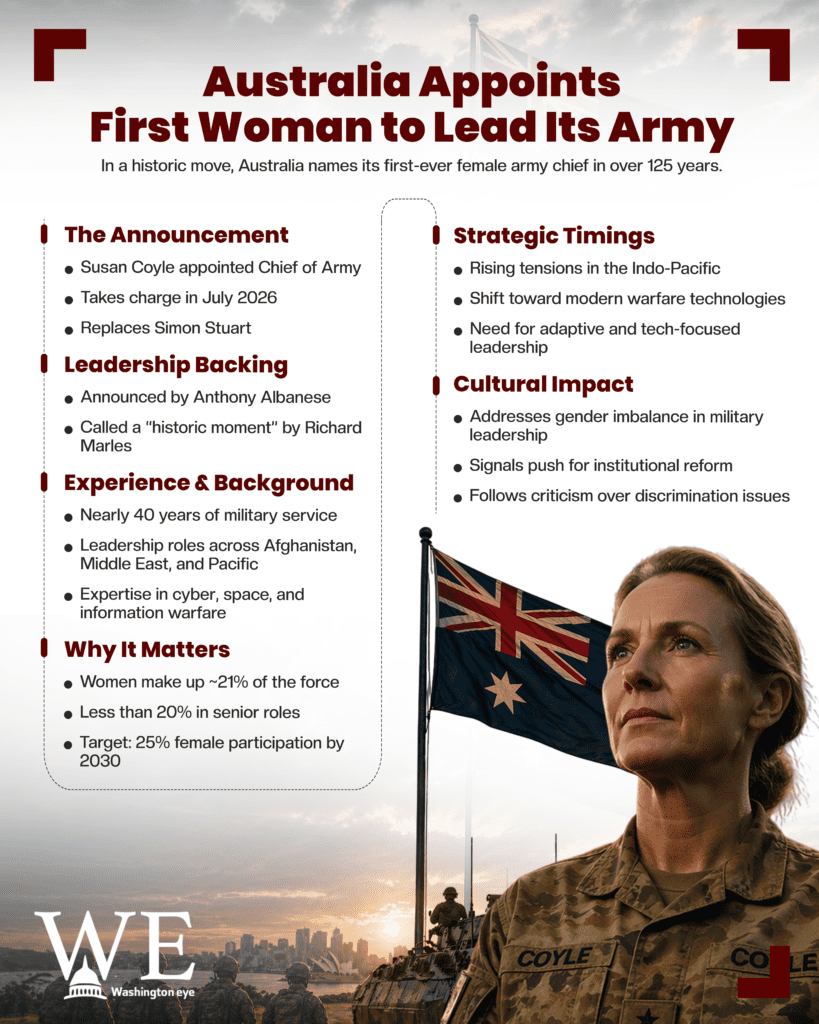
Australia has made history by appointing a woman to lead its army for the first time in its 125-year history, marking a significant milestone in military leadership and gender representation. According to multiple international reports, Lieutenant General Susan Coyle has been named the new Chief of Army by the government of Australia, with her term set to begin in July 2026. She will replace outgoing army chief Lieutenant General Simon Stuart as part of a broader leadership reshuffle within the Australian Defence Force (ADF).
Coyle, currently serving as Chief of Joint Capabilities, brings nearly four decades of military experience, having enlisted in 1987 and risen through the ranks in a traditionally male-dominated institution. Over her career, she has held senior command roles in operations across Afghanistan, the Middle East, Timor-Leste, and the Solomon Islands. Her leadership portfolio includes overseeing cyber, space, and information warfare capabilities, areas increasingly critical to modern military strategy.
The announcement was made on April 13, 2026, in Canberra, where Prime Minister Anthony Albanese described the appointment as a historic turning point. Defence Minister Richard Marles called it a “deeply historic moment,” highlighting its importance not only for the military but for society at large.

Coyle’s promotion is particularly significant given the longstanding gender imbalance in the ADF. Women currently make up about 21% of the force and less than one-fifth of senior leadership positions. The military has set a target of increasing female participation to 25% by 2030, and Coyle’s appointment is seen as a major step toward that goal.

The timing of this leadership change is also crucial. Australia is undergoing a strategic transformation in response to rising geopolitical tensions in the Indo-Pacific region and evolving warfare technologies such as drones, cyber operations, and artificial intelligence. Experts suggest that Coyle’s expertise in information warfare positions her well to lead the army into this new era of conflict.
Beyond strategy, the appointment carries strong symbolic weight. The ADF has faced criticism and legal challenges in recent years over allegations of systemic sexual harassment and discrimination against female personnel. Elevating a woman to the top leadership role in the army is widely viewed as an attempt to address these concerns and reshape institutional culture.
Globally, the move places Australia among a growing number of countries striving to break gender barriers in military leadership. While several nations have opened combat roles to women, relatively few have appointed women to command entire service branches. This development may influence other militaries to accelerate diversity reforms and rethink leadership pipelines.

From a critical perspective, however, representation alone does not guarantee structural change. While Coyle’s appointment is undeniably historic, analysts argue that the real test will be whether her leadership leads to measurable improvements in inclusion, accountability, and operational effectiveness. Symbolism must be matched by policy reform, institutional accountability, and cultural transformation to produce lasting impact.
At a personal level, Coyle’s rise reflects persistence and adaptability within a demanding and often exclusionary system. Her career trajectory, from enlisting in the late 1980s to commanding multinational operations, demonstrates both individual excellence and the gradual opening of opportunities for women in defence forces. Her leadership style, shaped by operational experience and technological expertise, may redefine traditional command models in the Australian Army.
In conclusion, the appointment of Lieutenant General Susan Coyle is more than a historic first; it represents a convergence of social progress, strategic necessity, and institutional reform. As Australia navigates an increasingly complex global security environment, her leadership will not only shape the future of the army but also signal how modern militaries evolve in the 21st century.