
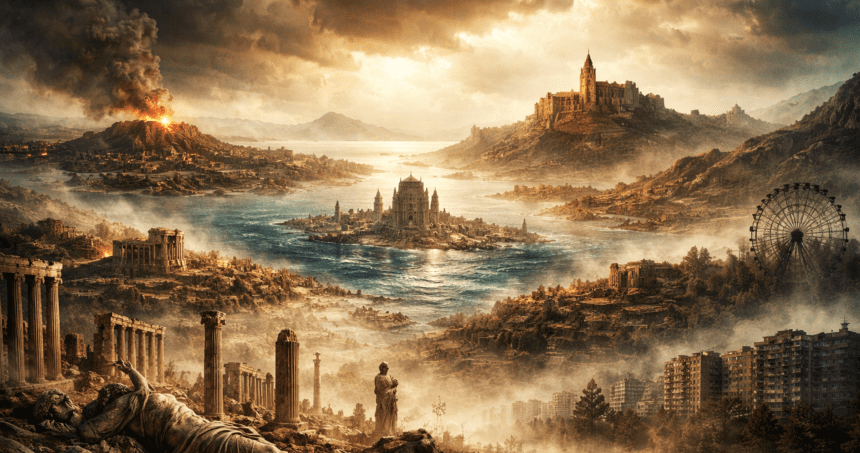
Across centuries, entire cities, cultures, and settlements have disappeared, some buried under natural disasters, others deliberately wiped out by human conflict, politics, or neglect. Historians and archaeologists continue to uncover traces of these lost places, offering glimpses into civilizations that once thrived but were later erased from collective memory. From ancient trade hubs to modern towns abandoned overnight, these stories highlight how fragile human existence can be when confronted with war, nature, and time.
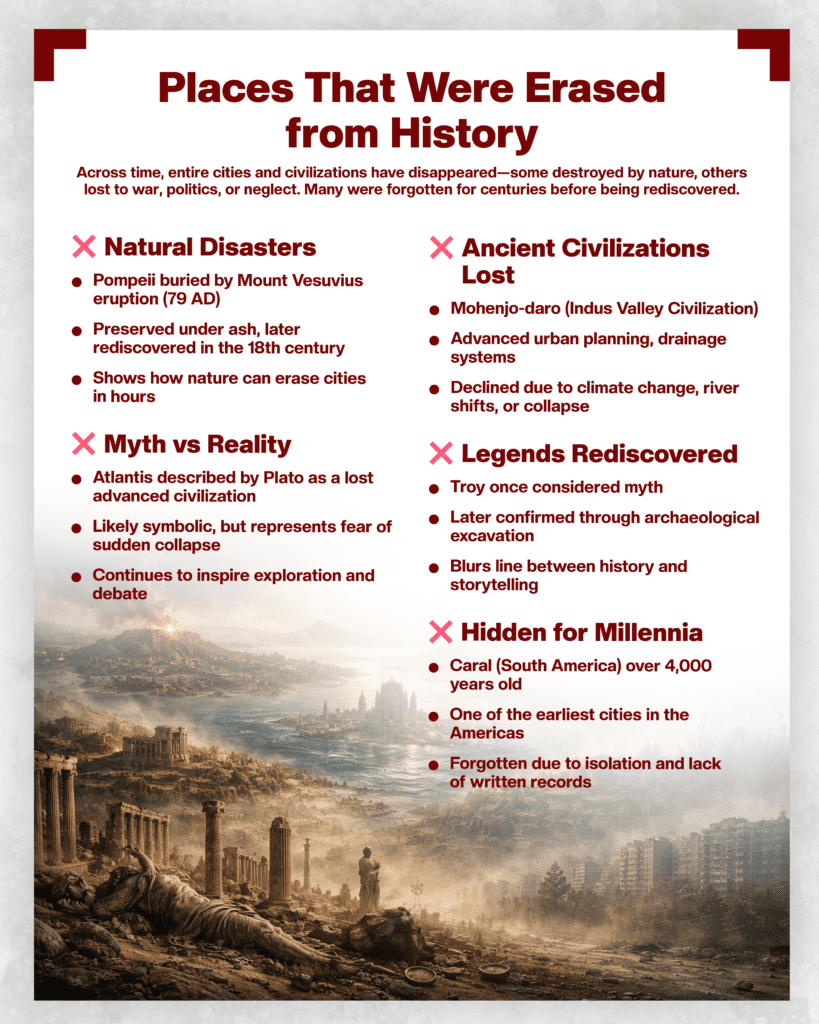
One of the most well-known examples is Pompeii, a Roman city in present-day Italy that was buried under volcanic ash when Mount Vesuvius erupted in 79 AD. The disaster preserved buildings, artifacts, and even human figures in astonishing detail, effectively freezing a moment in time. However, for centuries after the eruption, Pompeii vanished from maps and memory until it was rediscovered in the 18th century. Its disappearance was not intentional, but it demonstrates how natural forces can erase entire urban landscapes within hours.
Equally mysterious is Atlantis, a legendary civilization first described by the ancient Greek philosopher Plato. While widely regarded as a myth, Atlantis symbolizes the idea of advanced societies lost to catastrophe. Whether fictional or rooted in real events such as earthquakes or floods, the story continues to inspire exploration and debate about civilizations that may have vanished without trace.

In South Asia, Mohenjo-daro stands as a reminder of a once-flourishing urban center of the Indus Valley Civilization around 2500 BCE. Located in present-day Pakistan, the city featured advanced urban planning, drainage systems, and trade networks. Yet, its decline remains unclear, scholars suggest climate change, river shifts, or economic collapse as possible reasons. Over time, the city was abandoned and forgotten, only to be rediscovered in the early 20th century, highlighting how even sophisticated civilizations can fade into obscurity.

Another striking case is Troy, long thought to be purely mythological until archaeological excavations in modern-day Turkey revealed its remains. Immortalized in epic literature, including works attributed to Homer, Troy’s destruction is believed to have occurred around the 12th century BCE, possibly due to war. For centuries, its existence was debated, showing how history can blur into legend when physical evidence disappears.
In South America, the ancient city of Caral, dating back over 4,000 years, remained unknown to much of the world until recent archaeological work brought it to light. Despite its significance as one of the earliest known urban centers in the Americas, Caral was largely absent from historical narratives due to its remote location and lack of written records.
Not all erased places belong to ancient history. The city of Pripyat in Ukraine was evacuated overnight following the Chernobyl disaster. Once home to nearly 50,000 people, Pripyat became a ghost town, with buildings, schools, and amusement parks left frozen in time. Unlike ancient ruins, its disappearance was sudden and documented, yet it still represents how modern disasters can erase entire communities from active life.

Similarly, the medieval city of Ani, once a thriving cultural and trade hub, declined due to invasions, earthquakes, and shifting trade routes. Today, its ruins stand along the Turkish-Armenian border, largely abandoned and overshadowed by geopolitical tensions that have limited its recognition.
Experts note that places are often “erased” not only by physical destruction but also by political narratives and selective history writing. Wars, colonization, and regime changes have led to the deliberate suppression or neglect of certain cities and cultures. In many cases, rebuilding efforts or new developments overwrite older histories, making it difficult for future generations to recognize what once existed.
Archaeological advancements, satellite imaging, and global research collaborations are now helping rediscover these lost worlds. However, historians warn that many more sites may remain buried or permanently lost due to climate change, urban expansion, and looting. As the world continues to evolve, the stories of these vanished places serve as powerful reminders of humanity’s vulnerability and resilience. They challenge modern societies to preserve cultural heritage and ensure that history, no matter how fragile, is not completely erased.