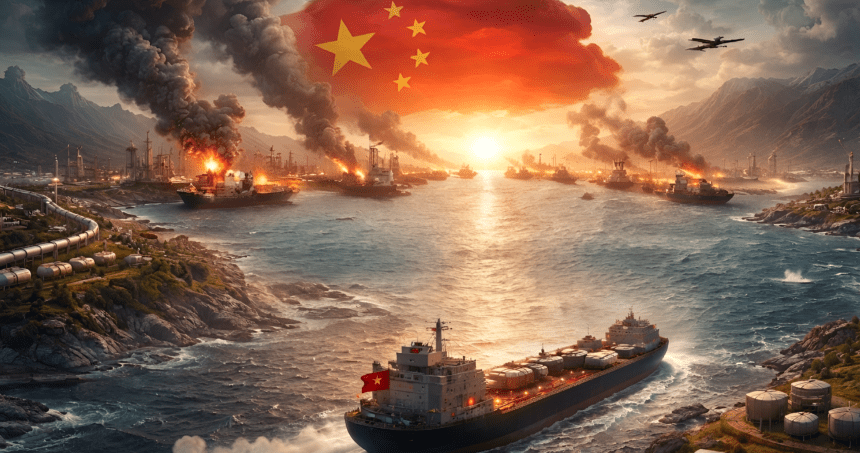
As tensions escalate in the Middle East and the strategic Strait of Hormuz faces repeated disruptions in 2026, global attention has turned to how major energy importers, particularly China, could withstand a prolonged blockade of the world’s most critical oil chokepoint. The narrow waterway between Iran and Oman carries roughly 20% of global oil and gas supplies, making it indispensable to the global economy and especially to Asia’s energy-hungry economies.
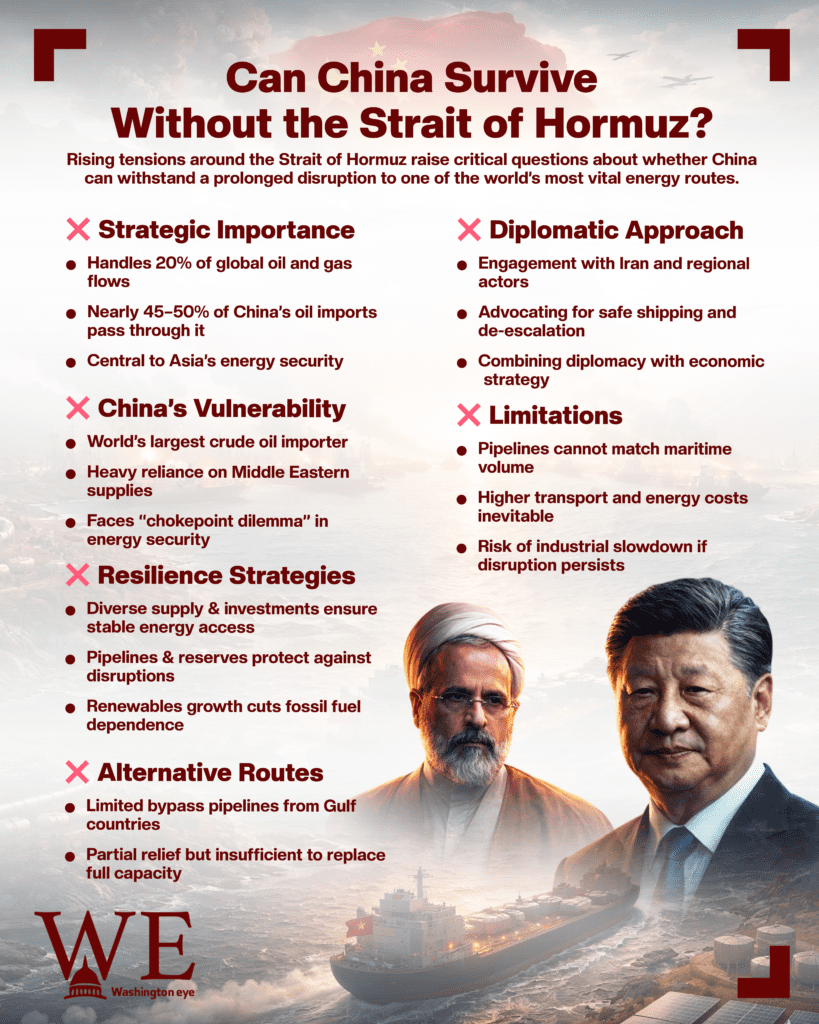
China, the world’s largest crude oil importer, is particularly exposed. Nearly 45–50% of its oil imports typically pass through the Strait of Hormuz, while over half of its crude imports originate from the Middle East. This dependency has long been viewed as a strategic vulnerability, often referred to by analysts as part of Beijing’s broader “chokepoint dilemma.” However, recent developments suggest that China may be better positioned than many assume to survive, though not without economic cost.
The current crisis, triggered by conflict involving Iran and Western powers, has already disrupted shipping and caused oil prices to surge above $100 per barrel, with traffic through the strait dropping dramatically. Despite this, Chinese state energy giant PetroChina has indicated that only about 10% of its supplies are directly affected by Hormuz disruptions, thanks to diversified sourcing strategies. This highlights a key pillar of China’s resilience: diversification.
Over the past decade, Beijing has aggressively reduced its reliance on any single energy route. A significant portion of its oil now comes from countries such as Russia, Kazakhstan, and Venezuela, many of which are connected via overland pipelines immune to maritime blockades. Pipelines from Russia and Central Asia provide a steady, geopolitically safer supply, even during maritime crises. While these pipelines cannot fully replace Middle Eastern volumes, they act as a crucial buffer.

Another critical factor is China’s strategic petroleum reserves. Estimates suggest that China holds reserves sufficient for several months of imports, around 90 to 115 days, allowing it to cushion short-term disruptions. These reserves are designed precisely for scenarios like a Hormuz blockade, enabling Beijing to stabilize domestic supply while seeking alternative sources.
China has also strengthened long-term supply contracts and investments in overseas energy assets. It maintains stakes in oil fields across Iraq, the UAE, and Africa, while simultaneously increasing imports from sanctioned or discounted sources like Russia and Iran. In 2024, nearly one-third of China’s crude imports came from countries outside the traditional Gulf suppliers, including Russia and Venezuela. This diversification reduces dependency on any single geopolitical region.
In addition, Beijing has invested heavily in renewable energy and domestic production. Although fossil fuels still dominate its industrial base, China leads the world in renewable capacity, including solar, wind, and hydroelectric power. These investments, combined with continued domestic coal production, provide a partial hedge against oil supply shocks. As a result, while industrial sectors remain vulnerable, the broader energy mix is gradually becoming more resilient.

Alternative shipping routes also offer limited relief. Gulf producers such as Saudi Arabia and the UAE have developed pipelines that bypass the Strait of Hormuz, redirecting oil to ports on the Red Sea or the Arabian Sea. However, these routes can only handle a fraction of total export volumes, meaning they cannot fully replace the strait’s capacity. For China, this means that while some oil can still reach global markets, supply constraints and higher transportation costs are inevitable.
Diplomatically, China has also pursued active engagement to keep the strait open. It has called for ceasefires, coordinated safe passage for vessels, and even engaged directly with Iran to ensure continued shipments. This reflects Beijing’s broader strategy of combining economic diversification with diplomatic risk management.
Despite these measures, experts caution that China cannot fully “escape” the impact of a prolonged Hormuz shutdown. Land-based pipelines currently supply only a fraction of China’s total demand, and no alternative infrastructure can match the scale of maritime النفط flows through the strait. A sustained disruption would likely lead to higher energy prices, industrial slowdown, and increased pressure on global supply chains.
In conclusion, China can survive without the Strait of Hormuz, but only in the short to medium term, and at a cost. Its resilience rests on a combination of diversified imports, strategic reserves, overland pipelines, renewable energy expansion, and diplomatic maneuvering. However, the strait remains a critical artery of global energy, and its prolonged closure would still reverberate across China’s economy and the wider world.