
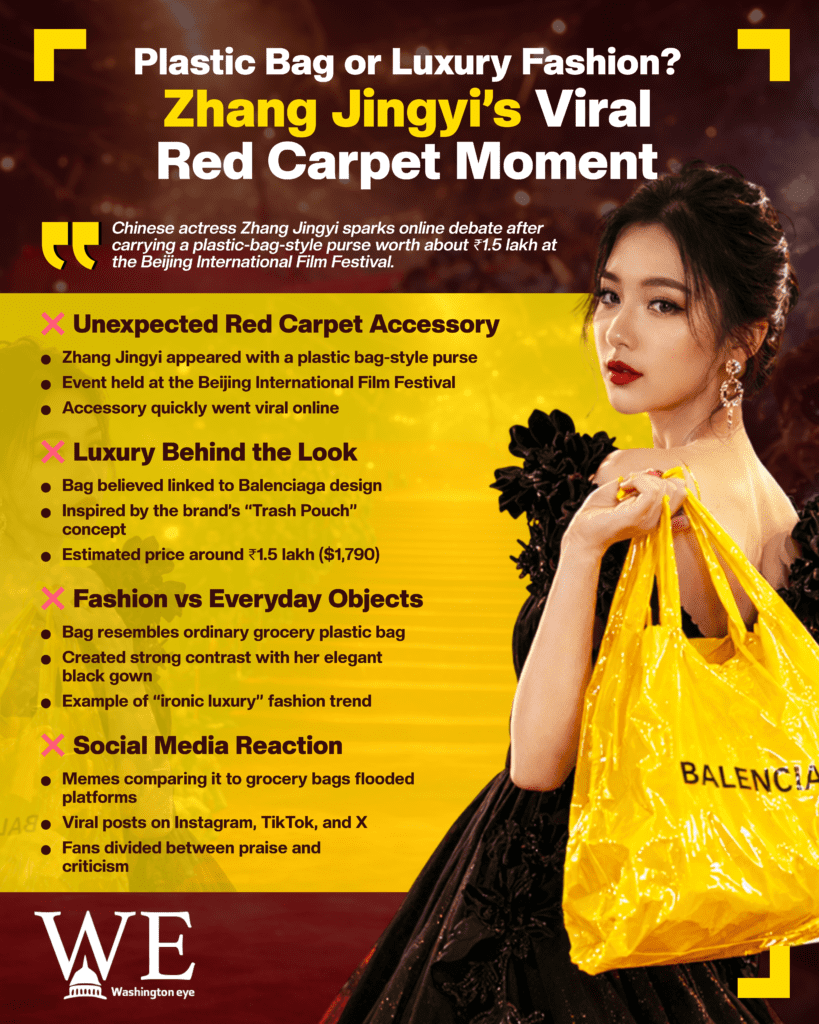
Chinese actress Zhang Jingyi sparked global conversation after appearing on the red carpet carrying what looked like a simple plastic shopping bag, an accessory many believed to be a luxury designer piece worth around ₹1.5 lakh (about US$1,790). The unusual fashion moment quickly went viral online, triggering memes, debates about luxury fashion, and widespread curiosity about the bag itself.
The surprising appearance occurred during the Beijing International Film Festival, where celebrities typically showcase glamorous couture and expensive accessories. Instead of the traditional designer clutch seen at high-profile film events, the 26-year-old actress walked the red carpet holding a yellow plastic bag-style purse. Photos and videos from the event spread rapidly across social media platforms, shifting attention away from her elegant outfit and toward the unusual accessory.
Zhang Jingyi, known for her roles in popular Chinese dramas such as Lighter and Princess and Blossoms in Adversity, is often praised for her polished style and sophisticated public appearances. On the festival’s red carpet, she wore a classic black gown decorated with delicate three-dimensional floral details on the shoulders, giving the outfit a graceful and romantic look. However, the accessory in her hand created a striking contrast. Instead of a sleek evening bag, she carried what looked like an everyday plastic grocery bag, something commonly used for shopping or even trash.

Soon after images from the event circulated online, speculation began about whether the bag was actually a luxury product. Many netizens claimed it resembled the controversial “Trash Pouch” designed by luxury fashion house Balenciaga, which intentionally mimics a garbage bag but is made from high-end materials such as calfskin leather. That designer bag reportedly sells for about US$1,790, roughly equivalent to ₹1.5 lakh, making it one of the most expensive items designed to resemble a disposable object.

The resemblance sparked widespread debate across social media platforms. Some fans applauded Zhang Jingyi’s bold fashion choice, calling it playful and creative. Others questioned the logic of luxury brands turning everyday items into expensive fashion statements. The moment reignited discussions about the modern fashion industry’s fascination with irony and viral marketing, where unusual or controversial designs often attract more attention than traditional luxury pieces.
Social media reactions were immediate and intense. Users across platforms such as X (formerly Twitter), Instagram, and TikTok began sharing memes comparing the bag to ordinary grocery or vegetable bags. One widely circulated post joked, “Zhang Jingyi flexing a $1,790 Balenciaga bag… Meanwhile the world: that’s our grocery bag.” The humorous comparisons quickly turned the accessory into a viral internet trend, with many people posting photos of their own plastic bags as “luxury fashion.”
Fashion critics also weighed in on the moment. Some described the look as a clever commentary on consumer culture and luxury branding. Others suggested the bag represented a growing trend in “meme fashion,” where designers intentionally create unconventional items designed to generate online buzz and controversy. The idea that something as ordinary as a plastic bag could become a red-carpet accessory highlighted how social media has transformed the relationship between fashion, celebrity culture, and public perception.

Despite the mixed reactions, the stunt succeeded in capturing global attention. Media outlets, fashion blogs, and entertainment platforms widely covered the moment, while images from the event continued to circulate online. For many observers, Zhang Jingyi’s red carpet appearance demonstrated how even a small detail can dominate headlines at major celebrity events.
Whether the bag was meant as a deliberate fashion statement, a playful joke, or simply an unusual accessory choice, the result was undeniable: a single plastic-bag-style purse managed to steal the spotlight from an entire red carpet. The viral moment also illustrated the growing influence of social media in shaping fashion trends, where creativity, and sometimes controversy, can turn the simplest object into a global talking point.