
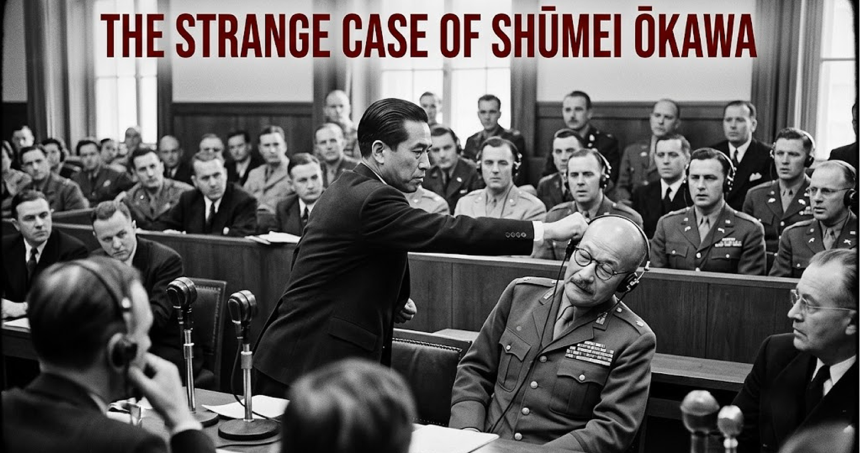
Few figures from the aftermath of World War II remain as enigmatic as Shūmei Ōkawa, a man once described by Allied prosecutors as the “Japanese Goebbels” and remembered today for one of the most bizarre moments in modern legal history. Charged as a Class-A war criminal before the International Military Tribunal for the Far East, commonly known as the Tokyo War Crimes Trial, Ōkawa stunned the courtroom with erratic behavior, including repeatedly slapping former Japanese Prime Minister Hideki Tojo on his bald head. The incident sparked a decades-long debate: was he genuinely insane, or was he cleverly avoiding justice?
Born in 1886 in Japan’s Yamagata Prefecture, Ōkawa was not a military commander but an influential political thinker, educator, and writer. He became one of the most prominent advocates of Pan-Asianism, a movement that promoted Asian unity against Western colonial powers. Critics, however, argue that his vision often served as intellectual justification for Japanese imperial expansion across Asia. Through books, speeches, and propaganda broadcasts, he helped popularize the idea that Japan was destined to lead and “liberate” Asia from Western influence. His writings gained widespread readership during the 1920s and 1930s and significantly influenced nationalist circles.
Following Japan’s defeat in World War II in 1945, Allied authorities sought to hold political and military leaders accountable for wartime aggression. Twenty-eight prominent figures were indicted as Class-A war criminals. Among them, Ōkawa stood out because he was neither a senior military officer nor a government minister. Prosecutors argued that his ideological influence helped shape the intellectual foundations of Japanese militarism and expansionism. They claimed his writings encouraged aggressive policies and fostered public support for war.

The turning point came during the opening stages of the Tokyo tribunal in 1946. While charges were being read, Ōkawa began behaving strangely. Witnesses reported that he appeared barefoot, dressed casually, shouted odd remarks, and suddenly struck Tojo on the head while shouting in German. Court officials restrained him, but he repeated the act again. At another point he reportedly declared, “This is act one of the comedy,” further convincing observers that something was seriously wrong. The courtroom spectacle quickly became international news and remains one of the most unusual incidents ever witnessed in a major war crimes tribunal.

Medical examinations were ordered to determine whether Ōkawa was competent to stand trial. U.S. Army psychiatrist Major Daniel Jaffe evaluated him and concluded that he was suffering from severe mental illness. Doctors later linked his condition to tertiary syphilis, an advanced stage of the disease that can affect the brain and cause hallucinations, confusion, and erratic behavior. Based on these findings, the tribunal ruled that he was mentally unfit to stand trial. The charges against him were dropped, making him the only Class-A defendant whose case was dismissed on those grounds.
Yet controversy never disappeared. Many contemporaries suspected that Ōkawa had exaggerated or even fabricated his symptoms to escape punishment. The timing certainly fueled speculation. Seven other major defendants, including Tojo, were eventually sentenced to death and executed, while others received lengthy prison terms. Ōkawa, by contrast, was transferred to medical facilities and later released. Historians continue to debate whether his courtroom behavior reflected genuine neurological illness or strategic performance. While medical records support the diagnosis of mental impairment caused by syphilis, skeptics point to his later ability to write and translate extensively as evidence that he may have recovered far more quickly than expected.
During his confinement in psychiatric institutions, Ōkawa turned increasingly toward religious scholarship. One of the most surprising chapters of his life was his work on a Japanese translation of the Quran. Having long been interested in Islamic civilization, he devoted considerable effort to studying Islamic texts and completed a major translation after the war. This unexpected transformation, from nationalist ideologue and war crimes suspect to translator of sacred scripture, further contributed to the mystery surrounding his legacy.

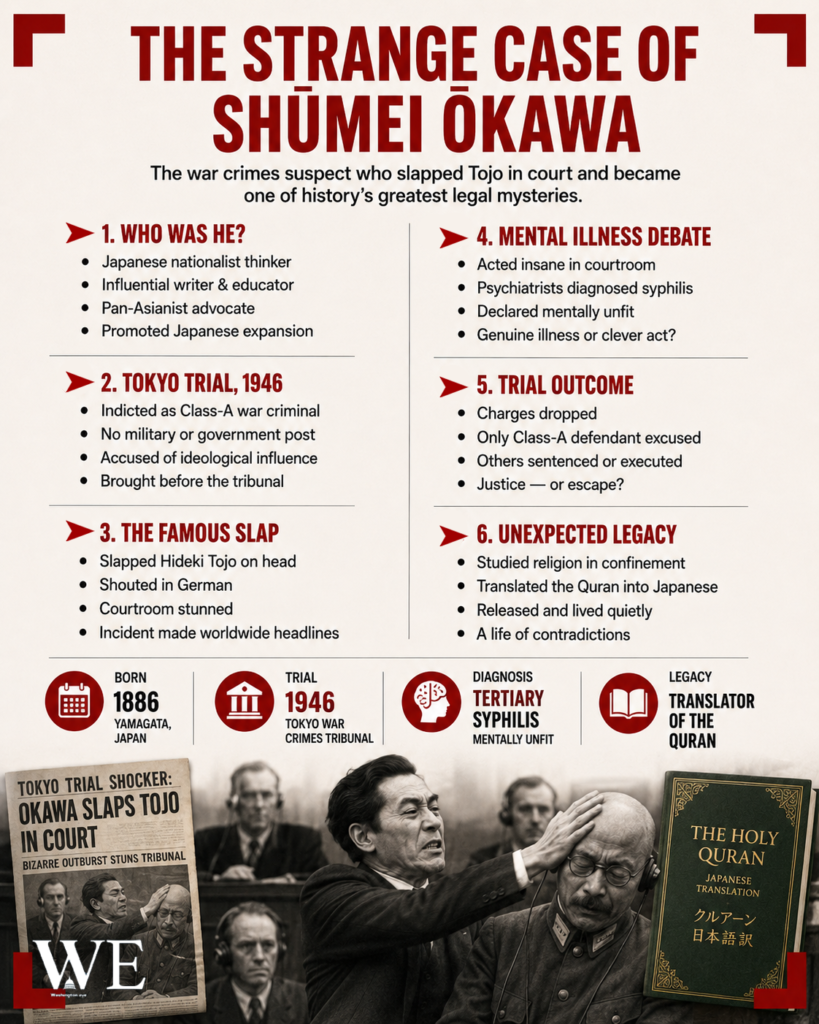
Today, the story of Shumei Ōkawa occupies a peculiar place in history. To some, he was a dangerous propagandist whose ideas helped pave the way for Japanese militarism. To others, he was a complex intellectual whose influence has been overstated. What remains undisputed is that his behavior at the Tokyo tribunal became one of the most memorable moments of the postwar reckoning with Japan’s wartime past. Eight decades later, the image of a war crimes suspect slapping the former prime minister in open court continues to fascinate historians and readers alike, symbolizing the strange intersections of ideology, justice, mental health, and history.