
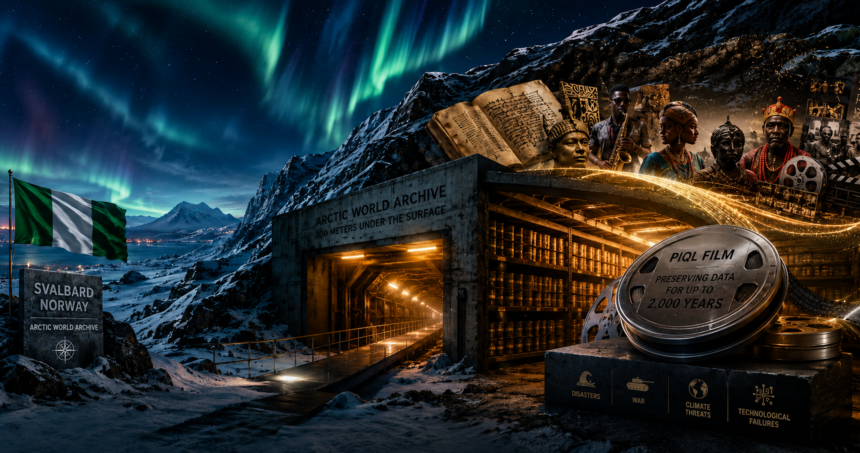
Nigeria has become the first African country to preserve parts of its cultural and historical memory inside the Arctic World Archive (AWA), a highly secure underground vault located in Svalbard, Norway, marking a symbolic and historic effort to protect African narratives for future generations. The move, announced after the February 2026 deposit ceremony, places Nigerian archives alongside some of the world’s most valuable historical records stored deep beneath the Arctic permafrost.
The Arctic World Archive is situated around 300 meters inside a decommissioned coal mine on the remote Norwegian archipelago of Svalbard, close to the North Pole. Inspired by the nearby Svalbard Global Seed Vault, often referred to as the “doomsday vault” for crops, the archive was designed to preserve humanity’s memory against disasters, technological failures, war, and climate threats. Unlike the seed vault that stores plant genetics, the Arctic World Archive protects digital and historical records encoded onto special light-sensitive film technology developed by Norwegian company Piql. The film can reportedly preserve data for up to 2,000 years without electricity or internet access.
Nigeria’s deposit included cultural, literary, artistic, and historical records collected from 12 Nigerian organizations. The archives feature manuscripts, Indigenous histories, creative industry records, memorial documents, and social research materials. Institutions involved in the project include Bloom Art, the Asaba Monument Trust, the Nsibidi Institute, and the Umuchieze Community Legacy Deposit. The initiative was led by Nigerian historian Nze Ed Emeka Keazor, who worked with Piql’s African office in Lagos to coordinate the preservation effort.

The decision to store Nigerian records in the Arctic reflects growing concerns about the fragility of archives in Africa, where many libraries, museums, and government repositories struggle with poor funding, weak preservation infrastructure, humidity damage, and digitization challenges. Historians and archivists have long warned that thousands of historical documents across the continent risk being permanently lost. According to experts involved in the project, many Nigerian public records dating back to independence in 1960 have already disappeared or deteriorated because of inadequate storage systems.

Among the preserved materials are records connected to the 1967 Asaba massacre, Indigenous governance systems from southeastern Nigeria, community oral histories, and documents related to Nigeria’s booming music and film industries. Organizers say the archive is not only about protection from physical destruction, but also about reclaiming African narratives that were historically overlooked or controlled by outside institutions.
The initiative also arrives during a period of renewed international recognition for Nigerian culture. Nigerian music, film, and literature continue to gain global influence through Afrobeats, Nollywood cinema, and contemporary African art. Supporters of the project say preserving these records in one of the world’s safest archival facilities sends a strong message about the value of African cultural memory and intellectual heritage.
Analysts describe the move as both practical and symbolic. Practically, Arctic conditions offer one of the safest environments for long-term storage because the permafrost provides naturally cold, dry, and stable conditions. Symbolically, the project places African history within a global preservation network that includes records from the Vatican Library, the European Space Agency, and major cultural institutions from dozens of countries.

The archive project also highlights growing global anxiety over digital disappearance. Researchers have warned that websites, databases, and digital records are increasingly vulnerable to cyberattacks, technological obsolescence, and data corruption. Studies cited by archive officials show that large portions of webpages created in the last decade have already vanished from the internet. In response, institutions worldwide are seeking more durable preservation methods beyond cloud storage and hard drives.
The Arctic World Archive itself was established in 2017 and has gradually expanded into a global memory vault. In 2025, the archive shifted toward a nonprofit structure to support organizations from lower-income regions that cannot afford the expensive preservation technology. UNESCO has also partnered with the initiative to help safeguard significant world heritage documents and cultural records.
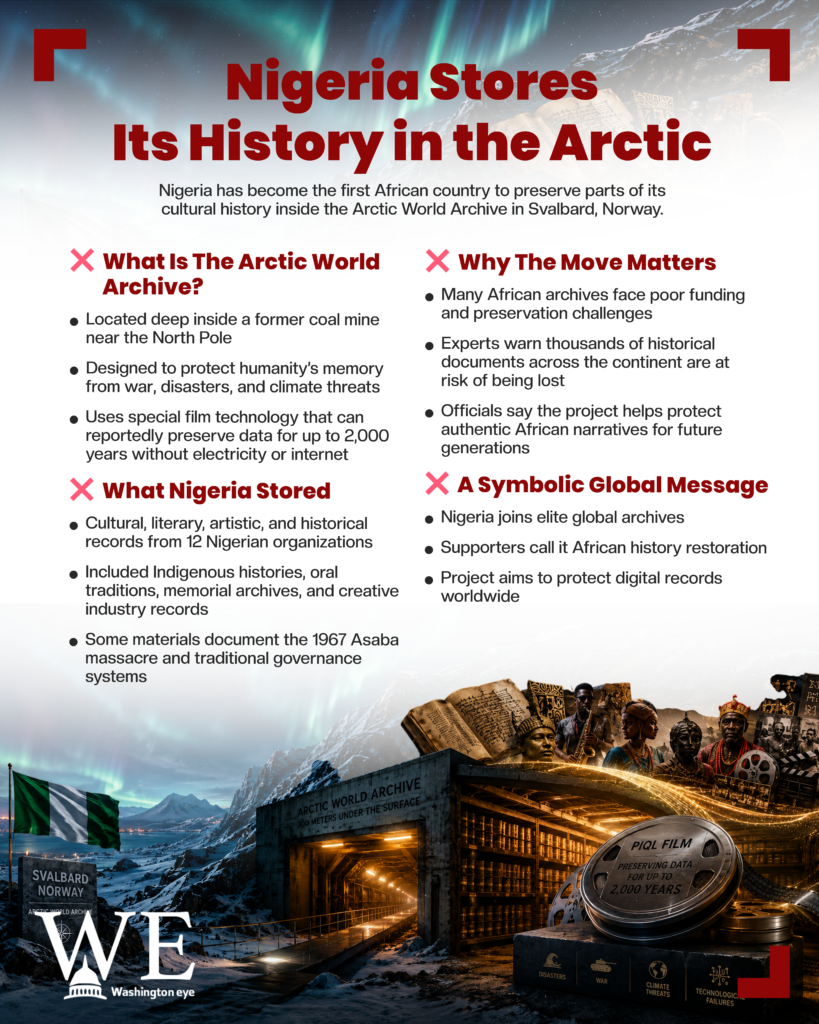
For Nigeria, the deposit represents more than archival preservation. Officials involved in the initiative described it as an act of “narrative restitution”, ensuring that future generations will have access to authentic African stories, identities, and histories regardless of future crises. As climate change, conflict, and technological instability continue to threaten records worldwide, Nigeria’s Arctic deposit has become a landmark moment in the global effort to preserve cultural memory.