For decades, the question of whether life exists on Mars has fascinated scientists, researchers and the public alike. Often referred to as the “Red Planet,” Mars has long been considered one of the most promising places in the solar system to search for signs of life beyond Earth. While no confirmed evidence of living organisms has yet been discovered, recent scientific missions and discoveries have revived debate over whether life on Mars is merely a myth or a potential reality waiting to be uncovered.
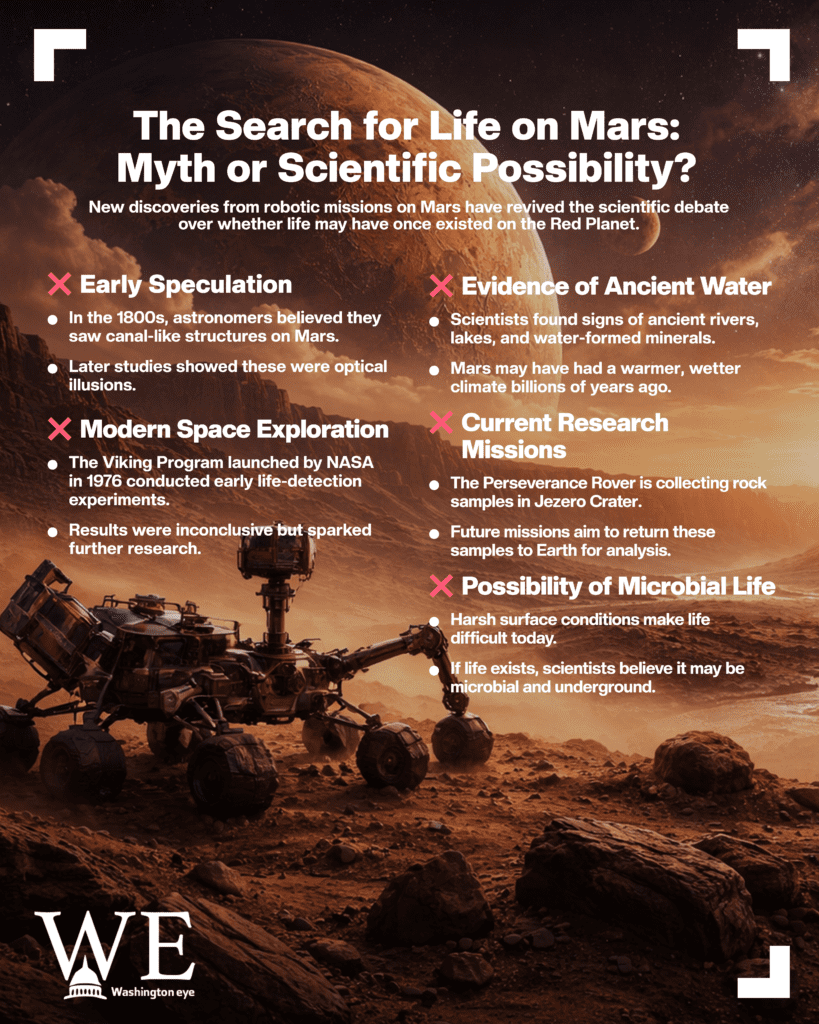
The search for life on Mars dates back more than a century. In the late 1800s, astronomers believed they had observed canal-like structures on the planet’s surface, leading to speculation that intelligent civilizations might exist there. Although later observations proved these claims to be optical illusions, the idea of Martian life captured the public imagination and became a popular theme in science fiction and media. Today, however, the question is no longer based on speculation alone but on scientific exploration and data gathered through advanced space missions.
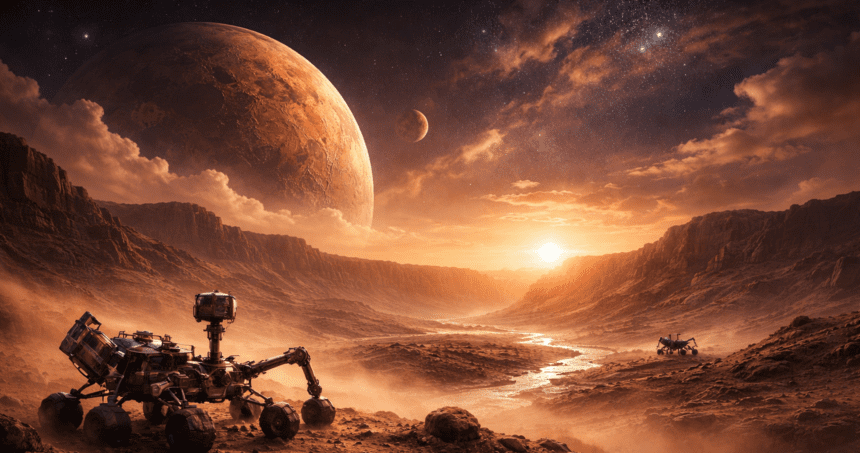
Modern research on Mars began in earnest during the 20th century when space agencies started sending robotic spacecraft to explore the planet. NASA’s Viking missions in 1976 were among the first to conduct experiments designed to detect biological activity in Martian soil. While the results were inconclusive, they opened the door for further exploration. Since then, several missions, including NASA’s Curiosity rover and the Perseverance rover, have been exploring the planet’s surface to analyze soil, rocks and atmospheric conditions.

One of the key reasons scientists believe Mars could have supported life in the past is evidence that liquid water once existed there. Data from orbiters and rovers show signs of ancient river valleys, lake beds and minerals that typically form in the presence of water. Scientists believe that billions of years ago, Mars had a warmer and wetter climate, conditions that may have been suitable for microbial life. The discovery of frozen water beneath the planet’s surface and occasional methane emissions in the Martian atmosphere has further strengthened the possibility that biological processes may once have occurred there.

Recent missions have intensified the search for biosignatures, chemical or physical traces that could indicate past or present life. NASA’s Perseverance rover, which landed on Mars in 2021 in the Jezero Crater, is currently collecting rock samples believed to contain ancient sediment deposits from a long-vanished lake. Scientists hope that future missions will return these samples to Earth for detailed laboratory analysis. If signs of ancient microbes are found in these samples, it could be one of the most significant discoveries in human history.
However, many scientists caution that evidence of life on Mars remains unconfirmed. The harsh conditions on the planet, including extremely low temperatures, high radiation levels and a thin atmosphere, make it difficult for life as we know it to survive on the surface today. Some researchers suggest that if life does exist, it is more likely to be microbial and possibly hidden beneath the planet’s surface where conditions may be more stable.
Beyond scientific research, the idea of alien life on Mars has also captured the imagination of millions of people around the world. Popular culture, films and conspiracy theories often depict Mars as home to advanced extraterrestrial civilizations. Scientists, however, emphasize that there is currently no evidence to support such claims. The focus of modern exploration is primarily on microscopic life rather than intelligent alien beings.

International space agencies, including NASA, the European Space Agency (ESA) and other global partners, are continuing to invest heavily in Mars exploration. Planned missions aim to return samples to Earth and send more sophisticated instruments capable of detecting even the smallest biological signatures. Some scientists also believe that future human missions to Mars could provide new insights into the planet’s geological and biological history.
The search for life on Mars remains one of the most important scientific quests of the 21st century. Discovering even simple microbial life would fundamentally change humanity’s understanding of life in the universe and our place within it. For now, life on Mars remains an open question, balanced between myth and possible reality. As technology advances and exploration continues, scientists hope that the answer may finally emerge in the coming decades.