Imagine the world’s richest person dies tomorrow, leaving behind hundreds of billions of dollars, but no children. Who gets the money? It sounds like a simple inheritance question, but for the ultra-wealthy, the answer can involve wills, spouses, relatives, trusts, charities, tax authorities and even the ownership structures of some of the world’s largest companies.
The first misconception is that a billionaire’s fortune simply passes to their children. Children are common beneficiaries of estates, but they are not automatically the only people who can inherit wealth. And if there are no children, billions of dollars do not simply disappear. Much depends on one crucial question: Did the person leave a valid estate plan?
Who Gets the Money?
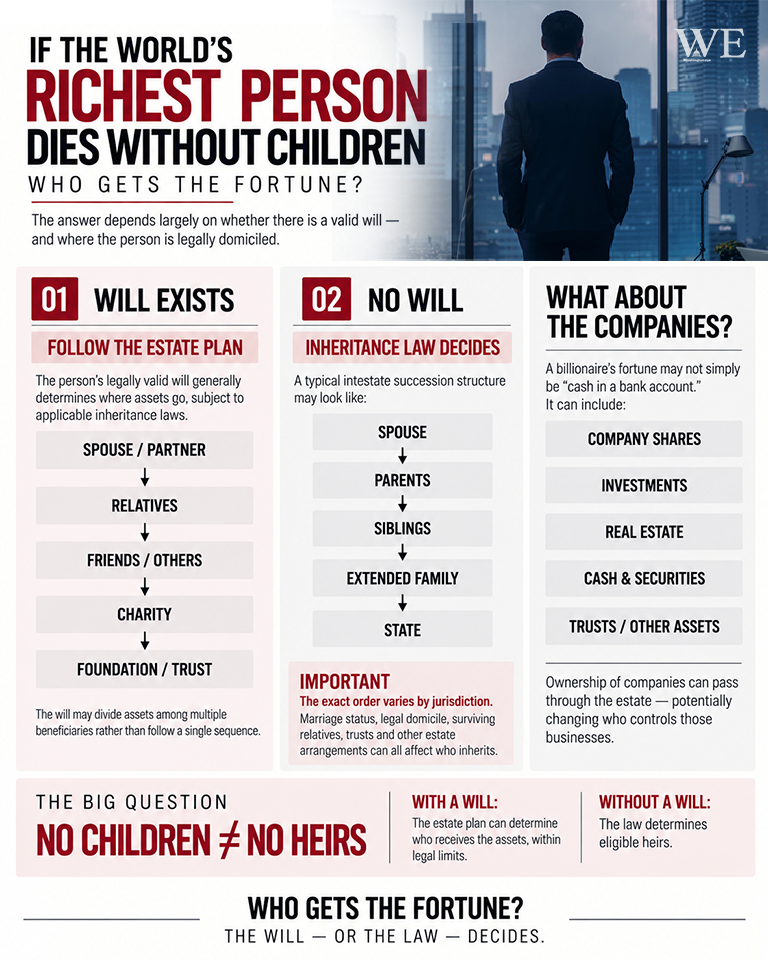
If a wealthy person has a valid will, their assets are generally distributed according to that document, subject to the inheritance and family-protection laws of the relevant jurisdiction. That means a billionaire without children could leave wealth to a spouse or partner, siblings, nieces and nephews, friends, employees, universities, foundations, charities or almost anyone else permitted under local law.
But the fortunes of the super-rich are rarely sitting in a bank account waiting to be divided. Most billionaire wealth consists of assets such as company shares, private businesses, investment portfolios, property, intellectual property, art and other holdings. Elon Musk’s wealth, for example, is heavily connected to his stakes in companies rather than existing as hundreds of billions of dollars in cash. The same principle applies to many of the world’s wealthiest entrepreneurs.

This means that when a billionaire dies, the process is not simply a giant transfer of cash. Executors and trustees must determine what the person owned, how those assets were structured, what debts and taxes apply and who legally receives control. For major shareholders, inheritance can even affect corporate power. If a founder owns a large stake in a public company, their death may raise questions over who receives those shares and whether voting control changes.
What If There Is No Will?
Things become more complicated if the person dies intestate, meaning without a legally valid will. In that situation, the inheritance laws of the country or jurisdiction generally determine who receives the estate. The precise rules vary considerably, but surviving spouses and close relatives are commonly given priority. If there are no children, a spouse may receive some or all of the estate depending on local law. If there is no spouse, inheritance may move through other family relationships, potentially including parents, siblings and more distant relatives.

If absolutely no legally recognised heir can be found, the remaining estate can eventually pass to the state under rules often described as escheat or, in some jurisdictions, bona vacantia. For a multibillionaire, however, reaching that point would be unusual. People with enormous fortunes normally use teams of lawyers, accountants and wealth advisers to establish detailed succession plans long before death. And a will may represent only one part of that planning.
Trusts, Charity and the Billionaire Legacy
The ultra-rich frequently use trusts, foundations and other legal structures to determine how wealth will be managed over decades or even generations. A trust can potentially hold assets and distribute them according to predetermined conditions. Instead of handing billions directly to one beneficiary, a wealthy individual might arrange for funds to support relatives, charitable projects or institutions over many years.
Philanthropy can become especially important when there are no direct descendants. Some of the world’s richest people have already promised to give away large portions of their fortunes. The Giving Pledge, launched by Bill Gates, Melinda French Gates and Warren Buffett in 2010, encourages billionaires to commit the majority of their wealth to charitable causes during their lifetimes or through their wills.
Buffett has repeatedly indicated that the overwhelming majority of his wealth is intended for philanthropy rather than becoming a vast dynastic inheritance. Taxes can also play an enormous role. Depending on where the deceased lived, where assets are located and who inherits them, an estate may face inheritance or estate taxes. Different countries treat enormous estates very differently, meaning geography can substantially change the final outcome.
The absence of children, therefore, does not leave a billionaire fortune ownerless. Instead, death can transform personal wealth into something else: family inheritance, charitable endowments, foundations, new corporate ownership or, in rare circumstances, property claimed by the state. For ordinary families, inheritance often concerns a home, savings and personal possessions.
For the world’s richest individuals, succession can involve billions of dollars, international legal structures and stakes in companies employing thousands of people. So if the richest person in the world died without children, the real question would not be “Where does the money go?” It would be: “What did they decide should happen to it, and what does the law say if they never decided?”