

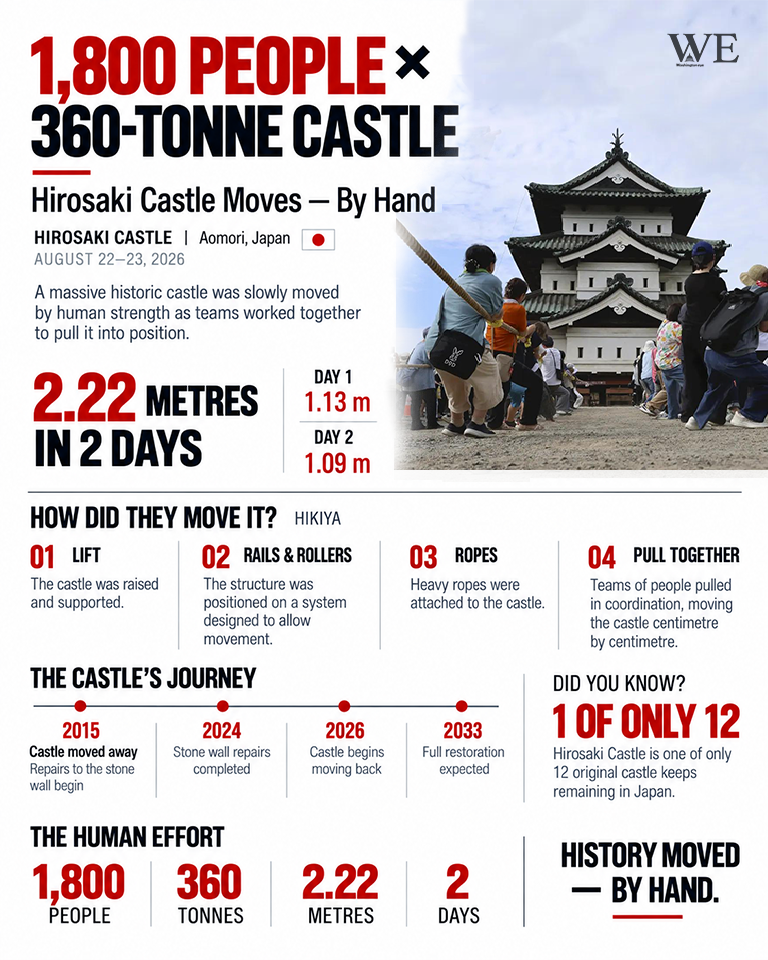
In an extraordinary combination of human strength, traditional engineering and historic preservation, around 1,800 people have helped move a centuries-old Japanese castle tower by hand, pulling the massive structure with ropes as it slowly travelled towards its original location. The unusual operation took place on August 22 and 23 at Hirosaki Castle in Aomori Prefecture, northern Japan.
Instead of relying entirely on cranes or other modern heavy machinery, groups of volunteers grabbed long ropes and collectively pulled the castle keep, which weighs around 360 tonnes. Over the two days, the historic structure travelled 1.13 metres on Saturday and another 1.09 metres on Sunday, a total of 2.22 metres. Although the distance may sound small, moving an entire centuries-old building intact was a remarkable feat. The event formed part of a much larger restoration project that has been underway for more than a decade.
Why Was an Entire Castle Being Moved?

Hirosaki Castle has stood as one of northern Japan’s most important historic landmarks for centuries. The original castle was completed in 1611 as the seat of the Tsugaru clan, although its original five-storey keep was destroyed after a lightning strike in 1627. The present three-storey keep was rebuilt in the early 19th century. Today, it is particularly valuable because it is one of only 12 surviving original castle keeps in Japan and the only one remaining from the Edo period in the country’s northeastern Tohoku region.
But the structure faced a serious preservation problem. A major earthquake in 1983 had damaged part of the stone wall supporting the castle. Authorities eventually launched an extensive project to repair and reconstruct the foundation. There was one major obstacle: the castle itself was standing on top of it.

In 2015, engineers therefore moved the entire keep roughly 78 metres from its original position so restoration teams could access the stone walls underneath. Rather than dismantling the nationally protected structure, they used a traditional Japanese building-moving technique known as hikiya. After years of work, all 2,185 stones in the damaged wall were carefully returned to their original positions, with the reconstruction completed in 2024. The challenge now is to bring the castle home.
Ropes, Rollers and 1,800 Volunteers
The hikiya technique allows an entire structure to be moved while keeping the building intact. The castle is supported on rails and rollers, allowing it to move gradually as force is applied. During the August event, teams of roughly 80 volunteers took turns pulling on ropes approximately 30 metres long. It was not simply a matter of finding enough people willing to help. The opportunity proved so popular that organisers reportedly received around 8,000 applications for just 1,800 places over the two main days.

Applications came not only from Hirosaki and elsewhere in Japan, but also from overseas, including Southeast Asia, Europe and North America. Some participants had even helped move the castle in 2015 and returned more than a decade later to help pull it back. The public event was designed to make local people part of the preservation process while demonstrating a traditional technique that was once used to relocate Japanese buildings. The 2015 operation had been the first time in around a century that the hikiya technique was used to move a Japanese castle.
A Five-Metre Human Effort, Then Machines Take Over
Despite the striking sight of hundreds of people pulling ropes, human strength will account for only a small part of the castle’s journey. Around 4,100 participants were expected to take part across the wider August programme, manually shifting the keep a total of approximately five metres.
Modern machinery will handle the remaining journey of around 73 metres, with the keep expected to return to its original position by the end of 2026. The restoration itself, however, is far from finished. Further preservation work is expected to continue for several years, and the castle is not expected to fully reopen until around 2033.
The project highlights Japan’s unusual combination of modern engineering and traditional preservation. Instead of demolishing, dismantling or replacing the historic tower, authorities have chosen the far more complicated task of moving the building intact, repairing what lies beneath it and then returning it. For the thousands who applied to take part, however, the project offered something even simpler: the rare opportunity to say they had helped move a castle with their own hands.