
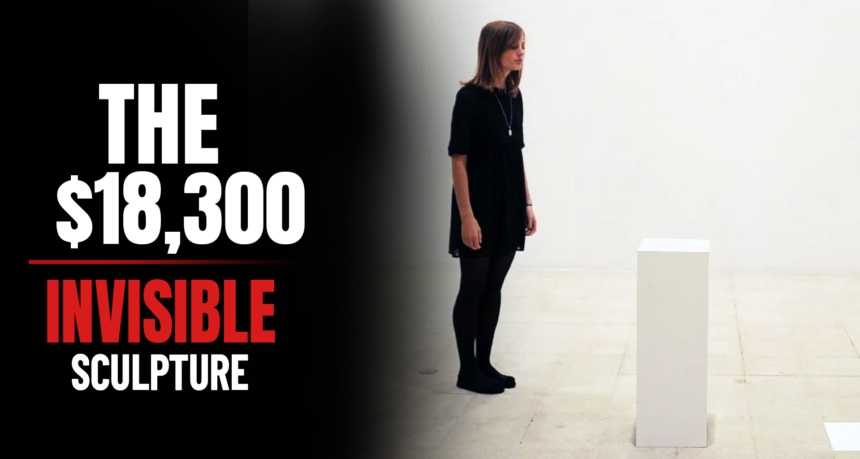
An invisible sculpture created by Italian artist Salvatore Garau was sold for €15,000 (approximately $18,300) at an auction in Milan in May 2021, attracting international attention and sparking debate over what constitutes art. The unusual artwork, titled Io Sono, meaning “I Am” in English, has no physical form, leaving its existence entirely to the imagination of the viewer.
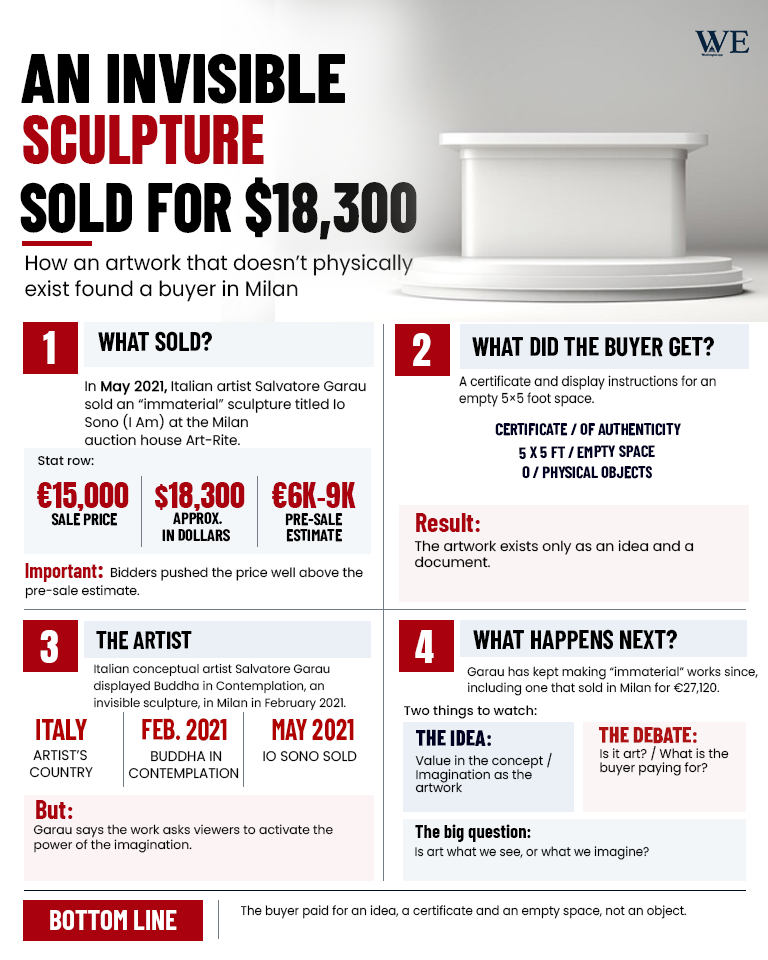
The sculpture was auctioned through the Italian auction house Art-Rite, where it was initially expected to fetch between €6,000 and €9,000. However, competitive bidding pushed the final price to €15,000, significantly exceeding its estimated value. Unlike conventional sculptures made from marble, bronze, wood or other materials, Garau’s creation consists of an empty space, with no visible object to display.
The unidentified buyer received a signed certificate of authenticity confirming ownership of the artwork, along with specific instructions for its exhibition. According to the artist, the sculpture must be displayed in an unobstructed area measuring approximately five feet by five feet, preferably inside a private residence. Since the artwork has no physical form, it requires neither special lighting nor climate-controlled conditions.

Garau, who was 67 at the time of the sale, defended his unconventional creation by explaining that the sculpture represents energy, imagination and the philosophical significance of emptiness. He argued that an apparently empty space is not necessarily devoid of meaning or existence. Referring to the Heisenberg uncertainty principle in quantum physics, Garau suggested that even a vacuum contains energy and therefore should not be regarded as absolute nothingness. His interpretation, however, is an artistic and philosophical argument rather than scientific proof that an invisible sculpture physically exists.

For Garau, the value of the artwork lies not in a tangible object but in the thoughts and emotions it generates. The artist believes that imagination allows people to experience something beyond the limits of physical observation, transforming an empty space into a meaningful artistic expression. The sale also brought renewed attention to conceptual art, a movement in which ideas and intellectual meaning often take precedence over physical appearance or craftsmanship. Rather than focusing on the materials used to create an artwork, conceptual artists challenge audiences to consider the significance of the idea behind it.
Garau had previously presented another invisible sculpture, titled Buddha in Contemplation, in February 2021 at Piazza della Scala in Milan. The installation consisted of an empty square marked with tape on a cobblestone walkway, indicating the space supposedly occupied by the artwork. He subsequently introduced another immaterial installation, Afrodite Piange (Aphrodite Cries), outside the New York Stock Exchange. The installation was represented by a white circle on the ground and received support from the Italian Cultural Institute.
These projects formed part of Garau’s broader exploration of immaterial art, through which he sought to challenge the relationship between physical objects, human perception and artistic expression. The $18,300 sale generated widespread reactions across social media, with some observers questioning why anyone would pay thousands of dollars for something that cannot be seen, touched or physically possessed. Others viewed the transaction as an example of how artistic value can emerge from ideas, symbolism and the reputation of an artist rather than material substance.

The controversy also raised broader questions about the commercialisation of contemporary art and the role of auction houses, collectors and certificates of authenticity in determining monetary value. While traditional artworks can be evaluated partly through their materials, craftsmanship and historical significance, conceptual creations frequently depend on intellectual interpretation and the willingness of audiences to engage with unconventional ideas.
The incident also reflected growing discussions about intangible ownership in the art market, particularly during a period when non-fungible tokens, or NFTs, were attracting considerable attention. Although Garau’s sculpture was not an NFT, both phenomena challenged established assumptions about what collectors can purchase and own. Garau continued exploring immaterial art in subsequent years, including another invisible work, Davanti a te, which sold for €27,120, according to later reporting by Artnet.
More than five years after the original auction, the sale of Io Sono remains a striking example of the evolving boundaries of contemporary art. Whether regarded as an imaginative artistic statement or an extravagant commercial transaction, the invisible sculpture demonstrates how an idea alone can command a substantial price in the international art market.