
From overcrowded cells holding several times their intended capacity to Scandinavian facilities designed around rehabilitation and eventual return to society, prisons around the world reveal dramatically different ideas about crime, punishment and justice.
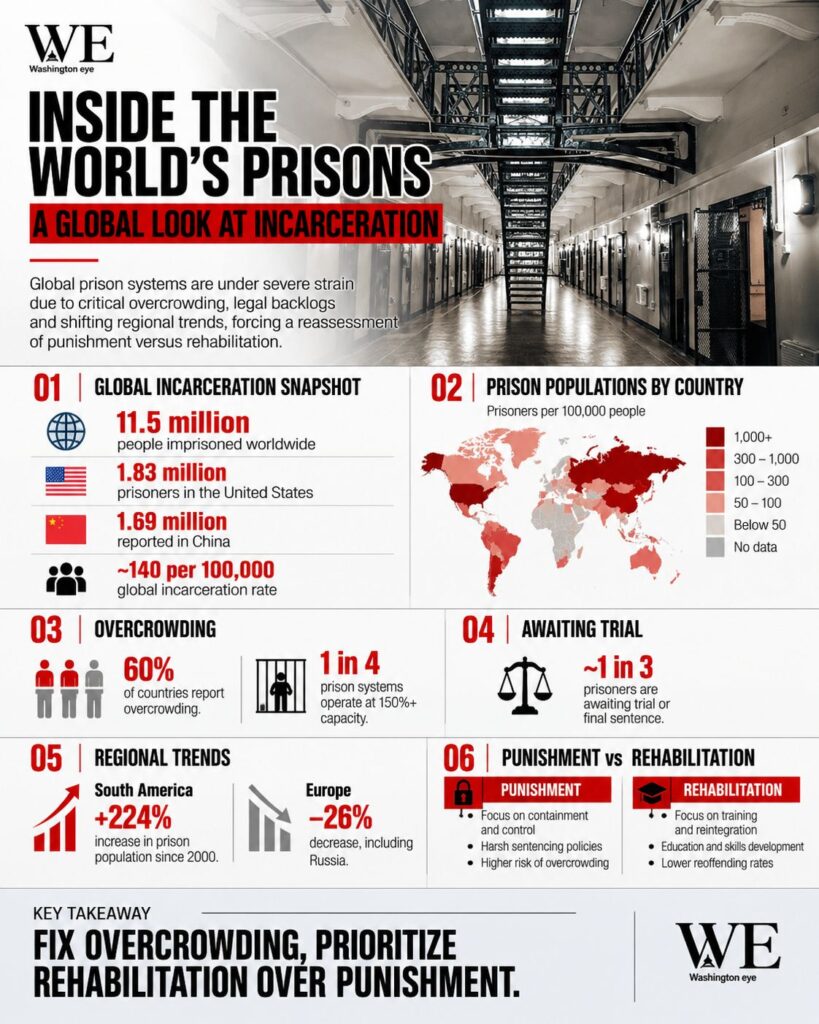
An estimated 11.5 million people are imprisoned worldwide, according to the latest comprehensive World Prison Population List from the Institute for Crime & Justice Policy Research (ICPR). Published national figures account for about 11 million people, but researchers estimate the real total is higher when people believed to be held in detention centres in China and prison camps in North Korea are included.
The scale is enormous, but imprisonment is far from evenly distributed. The latest World Prison Brief database lists the United States as having the world’s largest reported prison population, at about 1.83 million, followed by China at approximately 1.69 million.

The 2024 global comparison also recorded almost 840,000 prisoners in Brazil, 573,000 in India and more than 433,000 in Russia, although prison populations change continuously and countries report their statistics at different times.

From Mass Incarceration to Rehabilitation
Raw prisoner numbers tell only part of the story. A more revealing measure is the incarceration rate, the number of prisoners for every 100,000 people. The 2024 World Prison Population List put the global average at approximately 140 prisoners per 100,000 people. At that time, El Salvador recorded the world’s highest national rate at 1,086 per 100,000, followed by Cuba at 794 and Rwanda at 637. The United States recorded 531. These rankings can shift as newer national figures become available; for example, Rwanda’s latest World Prison Brief entry reports a lower rate of 489 based on August 2025 data.
El Salvador illustrates one of the most controversial approaches to incarceration. Its prison population expanded dramatically following the government’s sweeping anti-gang crackdown, under which large numbers of suspected gang members were detained. Supporters point to the country’s dramatic reduction in violence, while human-rights organisations have raised concerns about arbitrary detention, due process and conditions inside detention facilities.
Elsewhere, prison philosophy can look markedly different. Countries including Norway have become internationally associated with a rehabilitation-focused approach in which incarceration removes a person’s liberty but attempts to preserve other aspects of ordinary life. Education, employment, mental-health support and preparation for release play substantial roles in such systems.

These contrasting models reflect one of the oldest arguments surrounding imprisonment: should prisons primarily punish offenders, protect society, deter future crime or rehabilitate people so they are less likely to offend again? Most modern systems attempt some combination, but the balance differs dramatically between countries.
Overcrowding: A Global Prison Crisis
Perhaps the most immediate international problem is not prison architecture or philosophy but overcrowding. A 2024 United Nations Office on Drugs and Crime analysis found that prisons were operating at or above their official capacity in around 60% of countries with available data. Approximately one in four countries was operating at more than 150% of intended national prison capacity.
The situation was particularly serious in Africa and the Americas, where more than 70% of countries with available data reported prison systems exceeding their planned capacity. Overcrowding can turn incarceration into a wider health and human-rights problem. Too many prisoners competing for limited space can strain sanitation, healthcare, food provision, staff and rehabilitation programmes. Violence and infectious diseases can also become harder to control.
Another striking issue is that many prisoners have not yet been convicted. Around one-third of the world’s prison population consists of people in pre-trial detention or awaiting a final sentence, according to the World Prison Brief. Lengthy court delays can therefore contribute directly to overcrowding.
The Global Prison Population Keeps Growing
Despite criminal-justice reforms in some countries, the long-term global trend remains upward. Since 2000, South America’s prison population has increased by approximately 224%, while Western Asia’s has risen by 141% and Oceania’s by 84%, according to ICPR’s 2024 comparison.
The United States has moved in the opposite direction from its historical peak. Its incarceration rate exceeded 750 prisoners per 100,000 during the 2000s, while the 2024 international comparison placed it at 531. More than half a million fewer people were imprisoned than during the country’s 2006–08 peak period.
Europe is also unusual. Its overall prison population declined by 26% between 2000 and the latest 2024 comparison, driven heavily by large reductions in Russia and Central and Eastern Europe. Excluding Russia, however, Europe’s prison population actually increased by 12%.
Critical View: Do More Prisons Make Societies Safer?
The extraordinary differences between countries demonstrate that incarceration levels are shaped not simply by crime rates but also by laws, sentencing policies, policing practices, drug policies, use of pre-trial detention and political decisions.
Imprisonment remains necessary for people who pose serious threats to public safety, but critics argue that excessive incarceration can create another set of problems. Prisons are expensive to operate, overcrowding can undermine rehabilitation, and incarceration can disrupt employment, education and family relationships.
ICPR researchers argue that overuse of imprisonment imposes substantial public costs and can disproportionately affect poor and marginalised populations. Alternatives including probation, community sentences, treatment programmes and electronic monitoring are therefore increasingly debated for selected non-violent offenders, while imprisonment remains available for serious crimes.
The central challenge is ultimately what happens after the prison gate closes. A prison system can remove dangerous people from society temporarily. But because most prisoners will eventually be released, rehabilitation, education, addiction treatment, employment skills and successful reintegration also become questions of public safety.
With more than 11 million people currently behind bars and overcrowding affecting most national prison systems for which data are available, the global debate is shifting beyond how many people societies imprison. The harder question is increasingly what prisons are supposed to achieve, punishment alone, or a safer society after prisoners eventually return to it.