
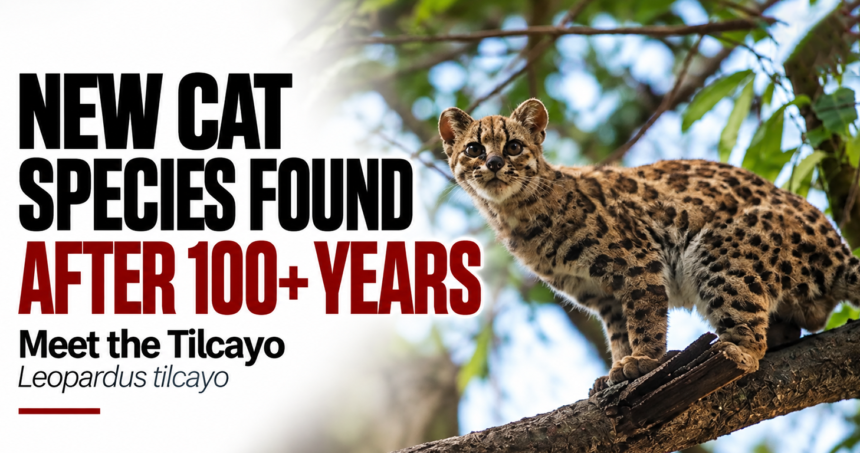
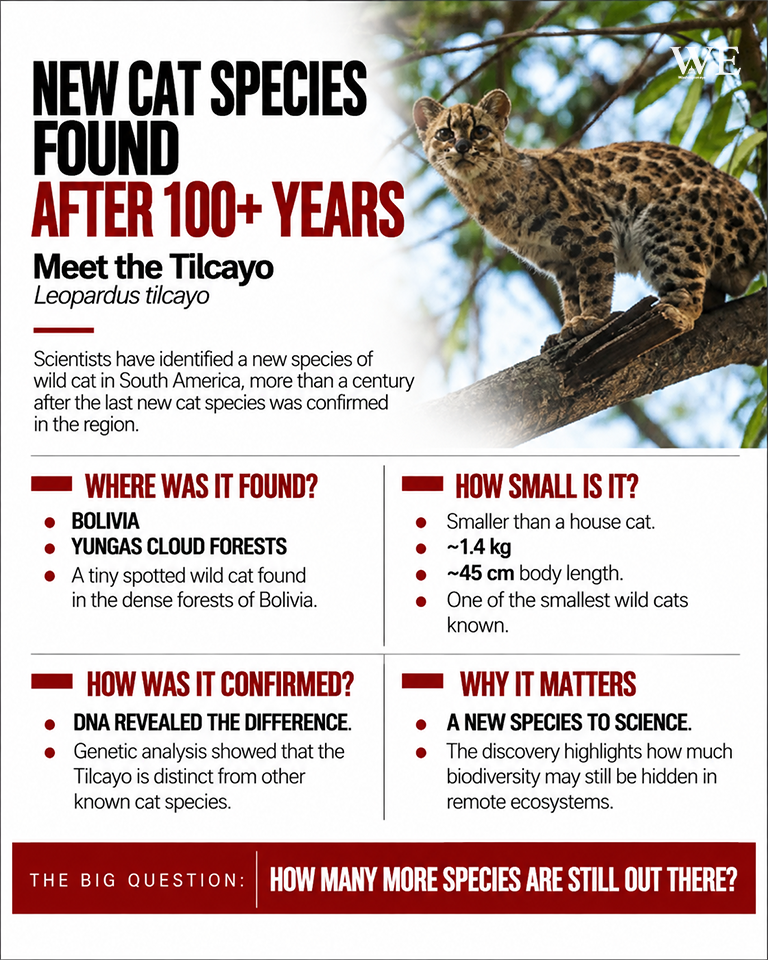
Scientists have identified a new species of wild cat in Bolivia, marking the first time in more than a century that a completely new living feline species has been formally described by science. Named Leopardus tilcayo, the tiny spotted cat lives in the cloud forests of Bolivia’s Yungas region and is smaller than an average domestic cat.
The discovery, announced in September 2026 following research published in the scientific journal Current Biology, has attracted international attention not only because of the animal’s appearance but also because of its rarity. The last comparable description of a new living cat species dates back more than 100 years, with the pampas cat described in 1923.
The tilcayo has been known to local communities for generations, but scientists had previously assumed cats of its appearance belonged to other South American tiger-cat species. Advanced genetic analysis has now shown that it represents its own distinct evolutionary lineage.

From a “Strange Cat” to a New Species
The story behind the discovery began nearly a decade ago. Bolivian biologist and National Geographic Explorer Paola Nogales-Ascarrunz encountered an unusual small cat after it was taken to the Senda Verde Wildlife Sanctuary in Bolivia.

The animal, now known as Tigrino, had reportedly been found as a kitten near a forest and was initially taken home by a local family who believed it might be an unusual domestic cat. After living with the animal for about a year, however, it became apparent that it was a wild feline, and it was eventually transferred to the sanctuary.
Tigrino immediately attracted scientific attention. He had a small face, short rounded ears, long whiskers and a light-brown coat covered in distinctive dark rosettes resembling the markings of a miniature leopard. The cat measures roughly 18 inches, or about 45 centimetres, in body length and weighs around three pounds, or 1.4 kilograms, making it smaller than many household cats.
Initially, researchers believed the animal was related to the known tiger cat Leopardus tigrinus. But differences in its markings raised questions. Scientists eventually carried out extensive genetic investigations involving samples from dozens of cats from different parts of South America.

The results revealed something unexpected: what had previously been treated as closely related tiger-cat populations actually contained several genetically distinct lineages. The Bolivian cat was sufficiently different to be classified as a new species, Leopardus tilcayo. Genetic evidence indicates that its lineage separated from its closest relatives about 1.4 million years ago. The name “tilcayo” was chosen because it is the name traditionally used for the animal by communities in the Bolivian Yungas, giving local knowledge a place in its formal scientific identity.
Where Does the Tilcayo Live?
The newly identified species is associated with the Yungas cloud forests, a mountainous and biologically rich region running along the eastern slopes of the Andes. The landscape forms a transition between high-altitude Andean environments and the Amazon basin and contains an extraordinary variety of plants and animals.
So far, Leopardus tilcayo has been genetically confirmed in Bolivia. Scientists still do not know how many tilcayos exist in the wild, how large their geographical range is, or many basic details about their behaviour, diet and reproduction.
That uncertainty is one of the most important aspects of the discovery. Recognising an animal as a separate species can dramatically change how scientists assess its conservation needs. A population previously considered part of a widespread species may turn out to be a much smaller and more vulnerable species restricted to one particular ecosystem.
Discovery Brings Conservation Concerns
The excitement surrounding the tilcayo has therefore been accompanied by concern about the future of its habitat. Bolivia’s Yungas forests face pressures including deforestation, agricultural expansion, forest fires and mining activities. Destruction or fragmentation of these forests could pose a particularly serious threat if the new cat has only a small natural range.
Researchers have shared their findings with the International Union for Conservation of Nature, which could eventually help determine how the newly recognised species should be assessed for conservation purposes. The discovery also highlights the importance of genetic science in modern wildlife research. Animals that look almost identical can sometimes represent different species whose evolutionary histories remained hidden until their DNA was examined.
For the public, meanwhile, Tigrino has become an unexpected wildlife attraction. Interest in the tiny cat has reportedly increased visits to the sanctuary where he lives. Staff have also taken precautions because the animal is naturally shy and can become stressed by too much human attention, limiting his exposure to visitors.
More importantly, scientists say the discovery demonstrates how much remains unknown about wildlife, even among familiar groups such as cats. The fact that a distinct feline species could remain scientifically unrecognised until the 21st century suggests other unidentified species may still be living in remote ecosystems.
The tilcayo’s recognition is therefore more than the addition of another name to the cat family tree. It is also a reminder that species can disappear before science fully understands them, making the protection of biodiversity-rich environments such as Bolivia’s cloud forests increasingly important.