
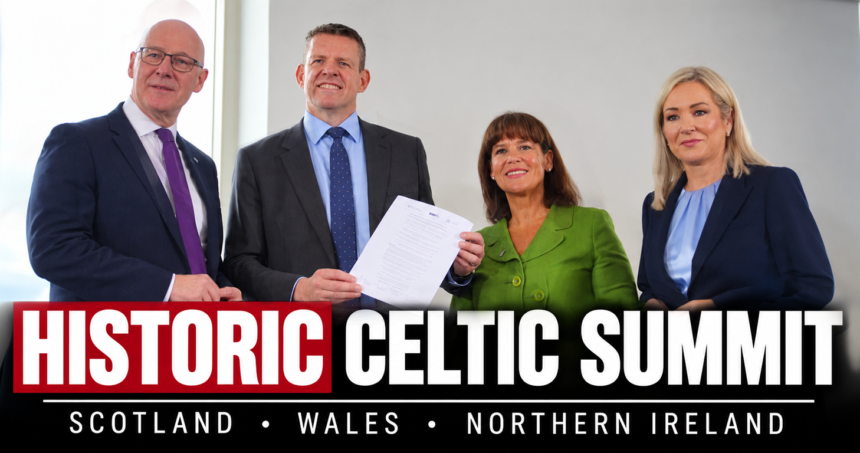
The political future of the United Kingdom has come under renewed scrutiny after nationalist leaders from Wales, Scotland and Northern Ireland gathered for a historic summit, declaring that their nations should have the right to determine their own constitutional futures.
Welsh First Minister and Plaid Cymru leader Rhun ap Iorwerth hosted Scottish First Minister and SNP leader John Swinney and Northern Ireland First Minister and Sinn Féin vice-president Michelle O’Neill in Cardiff on September 14. Sinn Féin president and Irish opposition leader Mary Lou McDonald also joined the talks.
The gathering marked an unprecedented political moment. For the first time, the devolved governments of Wales, Scotland and Northern Ireland are all led by politicians belonging to parties that favour breaking away from the United Kingdom in their respective constitutional contexts. The leaders attended the independence talks in their capacities as party leaders rather than formally representing their governments.

Together, they signed a memorandum calling for the right of people in their respective nations to decide their futures democratically and urging Westminster to facilitate constitutional change where voters demand it. Their message was striking: “Westminster’s time is coming to an end.”

Why Was the Celtic Summit Historic?
The summit brought together three nationalist movements with different histories but a shared argument: decisions about the constitutional future of Scotland, Wales and Northern Ireland should ultimately rest with their people rather than Westminster.
Scotland has already held an independence referendum. In 2014, voters chose to remain within the United Kingdom, with 55% voting “No” and 45% supporting independence. The SNP has continued campaigning for another vote, arguing that political circumstances have changed significantly since then, particularly following Brexit.
Northern Ireland has a different constitutional route. Under the 1998 Good Friday Agreement, a referendum can be held on whether Northern Ireland should remain part of the United Kingdom or become part of a united Ireland when the legal conditions for such a poll are judged to have been met.

Wales has historically had lower support for independence than Scotland, but Plaid Cymru’s rise to government has pushed the constitutional question further into mainstream Welsh politics. Rhun ap Iorwerth has ruled out holding an independence referendum during the current Senedd term, which runs until 2030. However, he wants Wales to have the power to decide for itself whether such a referendum should take place.
The summit therefore did not announce that any part of the UK was immediately becoming independent. Instead, it represented a coordinated attempt to establish the principle of self-determination.
Three Nations, Three Different Paths
Despite their united appearance in Cardiff, the three movements face very different political realities. Recent polling cited around the summit put support for Scottish independence at approximately 47%, compared with around 32% in Wales. Support for constitutional change in Northern Ireland was reported at roughly 36%, although polling questions and the unique issue of Irish reunification make direct comparisons difficult.
Scotland therefore appears closest to an evenly divided electorate, while the Welsh independence movement still faces the challenge of persuading a larger proportion of voters. The leaders nevertheless argued that Westminster should not permanently prevent referendums where there is democratic demand for one. Their cooperation also extends beyond independence.
Talks included economic issues, energy, fair public funding and relationships with Europe following Brexit. Wales and Scotland separately agreed to strengthen cooperation on areas including economic growth and tackling child poverty.
The summit comes at a particularly sensitive moment for the union. The UK’s departure from the European Union has intensified constitutional debates, especially because Scotland and Northern Ireland voted to remain in the EU in the 2016 Brexit referendum.
Could the United Kingdom Actually Break Apart?
Not anytime immediately, but the Cardiff meeting demonstrated why the question is no longer confined to one part of Britain. The UK Government continues to resist demands for new independence referendums. Prime Minister Andy Burnham has stressed economic and cost-of-living priorities, while questions remain over what level of public support would justify another constitutional vote.
There was also opposition within Northern Ireland. DUP deputy First Minister Emma Little-Pengelly argued that O’Neill could not represent the joint office of First Minister at the summit without her agreement, highlighting Northern Ireland’s power-sharing arrangements. The Cardiff declaration itself cannot dissolve the United Kingdom or automatically trigger referendums.
Its significance is political and symbolic. For decades, debates over Scottish independence, Welsh nationalism and Irish reunification have largely followed separate paths. The Cardiff summit placed them together, presenting constitutional change as a shared question about where political power should ultimately reside.
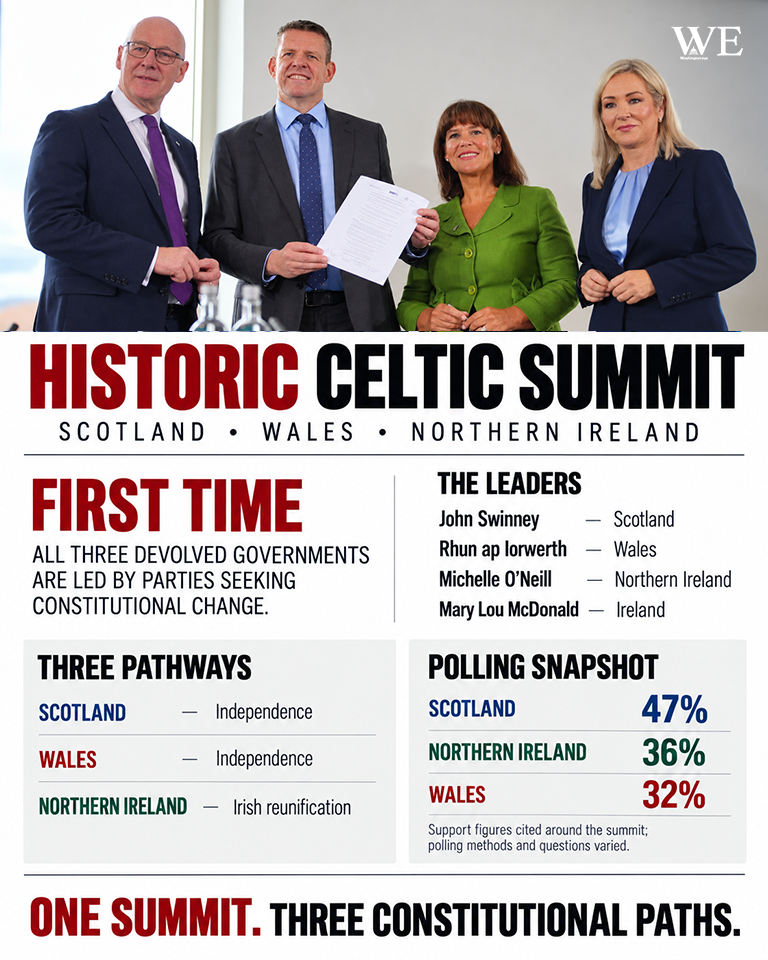
Whether that cooperation eventually redraws the map of the British Isles remains uncertain. But the sight of nationalist leaders from all three devolved nations standing together in Cardiff has created an image that would have been difficult to imagine only a generation ago, and one that could become an important moment in the continuing debate over the future of the United Kingdom.