
When people think of the world’s biggest industry, technology may immediately come to mind. Artificial intelligence, smartphones, social media and companies worth trillions of dollars dominate headlines. Others might guess oil and gas, banking, automobiles or real estate.
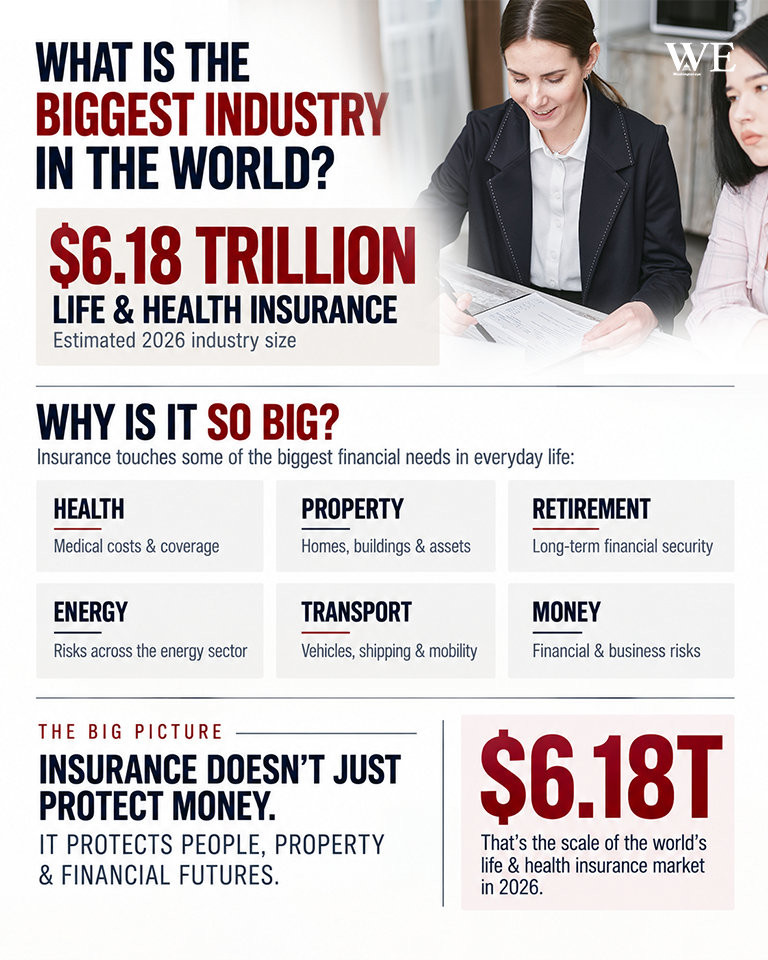
But measured by annual revenue, the answer is less obvious. Life and health insurance is currently ranked as the world’s largest individual industry by revenue, generating an estimated $6.18 trillion in 2026. That puts an industry built largely around managing risk ahead of some of the most visible sectors of the global economy.
But determining the “biggest industry” is not as straightforward as it sounds. Rankings change depending on whether size is measured by revenue, profit, employment, market value or contribution to the wider economy.
Why Insurance Is So Huge
Insurance operates almost everywhere. Individuals pay premiums to protect themselves against medical costs, accidents, disability and death, while companies use insurance to protect employees, property and operations. When billions of people and businesses make regular payments into the system, the numbers become enormous.
Life and health insurance generated an estimated $5.53 trillion in revenue in 2025, according to industry rankings. For 2026, estimates place the figure at approximately $6.18 trillion. One reason for its enormous scale is that insurance is connected to some of life’s most fundamental risks.
People become ill. Families need financial protection when a breadwinner dies. Medical treatment can be expensive. Ageing populations need increasing levels of healthcare and financial security. Unlike industries dependent on the popularity of a particular product, risk does not disappear.
The sector is also deeply connected with the financial system. Insurers do not simply collect premiums and wait for claims. Major insurance companies manage enormous investment portfolios, making them significant participants in global financial markets.

The Trillion-Dollar Industries Behind Everyday Life
Insurance is not alone at the top. Commercial real estate is estimated to generate close to $5.6 trillion annually in 2026, making it another giant of the global economy. Offices, warehouses, shopping centres, hotels, factories and other commercial properties all contribute to the sector. Pension funds are also among the largest industries, managing money accumulated by workers around the world for retirement.
Then comes another industry that has shaped modern civilisation for more than a century: oil and gas. Despite rapid investment in renewable energy and electric vehicles, oil and natural gas remain central to transportation, manufacturing, electricity, chemicals and global trade. Oil and gas exploration and production alone generates trillions of dollars in revenue.
The automobile industry is similarly enormous when its different components are considered. Vehicle sales, automobile manufacturing and parts production each represent massive global businesses. Banking and telecommunications also operate on a scale measured in trillions. What is striking is what does not necessarily occupy the top position: technology.
Apple, Microsoft, Alphabet, Amazon, Nvidia and other technology giants may rank among the world’s most valuable individual companies, but company valuation is not the same thing as industry revenue. An AI company, for example, may be valued extremely highly because investors expect rapid future growth even though its current revenue is far below that of industries handling insurance premiums, property or energy worldwide.
So What Is Really the World’s Biggest Industry?
The answer depends on the question being asked. If “biggest” means the individual industry generating the greatest annual revenue, current estimates point to life and health insurance. If the comparison is instead based on broad economic sectors, classifications can produce a different answer. Wholesale and retail trade, manufacturing, financial services and other huge categories combine many individual industries and employ enormous numbers of people.
And if “biggest” means influence over the future, the picture changes again. Artificial intelligence is transforming businesses at extraordinary speed. Renewable energy is expanding as governments and companies seek alternatives to fossil fuels. Healthcare is being reshaped by ageing populations, biotechnology and medical innovation, while e-commerce continues to change global retail.
That means today’s largest industry does not necessarily have to be tomorrow’s. What the rankings do reveal is something less glamorous but more fundamental about the global economy. The biggest pools of money are often attached to basic human and economic needs: health, financial security, property, transportation and energy.
Technology may dominate the conversation, but the world’s largest industries are still largely the ones that insure our lives, house our businesses, fund our retirements, power our economies and move people around the planet.