
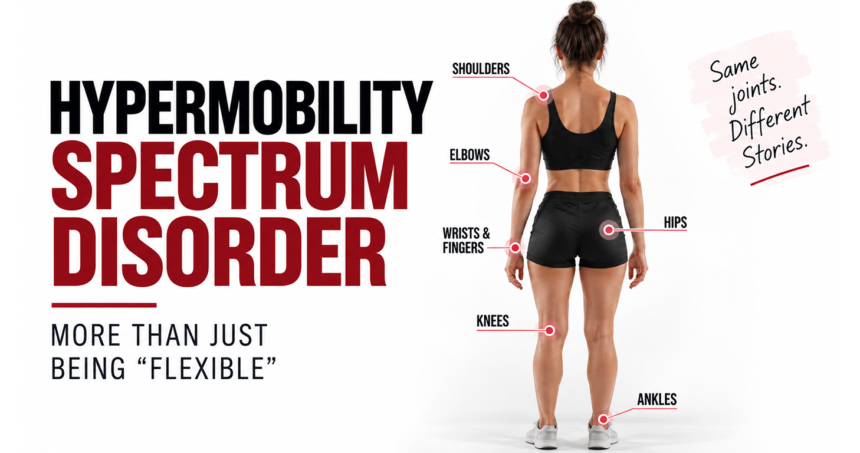
For some people, touching the floor with straight knees, bending a thumb towards the wrist or extending joints unusually far is simply a sign of flexibility. For others, however, being “double-jointed” comes with persistent pain, unstable joints, repeated injuries and fatigue that can significantly affect everyday life.
This is the reality of Hypermobility Spectrum Disorder (HSD), a group of connective-tissue disorders associated with symptomatic joint hypermobility. While flexibility itself is not an illness, HSD is considered when unusually mobile joints are accompanied by problems such as pain, instability or injury and the symptoms cannot be better explained by another condition. The condition remains relatively poorly understood outside specialist medical circles and is sometimes confused with Ehlers-Danlos syndrome (EDS), particularly hypermobile Ehlers-Danlos syndrome, or hEDS.
When Flexibility Becomes a Problem

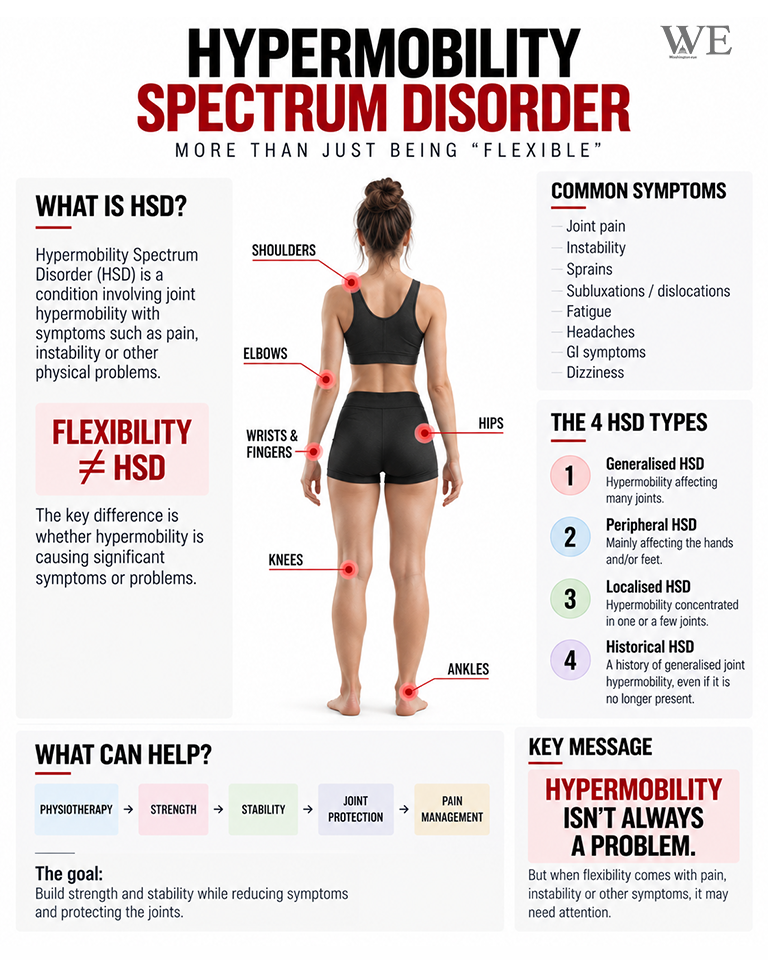
Joint hypermobility means that one or more joints can move beyond the range normally expected. It is particularly common in children and young people, and many people who are naturally flexible never experience any health problems. In fact, asymptomatic hypermobility does not require treatment. Flexibility can even be advantageous for dancers, gymnasts and athletes. HSD is different because the increased movement is associated with symptoms.
People may experience joint instability, recurrent sprains, subluxations or dislocations, and acute or chronic musculoskeletal pain. Some also report fatigue, headaches, gastrointestinal problems and symptoms of autonomic dysfunction, such as dizziness. The type and severity of symptoms can vary considerably between individuals.

The term Hypermobility Spectrum Disorders was proposed in 2017 as part of a new framework designed to better classify people with symptomatic joint hypermobility who did not meet diagnostic criteria for another recognised syndrome.
Four adult forms are generally recognised: generalised HSD, where hypermobility occurs throughout the body; peripheral HSD, mainly affecting the hands or feet; localised HSD, involving a particular joint or region; and historical HSD, where a person previously had generalised hypermobility but may no longer demonstrate the same flexibility.
HSD or Ehlers-Danlos Syndrome?

One of the most common areas of confusion is the relationship between HSD and Ehlers-Danlos syndromes. EDS refers to a group of 13 heritable connective-tissue disorders. Features can include joint hypermobility, unusually extensible skin and tissue fragility, although the manifestations differ according to the particular EDS type.
HSD, meanwhile, is diagnosed when symptomatic joint hypermobility is present but another condition does not better explain it. Someone can therefore have significant pain and disability from HSD without meeting the diagnostic criteria for hEDS. There is currently no single blood test, scan or genetic test that can confirm HSD. Diagnosis relies on medical history, physical examination and excluding alternative explanations for the symptoms.
Clinicians assess the range of movement of different joints, and scoring systems such as the Beighton score can form part of an assessment of generalised joint hypermobility. The cause of HSD itself remains uncertain. Joint hypermobility often runs in families, but researchers have not yet established whether HSD itself represents a specific genetic disorder.
Living With HSD
There is currently no single cure for HSD, so treatment focuses on controlling symptoms, improving function and protecting joints. Physical therapy is a major part of management. Rather than simply increasing flexibility, exercises generally aim to improve muscular strength, stability, coordination and control around vulnerable joints. Pain management and adapting activities to reduce repeated injuries may also be needed.
Because HSD can affect people differently, care may involve several healthcare professionals depending on the individual’s symptoms. Perhaps one of the biggest challenges is that hypermobility can look impressive rather than disabling. A person who can bend a joint unusually far may appear exceptionally flexible while simultaneously dealing with chronic pain, fatigue or repeated injuries that are largely invisible to others.
Growing awareness is therefore changing the conversation around hypermobility. Being flexible is not automatically a disorder, but neither should persistent symptoms associated with hypermobile joints simply be dismissed as being “bendy.” For people with HSD, the difference lies not in how far a joint can move, but in what that movement costs them.