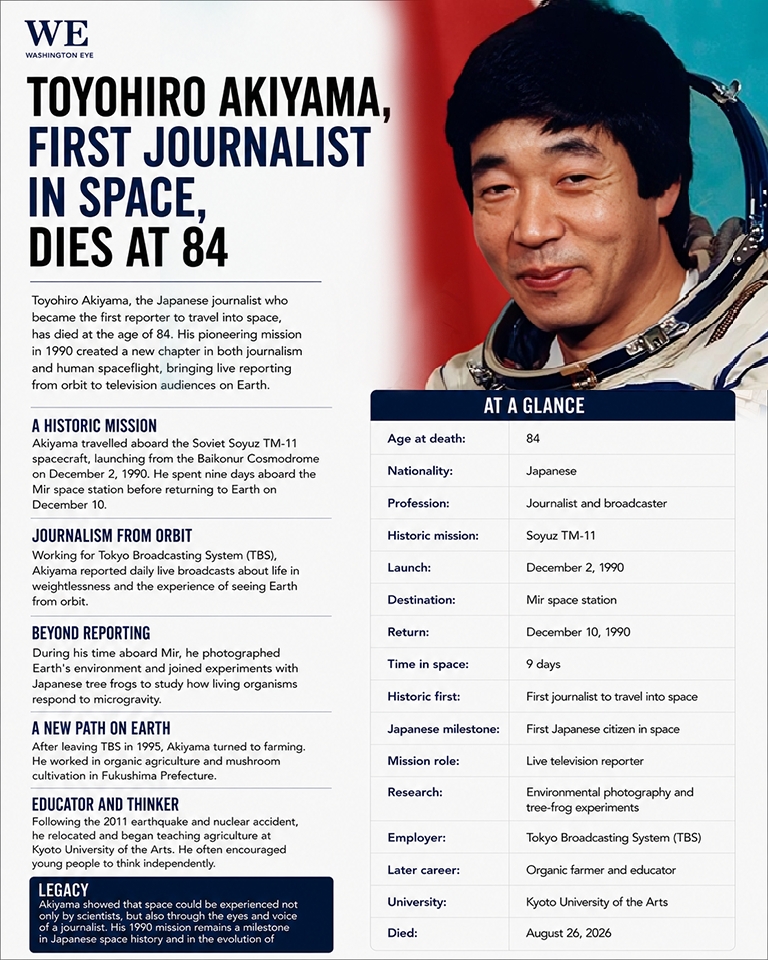
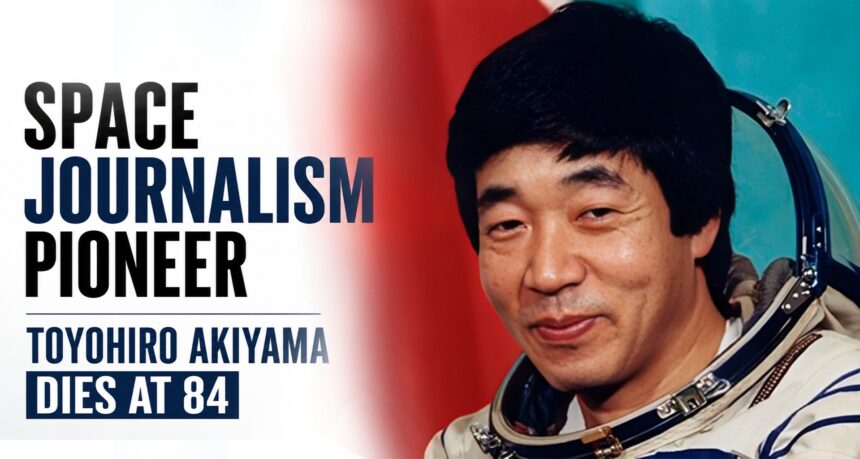
Toyohiro Akiyama, the Japanese journalist who became the first reporter to travel into space, has died at the age of 84. His pioneering mission in 1990 created a new chapter in both journalism and human spaceflight, bringing live reporting from orbit to television audiences on Earth.
Akiyama travelled aboard the Soviet Soyuz TM-11 spacecraft, launching from the Baikonur Cosmodrome on December 2, 1990. He spent nine days aboard the Mir space station before returning to Earth on December 10.
Unlike traditional astronauts, Akiyama’s primary role was not simply scientific research. Working for Tokyo Broadcasting System (TBS), he reported directly from space, delivering daily live broadcasts about life in weightlessness and the experience of seeing Earth from orbit.
His journey was part of a commercial spaceflight initiative financed by TBS in cooperation with the Soviet Union. Before launch, Akiyama underwent extensive training at the Yuri Gagarin Cosmonaut Training Center in Star City.
During his time aboard Mir, he combined journalism with scientific assignments. He photographed environmental conditions on Earth and participated in experiments involving Japanese tree frogs, helping researchers examine how living organisms responded to microgravity.

His mission was especially significant for Japan. Akiyama became the first Japanese citizen to travel into space, arriving before the country’s government-backed astronaut programme had sent one of its own representatives into orbit. A planned mission involving Mamoru Mohri had been delayed following the 1986 Challenger disaster.
After returning home, Akiyama continued his career at TBS before leaving the broadcaster in 1995. Rather than remaining permanently associated with the space industry, he chose an unexpected second career: agriculture.
He moved to Fukushima Prefecture and began working in organic farming, including mushroom cultivation. Akiyama described farming as a way to understand fundamental questions about food, society and Japanese history through direct experience.

The devastating earthquake and nuclear accident of March 2011 forced another major change. Concern about radiation exposure led him to leave his farm and relocate. Later that year, he began teaching agriculture at Kyoto University of Art and Design, now Kyoto University of the Arts.
Akiyama remained interested in how people understand the world around them. In later years, he became increasingly critical of conventional media and encouraged young people to develop independent thinking rather than simply accepting information from established sources.
His life therefore extended far beyond a historic spaceflight. Akiyama moved from television studios to orbit, from space exploration to farming and eventually into education.
His 1990 mission demonstrated that space could become a platform not only for scientists and engineers, but also for journalists and storytellers. More than three decades later, his pioneering journey remains an important milestone in the history of both Japanese space exploration and live journalism.