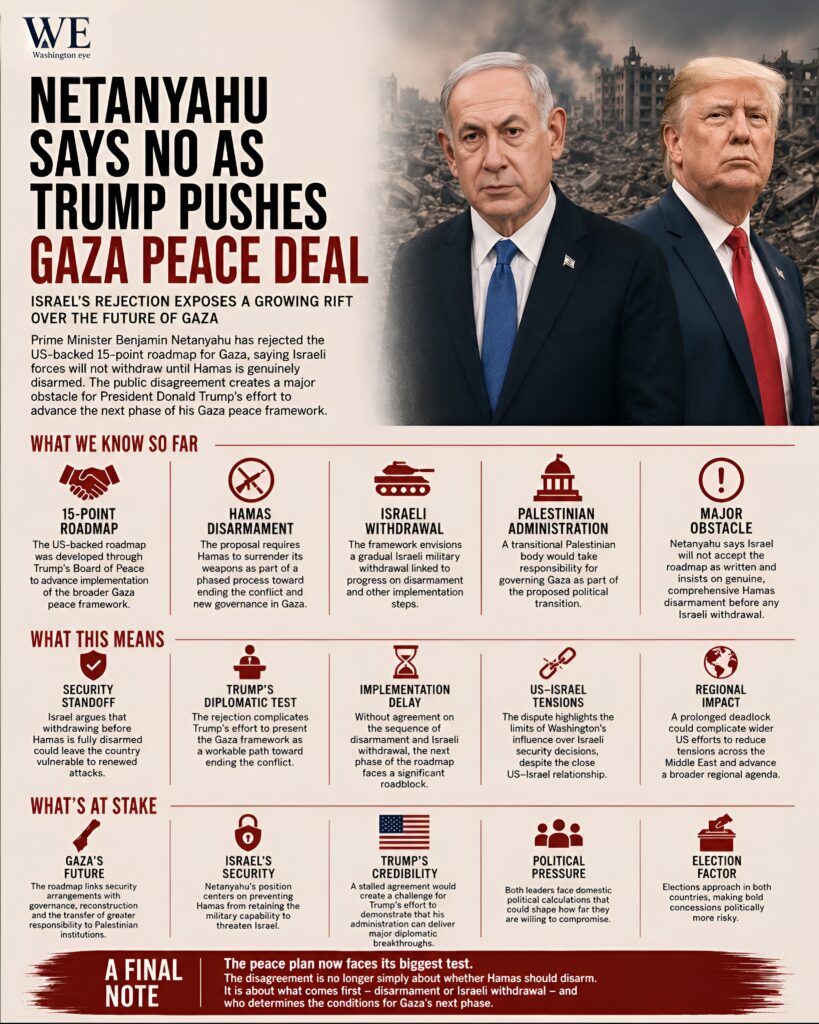
Benjamin Netanyahu has publicly rejected a US-backed proposal aimed at ending the war in Gaza, creating an unusually visible disagreement with President Donald Trump and raising doubts about Washington’s ability to broker a ceasefire.
The 15-point proposal, developed through Trump’s Board of Peace, is built around a major exchange that Hamas would surrender its weapons while Israel would gradually withdraw its forces from Gaza. The plan also requires transferring control of the territory to an independent Palestinian committee as part of a broader political transition.
However, the PM has made clear that Israel will not withdraw its forces before Hamas is completely disarmed. His government argues that allowing the armed group to retain weapons would leave Israel exposed to another attack and make any long-term peace arrangement impossible.
The disagreement is significant because Trump has sought to portray himself as a president capable of ending major conflicts in the Middle East. A successful Gaza agreement would strengthen that image, while a public dispute with one of Washington’s closest allies risks undermining the administration’s diplomatic ambitions.
Now looking into the Israeli position, it reflects growing political pressure inside the country. Netanyahu faces criticism from different sides over the conduct and duration of the Gaza war, while his government remains under pressure to protect Israeli security and address the fate of hostages and displaced civilians.
Trump, meanwhile, faces his own political calculations. His administration wants progress on several interconnected Middle Eastern conflicts, including efforts involving Iran and Lebanon. Reducing regional tensions could have wider consequences for international shipping, energy markets and fuel prices, particularly around the strategically important Strait of Hormuz.
The dispute also highlights the limits of the US-Israel alliance. Although Washington remains a crucial diplomatic and military partner for Israel, Netanyahu has repeatedly demonstrated that he is prepared to resist American pressure when he believes Israeli security interests are at stake.
The issue could become even more politically complicated as elections approach in both countries. In the United States, debate over support for Israel has increasingly divided voters and political parties. Within the Republican Party, there are also emerging voices questioning the costs and objectives of continued American involvement in Middle Eastern conflicts.
For Trump, the choice is difficult. Applying greater pressure could damage relations with Netanyahu and anger parts of his political base. Backing away, however, could leave his Gaza initiative stalled. Therefore, this rejection represents more than a disagreement over a peace proposal. It could become a test of the future relationship between them, as well