
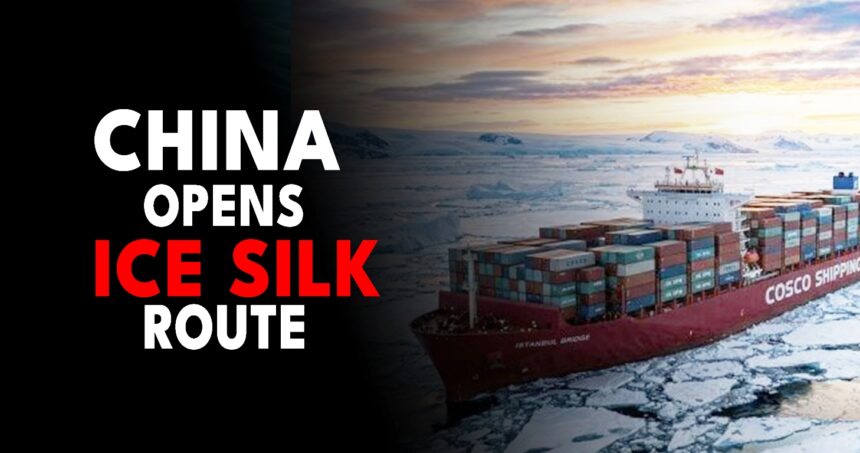
China has taken a major step towards reshaping global maritime trade by launching a regular container shipping service through the Arctic, a route branded the “Ice Silk Road.” Connecting eastern China with northern Europe through waters along Russia’s Arctic coastline, the new service could cut the journey between China and Britain roughly in half while allowing Chinese exporters to bypass some of the world’s most vulnerable maritime chokepoints.
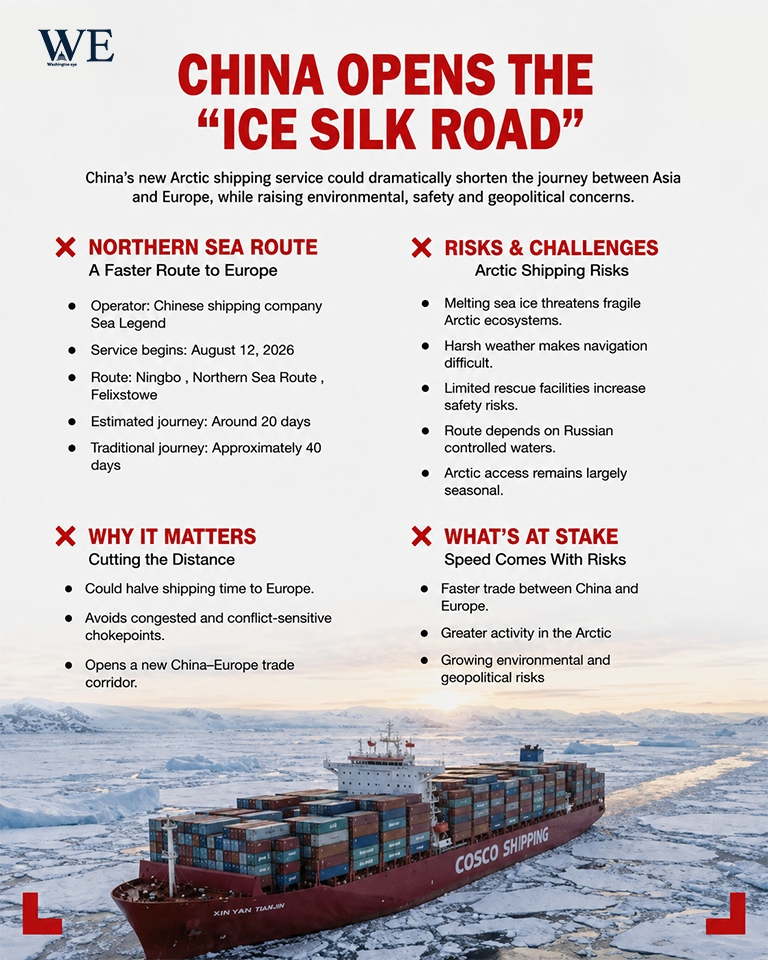
The service, operated by Chinese container shipping company Sea Legend, began regular operations in August between Ningbo-Zhoushan Port in eastern China and Felixstowe in the United Kingdom. Ships travel through Russia’s Northern Sea Route, or NSR, across the Arctic Ocean rather than taking the conventional journey through Southeast Asia, the Indian Ocean, Red Sea and Suez Canal. The development has attracted international attention because it combines three major forces transforming world trade: climate change, geopolitical instability and China’s expanding partnership with Russia.
How the Ice Silk Road Works
The Northern Sea Route stretches along Russia’s Arctic coastline and provides a considerably shorter connection between East Asia and northern Europe. Under favourable conditions, Sea Legend says its ships can travel from China to Britain in around 20 days, compared with roughly 40 days on conventional routes. A voyage around Africa’s Cape of Good Hope can take even longer. The idea has already been tested.
In 2025, the container ship Istanbul Bridge departed Ningbo-Zhoushan Port and reached Felixstowe through the Northeast Passage in just 20 days. It subsequently called at European ports including Hamburg, Gdansk and Rotterdam. The successful voyage helped establish the basis for regular seasonal operations in 2026.

Sea Legend is now attempting to turn what had largely been an occasional Arctic voyage into a more predictable commercial service. Reports indicate that multiple voyages are planned during the navigable 2026 season. The route, however, is not currently a year-round alternative to Suez. Arctic sea ice means commercial operations remain heavily dependent on the season and changing ice conditions. Sea Legend’s 2026 service is concentrated in the relatively ice-free late-summer and early-autumn period.
Why China Wants an Arctic Trade Route
For Beijing, the attraction goes far beyond saving time. A huge proportion of China’s maritime trade depends on narrow waterways. Ships travelling between China and Europe normally encounter strategic chokepoints including the Strait of Malacca, Bab al-Mandab and Suez Canal. Recent conflicts have demonstrated how vulnerable these routes can become. Attacks on commercial shipping in and around the Red Sea have disrupted the Suez route, while wider Middle Eastern instability has intensified concerns about other crucial waterways, including the Strait of Hormuz.

The Arctic provides China with another option. Rather than sending ships southwest from China through Southeast Asian waters and towards the Middle East, vessels can head north and west through Arctic waters before reaching Europe. That diversification has strategic value. China would become somewhat less dependent on maritime corridors vulnerable to war, piracy, blockades or political pressure. Beijing has been interested in this possibility for years. China described itself as a “near-Arctic state” in its 2018 Arctic policy and promoted the concept of a Polar Silk Road as an extension of its wider Belt and Road ambitions.
Russia’s Critical Role
China cannot develop the Ice Silk Road independently because much of the Northern Sea Route runs alongside Russia’s enormous Arctic coastline. Moscow therefore plays a central role in administering and supporting Arctic navigation. Russia has also invested heavily in ports, energy projects and icebreaker capabilities in its northern territories. The partnership benefits both countries. China gains access to a shorter route towards Europe and potentially greater access to Arctic resources.
Russia gains shipping traffic, investment and an economically powerful partner at a time when Western sanctions have increasingly isolated Moscow from traditional European markets. The result is that the Ice Silk Road is becoming not only a transport project but also part of a broader China-Russia strategic relationship. For Western governments, this raises geopolitical concerns. An Arctic once regarded primarily as a remote environmental region is increasingly becoming an arena for competition involving China, Russia, the United States, Canada and European Arctic states.
Cost, Speed and Economic Impact
The greatest commercial advantage is potentially speed. Reducing a China-Europe journey from around 40 days to approximately 20 could be attractive for high-value products where delivery time matters, including electric vehicles, batteries, electronics and machinery. Shorter voyages could theoretically reduce fuel consumption and operating costs, while allowing companies to move inventory between Asian factories and European markets more rapidly.
But the economic equation is not straightforward. Ships operating in Arctic waters may require specialized construction, additional insurance, trained crews and assistance when ice conditions deteriorate. Search-and-rescue infrastructure is also much more limited than along traditional global shipping corridors. The route therefore remains a complement to established shipping lanes rather than a realistic replacement for the Suez Canal.
A Trade Opportunity Created by Climate Change
The biggest contradiction surrounding the Ice Silk Road is environmental. The route is becoming increasingly commercially attractive partly because Arctic sea ice is shrinking as the planet warms. Climate change is effectively opening a shipping corridor that was historically too difficult and dangerous for routine commercial navigation. More ships could then create additional environmental pressures. Environmental groups and researchers worry about oil spills in remote waters, underwater noise disturbing marine mammals and emissions of black carbon, which can settle on snow and ice, darken the surface and accelerate melting.
Responding to a major shipping accident would also be exceptionally difficult in the isolated Arctic environment. Some major European shipping companies remain cautious about using the Northern Sea Route because of these environmental and geopolitical concerns. The Ice Silk Road therefore represents both an opportunity and a warning. For China, it offers a faster route to Europe, greater resilience against geopolitical disruption and another dimension to its Belt and Road strategy. For Russia, it strengthens the economic importance of its vast Arctic coastline. For Europe, it could provide faster connections to Asian manufacturing.
But for the Arctic, increased shipping introduces new risks to one of the world’s most environmentally fragile regions. The new route is unlikely to replace Suez anytime soon. Yet its emergence demonstrates something potentially more important: climate change and geopolitics are beginning to redraw the map of global trade. What was once an almost impassable frozen frontier is slowly becoming a commercial highway, and China intends to be one of the first major powers to take advantage of it.