Power is often associated with presidents, armies and royal palaces, but its real operation is less visible and far more complex. It exists wherever one person, institution or country can influence another’s actions, choices or beliefs. From government decisions in Washington and Beijing to workplace rules, social-media algorithms and public demonstrations, power determines who receives resources, whose voice is heard and which version of reality becomes accepted.
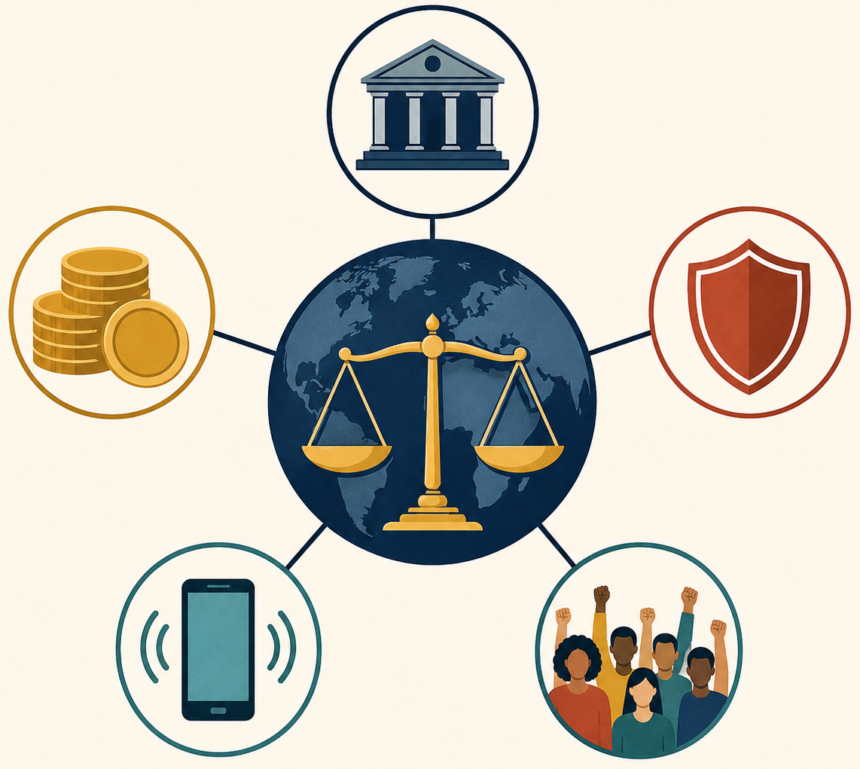
In its simplest meaning, power is the ability to produce an intended result. Political power allows governments to make and enforce laws. Economic power comes from controlling money, jobs, trade, land and essential resources. Military power uses force or the threat of force, while diplomatic power builds alliances and negotiates outcomes. “Soft power,” a concept developed by American scholar Joseph Nye, attracts others through culture, values and reputation. “Smart power” combines attraction with economic pressure, diplomacy and military capability.
Power has changed throughout history. Ancient rulers depended on territory, soldiers, religion and claims of divine authority. Empires such as Rome, the Ottomans and Britain expanded through conquest, taxation and control of trade routes. The Enlightenment, the American and French revolutions, industrialisation and anti-colonial movements challenged hereditary authority. Constitutions, elections, courts, trade unions and independent media attempted to distribute power more widely. However, modern institutions did not eliminate elite influence; they merely changed the channels through which it operates.
At the international level, power remains highly unequal. The United States combines the world’s largest economy, extensive alliances, technological leadership and global military reach. China exercises influence through manufacturing, trade, infrastructure investment and a rapidly modernising military. Russia possesses nuclear weapons, energy resources and the capacity to disrupt regional and international security. India’s population, economic growth and diplomatic position are increasing its influence, while the European Union uses access to its large market and regulatory standards as leverage. World Bank figures put 2025 GDP at approximately $30.8 trillion for the United States, $19.5 trillion for China and $4 trillion for India, illustrating the economic gap between leading states.
Military strength remains the hardest expression of power. Global military expenditure reached a record $2.887 trillion in 2025, marking an eleventh consecutive annual increase. The United States, China and Russia together accounted for 51 percent of the total, according to the Stockholm International Peace Research Institute. Yet weapons alone do not guarantee success: intelligence, economic endurance, public support, alliances and political legitimacy determine whether force can achieve lasting objectives.
Inside countries, power works through both formal rules and informal relationships. A constitution may grant authority to parliament, courts and elected leaders, but wealthy donors, corporations, military establishments, bureaucracies, lobbyists and media owners can influence which issues receive attention. In democracies, power is theoretically temporary and accountable through elections. In authoritarian systems, it is concentrated through censorship, surveillance, patronage and coercion. Nevertheless, elections alone do not prevent abuse if courts, journalists and opposition parties cannot operate freely.
This concern has intensified worldwide. Freedom House reported that global freedom declined for the twentieth consecutive year in 2025: 54 countries experienced deterioration in political rights and civil liberties, compared with 35 that improved. Coups, attacks on peaceful protesters and the concentration of executive authority were among the principal causes.

Technology has added another centre of power. Digital platforms can decide which political messages become visible, governments can monitor populations using large datasets, and artificial intelligence can amplify propaganda or discrimination. Information power is especially effective because it does not merely command people; it shapes what they believe is possible, dangerous or normal. Ownership of data, communication networks and computer infrastructure is therefore becoming as strategically important as ownership of oil or territory.
People without official authority are not necessarily powerless. Workers can strike, consumers can boycott, journalists can expose corruption and citizens can protest or vote. Recent youth-led demonstrations across several countries have shown how economic frustration and online organisation can force issues onto national agendas. Yet participation carries greater risks where governments use arrests, internet shutdowns or violence against dissenters.
The critical question, therefore, is not simply who governs, but who can hold decision-makers accountable. Power can provide security, organise public services and protect rights, but unchecked power can produce corruption, inequality and repression. It works most responsibly when authority is divided, information remains open and ordinary people can challenge decisions without fear. Ultimately, power belongs not only to those who issue orders, but also to those whose consent, labour and cooperation make those orders effective.