
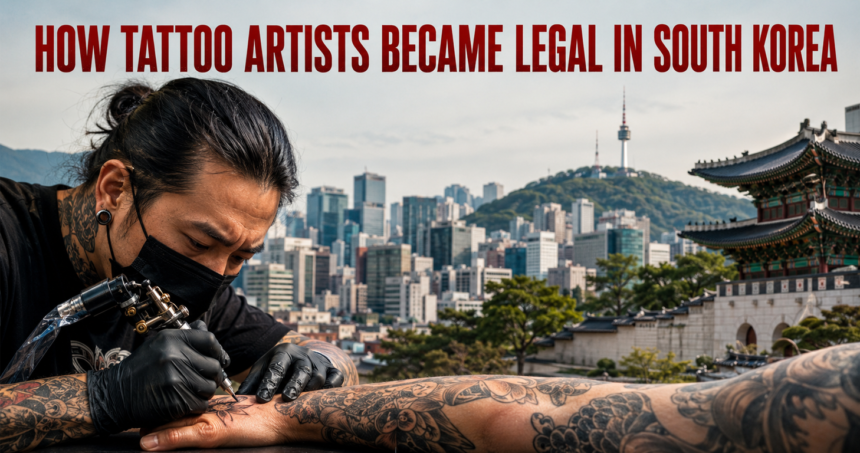
After more than three decades of legal uncertainty, tattoo artists in South Korea are finally on the path to becoming recognized professionals under the law. The change marks a historic shift for an industry that has long operated in a legal gray zone despite the growing popularity of tattoos among younger generations, celebrities, and K-pop stars.
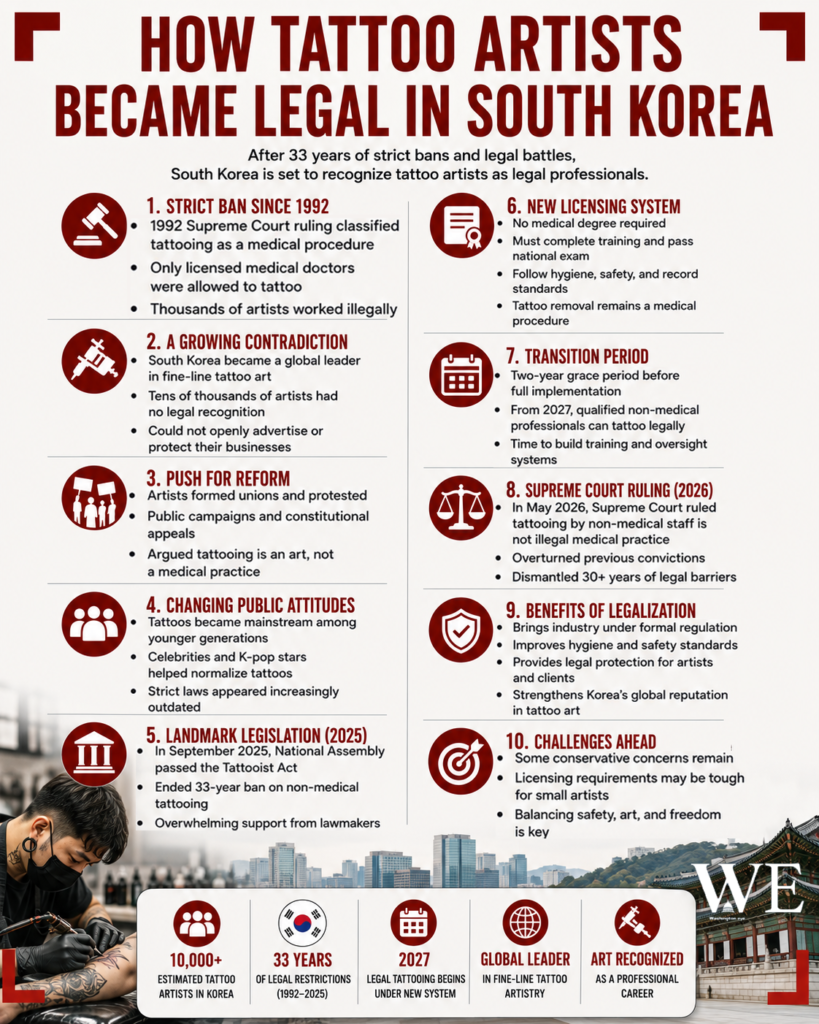
For years, South Korea maintained one of the world’s strictest tattoo regulations. A 1992 Supreme Court ruling classified tattooing as a medical procedure, arguing that the use of needles could pose health risks. As a result, only licensed medical doctors were legally permitted to perform tattoos. This effectively criminalized thousands of professional tattoo artists who had no medical qualifications but had developed internationally recognized artistic skills.
The contradiction became increasingly apparent over time. South Korea emerged as a global leader in fine-line tattoo artistry, attracting international clients and producing artists whose work was admired worldwide. Yet most of these artists technically operated illegally. Industry estimates suggested that tens of thousands of tattooists were working without legal recognition, often unable to openly advertise their businesses or secure legal protections.

The push for reform gained momentum throughout the 2010s and early 2020s. Tattoo artists organized unions, held demonstrations, launched public awareness campaigns, and filed constitutional appeals. Supporters argued that tattooing is primarily an artistic profession rather than a medical practice. They also emphasized that countries such as the United States, Germany, Japan, and the United Kingdom regulate tattooing through licensing and hygiene standards rather than requiring artists to become doctors.

Public attitudes toward tattoos were also changing. Historically associated with criminal gangs and social stigma, tattoos gradually became more accepted among younger South Koreans. Athletes, musicians, actors, and social media influencers increasingly displayed body art, contributing to a broader cultural shift. Internationally famous Korean celebrities helped normalize tattoos, making the country’s strict legal framework appear increasingly outdated.
A major breakthrough came in September 2025 when South Korea’s National Assembly passed the Tattooist Act, ending a 33-year ban on tattooing by non-medical professionals. The legislation received overwhelming support from lawmakers and was hailed as a landmark victory for artists who had spent decades advocating for recognition. The law was later promulgated by the government, formally establishing a pathway for professional tattoo licensing.
Under the new system, tattoo artists no longer need to obtain medical degrees. Instead, they must satisfy specific professional requirements established by the government. These include completing approved training, passing a national examination, complying with hygiene and safety regulations, maintaining records of procedures, and meeting licensing requirements. Tattoo removal procedures, however, remain restricted to medical professionals.
The legislation also includes a two-year transition period before full implementation. Beginning in 2027, qualified non-medical professionals will be able to legally provide tattoo services under the new licensing framework. The grace period is intended to allow authorities to develop training programs, certification standards, and oversight mechanisms.
The legal reforms received another boost in May 2026 when South Korea’s Supreme Court issued a landmark ruling declaring that tattoo procedures performed by non-medical practitioners do not constitute illegal medical practice. The court overturned previous convictions against tattoo artists and effectively dismantled the legal reasoning that had underpinned restrictions for more than three decades. Legal experts described the decision as one of the most significant developments in the history of South Korea’s tattoo industry.
Supporters argue that legalization will improve public safety by bringing the industry under formal regulation. Rather than forcing artists to operate underground, the new system will allow authorities to monitor hygiene standards, regulate tattoo inks, enforce training requirements, and provide legal protections for both artists and consumers. Industry representatives say the changes will professionalize the sector while preserving South Korea’s reputation as a global center for innovative tattoo art.
Despite the reforms, challenges remain. Some conservative groups continue to express concerns about health risks and social perceptions of tattoos. Others argue that licensing requirements could be burdensome for small artists. Nevertheless, most observers view the legislation as a major step toward balancing public safety with artistic freedom.
As South Korea prepares to implement its new licensing system, tattoo artists who once worked in fear of prosecution are looking ahead to a future of legal recognition. For many, the change represents more than a regulatory update, it is official acknowledgment that tattooing is an art form deserving of professional status in one of Asia’s most influential cultural hubs.