
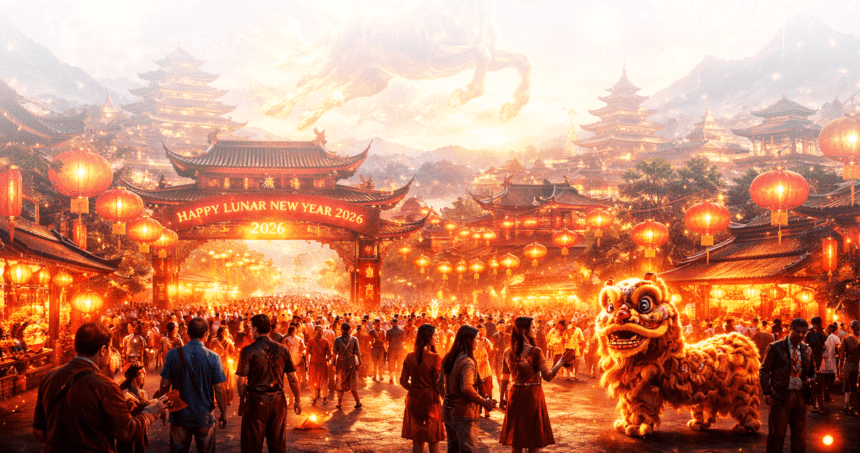
Millions of people around the world are marking the arrival of the Lunar New Year 2026, a major cultural celebration that ushers in a new year according to the traditional lunisolar calendar. Falling this year on Tuesday, February 17, the festival heralds the start of the Year of the Fire Horse, a rare and dynamic sign in the Chinese zodiac that returns only once every 60 years.
Known variously as Lunar New Year, Chinese New Year, Spring Festival, Seollal (in Korea), or Tết Nguyên Đán (in Vietnam), this holiday is deeply rooted in centuries-old traditions that celebrate family reunions, renewal, prosperity, and cultural heritage. It does not correspond to a fixed date on the Western (Gregorian) calendar because it depends on the phases of the moon and the sun, specifically, the second new moon after the winter solstice.
In China, where the festival is most widely observed, the Lunar New Year marks the beginning of the Spring Festival season. Celebrations typically span up to 15–16 days, beginning with preparations in early February and concluding with the Lantern Festival in early March. State media and official calendars note that in 2026 the Chinese public holiday spans February 15–23, offering extended time off for families to travel, relax, and participate in festivities.
This year’s New Year arrives amid one of the largest annual human migrations on Earth. Known in China as Chunyun, the mass movement sees hundreds of millions of people crisscrossing the country to reunite with loved ones or embark on holiday travel. Authorities project a record 9.5 billion domestic trips during the roughly 40-day period surrounding the holiday, highlighting both the cultural importance and economic impact of the festivities.

Beyond mainland China, Lunar New Year traditions take distinct forms around the world. In Vietnam, the festival becomes Tết, the country’s most significant holiday, celebrated with family meals, ancestral rites, and local fare such as bánh chưng and pickled onions. In South Korea, Seollal brings its own customs, including wearing traditional dress (hanbok), performing ancestral rites (charye), and eating rice cake soup (tteokguk).
Across Southeast Asia, in Malaysia, Singapore, Indonesia, Thailand, and the Philippines, Chinese communities and wider populations join in parades, street festivals, dragon and lion dances, and markets awash with red decorations symbolizing prosperity and good fortune. In cities from New York to London, Sydney to Toronto, diaspora communities host lantern parades, cultural performances, and family events that bring Asian traditions into global urban life.
Although the core theme everywhere is renewal, the reason behind Lunar New Year is deeply symbolic. It reflects ancient beliefs in cleansing the past and inviting good fortune for the year ahead. Families often perform thorough home cleanings before the holiday to dispel bad luck, decorate with vibrant reds and golds to attract prosperity, and exchange hongbao (red envelopes with money) as tokens of good will and blessings. Traditional foods, from dumplings to long noodles, play symbolic roles, representing wealth, longevity, and togetherness.

In China, large public celebrations often include dragon and lion dances, firecracker displays, temple fairs, and lantern assemblies. One example is the Zigong International Lantern Festival in Sichuan province, where hundreds of elaborate lantern displays, including mythical creatures and zodiac themes, illuminate streets and public parks.

While Lunar New Year is most strongly associated with Chinese culture, its broader meaning resonates across Asia and beyond: the cycle of seasons, family unity, hope for prosperity, and the renewal of life itself. Across urban centers, rural towns, and diaspora communities worldwide, the 2026 festivities are set to be one of the most observed since the start of the decade, celebrated with both ancient traditions and modern vibrancy.