
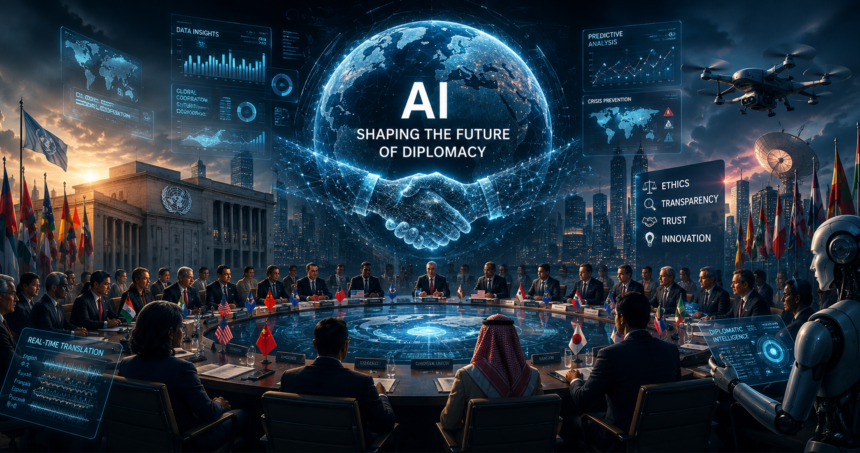
Artificial intelligence (AI) is rapidly transforming diplomacy, ushering in a new era where algorithms, data analytics, and machine learning increasingly influence how nations communicate, negotiate, and project power. From diplomatic negotiations and crisis management to cultural outreach and global governance, AI is becoming a central feature of international relations. As governments race to harness its benefits, diplomats and policymakers are simultaneously grappling with profound questions about ethics, sovereignty, security, and the future of global cooperation.
The rise of AI diplomacy comes at a critical moment in world politics. In recent years, governments have accelerated efforts to establish international frameworks governing artificial intelligence. The United Nations has launched initiatives such as the Global Dialogue on AI Governance and the Independent International Scientific Panel on AI, reflecting growing recognition that AI is no longer merely a technological issue but a diplomatic and geopolitical one. Experts argue that 2026 may prove to be a pivotal year in establishing global norms for AI governance.
Traditionally, diplomacy relied heavily on human interaction, personal relationships, negotiation skills, and political judgment. However, AI is increasingly assisting diplomats by processing vast amounts of information, monitoring global sentiment, identifying emerging risks, and generating policy insights. Advanced language models can summarize international developments in seconds, while predictive analytics can help governments anticipate crises, conflicts, and economic disruptions. Researchers note that AI may even be used to simulate diplomatic scenarios and potential conflict outcomes, providing policymakers with new tools for decision-making.
The growing role of AI has given rise to what analysts describe as “tech diplomacy” and “algorithmic diplomacy.” Tech diplomacy focuses on managing relationships between governments and technology companies, while algorithmic diplomacy refers to situations where AI systems actively shape diplomatic processes. Several countries have already appointed technology ambassadors and established dedicated diplomatic structures focused on digital governance, cybersecurity, and emerging technologies.
AI is also becoming a powerful instrument of soft power. In the past, countries projected influence through culture, education, media, and international aid. Today, technological leadership increasingly serves as a source of prestige and attraction. Nations that develop advanced AI systems, establish ethical standards, and provide technological assistance to developing countries can strengthen their international influence. The competition over AI leadership is therefore not only economic or military but also diplomatic and cultural.
Supporters of AI-driven diplomacy argue that the technology can significantly improve efficiency and inclusiveness. AI can assist diplomats in analyzing multilingual information, tracking global public opinion, and responding more rapidly to emerging events. It may also help smaller states with limited diplomatic resources access sophisticated analytical capabilities previously available only to major powers. International organizations are increasingly exploring how AI can enhance cooperation, improve governance, and support evidence-based policymaking.
However, the rise of AI diplomacy is not without risks. Critics warn that excessive reliance on algorithms could undermine human judgment and reduce accountability in foreign policy decisions. AI systems can reflect biases present in training data, potentially producing misleading recommendations. There are also concerns that authoritarian governments could use AI-powered surveillance and information operations to expand influence abroad while restricting freedoms at home. Furthermore, the growing involvement of private technology companies raises questions about who truly shapes international norms and decisions in the digital age.

Another challenge lies in the fragmented nature of global AI governance. While many countries support international cooperation, disagreements persist regarding regulation, sovereignty, data sharing, and ethical standards. Some states advocate strong multilateral governance frameworks under the UN, while others favor national approaches that prioritize innovation and strategic competition. This divergence reflects broader geopolitical tensions among major powers competing for technological leadership.
Looking ahead, experts believe diplomacy will increasingly involve two interconnected dimensions: “AI for diplomacy” and “diplomacy for AI.” The first focuses on using AI to improve diplomatic practice, while the second concerns negotiating international rules governing artificial intelligence itself. Both dimensions are expected to define foreign policy agendas for decades to come. As AI becomes embedded in economies, security systems, and communication networks, diplomatic institutions will need to adapt rapidly to remain effective and credible.
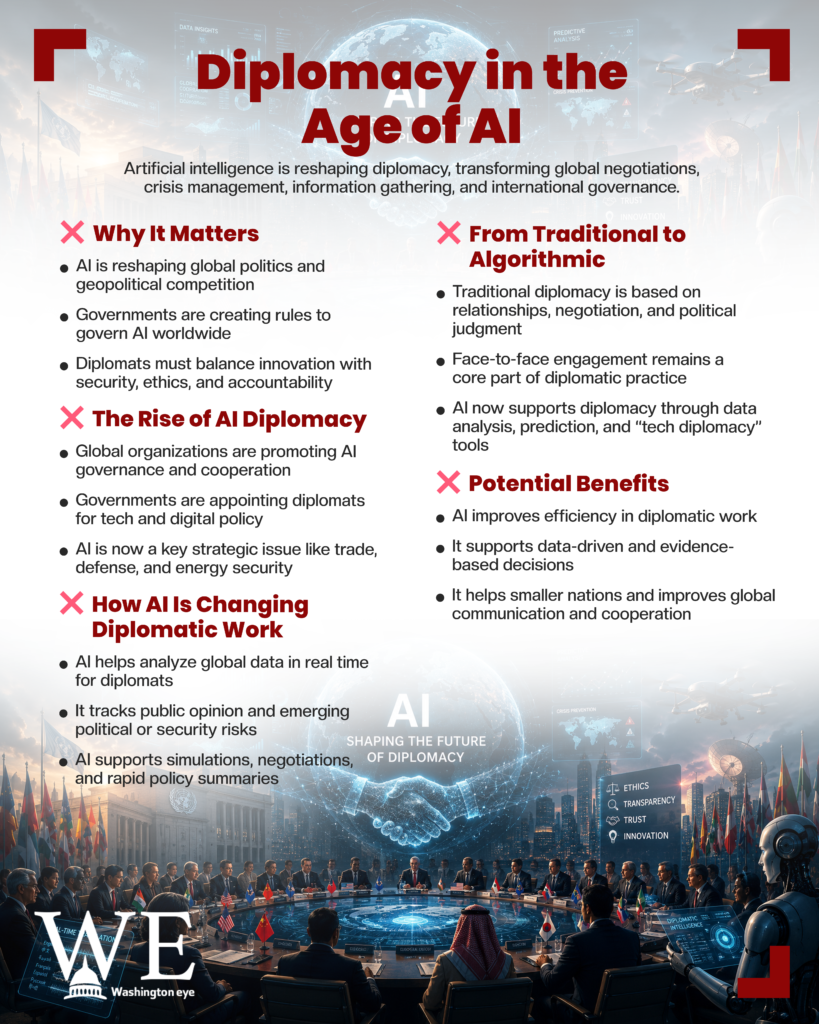
Ultimately, AI is unlikely to replace diplomats, but it will fundamentally change how diplomacy is conducted. The challenge for governments is to harness AI’s potential while preserving human judgment, democratic accountability, and international cooperation. In an increasingly interconnected and technologically driven world, the future of diplomacy may depend as much on algorithms and data as on ambassadors and negotiations.