
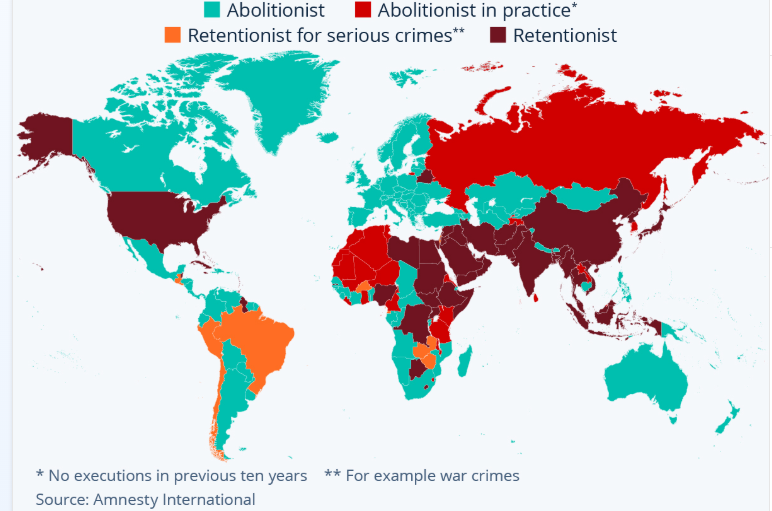
Capital punishment, commonly known as the death penalty, remains one of the most controversial legal practices in the modern world, as countries continue to diverge sharply on its use despite a long-term global trend toward abolition. As of 2025–2026, more than 70 percent of countries have abolished the death penalty in law or practice, signaling a significant shift toward human rights-based justice systems. However, around 55 countries still retain and actively use capital punishment, reflecting deep legal, cultural, and political divisions worldwide.
The death penalty is typically reserved for what states define as the most serious crimes, including murder, terrorism, treason, and, in some countries, drug-related offenses. Nations such as China, Iran, Saudi Arabia, Iraq, and the United States remain among the most prominent users of capital punishment, collectively accounting for the majority of executions globally. China is believed to execute thousands of people annually, though exact figures remain classified, while Iran alone reportedly carried out hundreds to over a thousand executions in recent years, many linked to drug offenses.
Recent data indicates a worrying resurgence in executions. In 2024, at least 1,500 known executions were recorded globally, the highest figure since 2015, while 2025 saw continued increases in several countries. Saudi Arabia, for instance, recorded a historic surge with over 350 executions in a single year, many involving non-violent drug crimes and foreign nationals. Similarly, the United States carried out 47 executions in 2025, marking its highest annual total in 16 years, while countries such as Afghanistan resumed public executions, raising serious human rights concerns.

Legal frameworks governing capital punishment vary widely. In the United States, the death penalty is applied at both federal and state levels, with differing laws across states. In contrast, the European Union strictly prohibits capital punishment under its human rights framework, making Belarus the only European country still actively using it. Many African and Latin American nations have also abolished the death penalty or imposed long-standing moratoria, reflecting regional shifts toward abolition.

One of the most contentious aspects of capital punishment is its application to specific groups and crimes. International law restricts the use of the death penalty for juveniles and non-lethal offenses, yet some countries continue to impose it in cases involving drug trafficking or political dissent. Human rights organizations have repeatedly raised alarms about executions following unfair trials, lack of legal representation, and coerced confessions. In Saudi Arabia and Iran, for example, critics argue that the death penalty has been used as a tool to suppress dissent and target marginalized communities.
Another major concern is the risk of wrongful convictions. Opponents of capital punishment argue that irreversible errors in judicial systems can lead to the execution of innocent individuals. Studies and advocacy groups highlight systemic biases, including disproportionate sentencing of minorities and economically disadvantaged individuals. In the United States, racial disparities in death row populations have been widely documented, fueling ongoing debates over fairness and justice.
Methods of execution also vary, with some widely criticized as cruel or inhumane. Lethal injection remains the most common method in the United States, though controversies over drug protocols have led to alternative methods such as nitrogen gas executions, which have drawn condemnation from international observers. In other regions, executions are carried out by hanging, beheading, shooting, or even public display, intensifying global scrutiny over what constitutes “cruel and unusual punishment.”

Despite these concerns, supporters of capital punishment argue that it serves as a deterrent against serious crimes and delivers justice for victims. Governments in retentionist countries often justify its use on grounds of public safety, national security, and cultural or religious norms. However, empirical evidence on its deterrent effect remains inconclusive, with many studies suggesting no clear link between the death penalty and reduced crime rates.
Globally, the trajectory points toward gradual abolition, even as execution numbers fluctuate. Over the past few decades, more than 100 countries have fully abolished capital punishment, and many others have ceased carrying out executions altogether. Yet, the persistence of the death penalty in key nations ensures that the debate remains unresolved. As international pressure grows and human rights advocacy intensifies, the future of capital punishment will likely continue to be shaped by the tension between state sovereignty, justice systems, and evolving global norms.