
Workers around the world continue to face significant differences in wages despite improvements in employment levels and salaries in several major economies, according to recent data from the International Labour Organization (ILO) and the Organisation for Economic Co-operation and Development (OECD). While employees in wealthier countries generally receive higher earnings, millions of workers in developing economies continue to struggle with low wages, inflation and rising living expenses.
The OECD’s Employment Outlook 2026, released in July, revealed that real wages remained below their levels of five years earlier in approximately one-third of the countries examined, highlighting the continuing impact of the global cost-of-living crisis. According to the OECD, average real wages increased by 2.2 percent during the first quarter of 2026 across 37 countries with available data, compared with 2.7 percent during the same period in 2025.
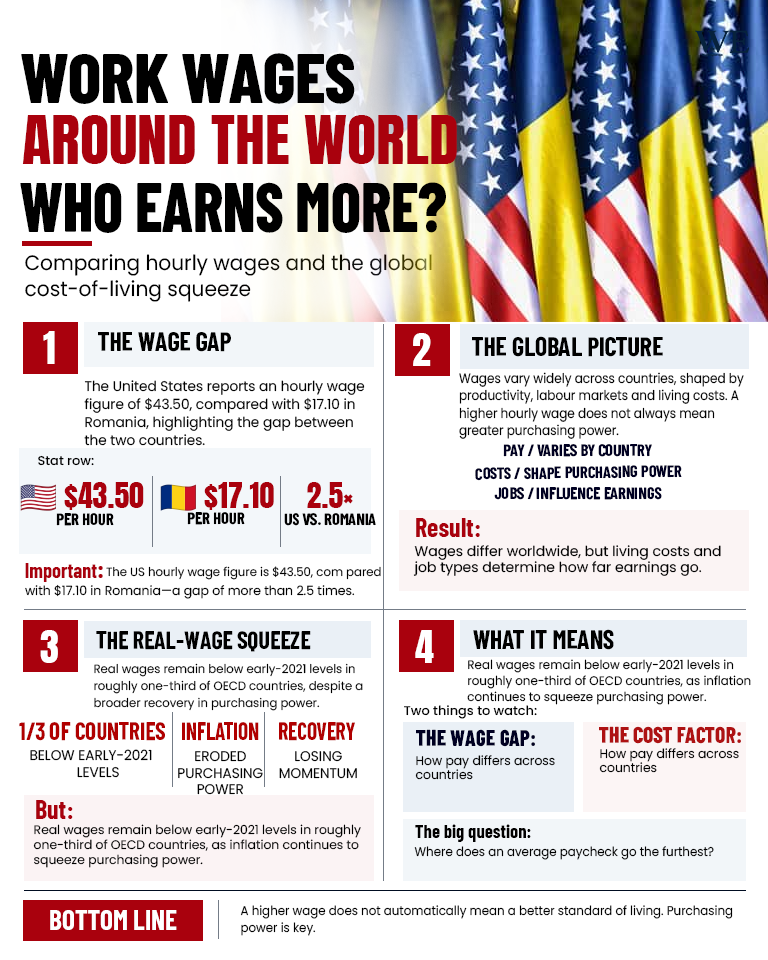
The slowdown suggests that although salaries are increasing in many economies, workers are experiencing weaker improvements in purchasing power. The differences become particularly evident when comparing hourly earnings across countries. Data compiled by the ILO and published by Our World in Data show that average hourly employee earnings in the United States reached approximately $43.50, compared with $35.90 in Switzerland, $34.60 in Germany and $33 in Canada.

Other economies recorded lower figures, including South Korea at $27.60, the United Kingdom at $21.80, France at $18.80 and Romania at $17.10 per hour. These figures represent purchasing-power-adjusted international dollars at 2021 prices rather than actual hourly payments in US currency. The comparison uses 2025 data where available and the closest available observations from 2020 to 2024 for other countries.

The figures demonstrate substantial differences in earnings, even among developed economies. However, experts caution that higher wages do not automatically translate into better living standards, as housing costs, taxation, healthcare expenses and other essential expenditures vary considerably between countries.
Minimum wage policies also differ significantly across the world, reflecting contrasting economic conditions and government approaches to labour protection. A March 2026 report by Germany’s Hans Böckler Foundation compared statutory minimum wages using purchasing power parity, allowing researchers to account for differences in living costs.
The study found that Germany’s minimum wage had a purchasing-power-adjusted value of approximately €12.58 per hour in January 2026, compared with €12.40 in the Netherlands, €12.12 in Belgium and €12.04 in Ireland. Outside Europe, Australia’s comparable minimum wage stood at €11.19, while the United States recorded €4.74 and Brazil €1.84. These figures reflect purchasing-power-adjusted values rather than the nominal minimum wages paid in local currencies.

The findings underline the substantial differences in wage protection between countries, although variations in regional regulations, eligibility requirements and collective bargaining systems complicate direct comparisons. The United States, for example, maintains a federal minimum wage of $7.25 per hour, although many states and cities require employers to pay considerably higher rates.
Meanwhile, several European countries rely on collective bargaining agreements rather than a single nationwide statutory minimum wage, demonstrating that wage protection can operate through different regulatory systems. In developing economies, wage inequality remains an especially pressing concern. Workers in informal employment, agriculture, domestic services and other low-paid sectors often experience limited social protection, unstable income and weaker access to labour rights.
The ILO’s Global Wage Report 2024–25 found that wage inequality had declined in approximately two-thirds of countries since the beginning of the century. Nevertheless, significant differences persisted, particularly in lower-income economies. The organisation also highlighted the disproportionate impact of inflation on low-paid workers, who spend a greater share of their income on food, housing, transportation and other essential needs.
Rising energy prices and economic uncertainty have added further pressure to household budgets during 2026. The OECD warned that renewed inflationary pressures could weaken purchasing power, even where employment levels remain relatively strong. In May 2026, employment across OECD economies reached approximately 670 million, while the unemployment rate stood at 4.9 percent.
Despite these encouraging employment figures, the organisation emphasised that job availability does not necessarily guarantee improvements in financial security. Differences in education, productivity, technological development and bargaining power also influence wages, creating considerable disparities between industries and occupational groups.
The growing use of artificial intelligence and automation has introduced additional questions about future earnings and employment opportunities, although the OECD reported that evidence of their impact on younger workers remained limited. Labour organisations continue to emphasise the importance of fair wage-setting mechanisms, stronger worker protections and policies that help salaries keep pace with living expenses.
As economies navigate inflation, technological change and shifting labour markets, the global wage divide remains a central challenge for governments and employers. The latest findings highlight a fundamental reality of the international labour market: while employment and wages may be increasing, the financial benefits are not distributed equally, leaving millions of workers facing different economic opportunities depending on where they live and work.