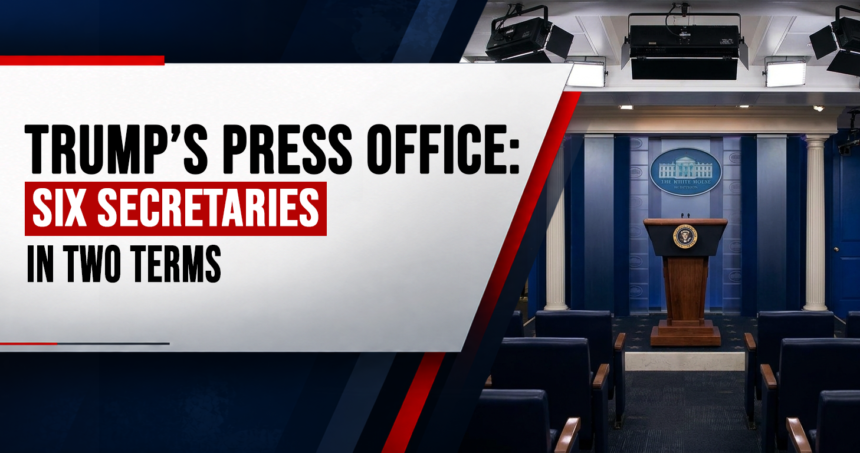
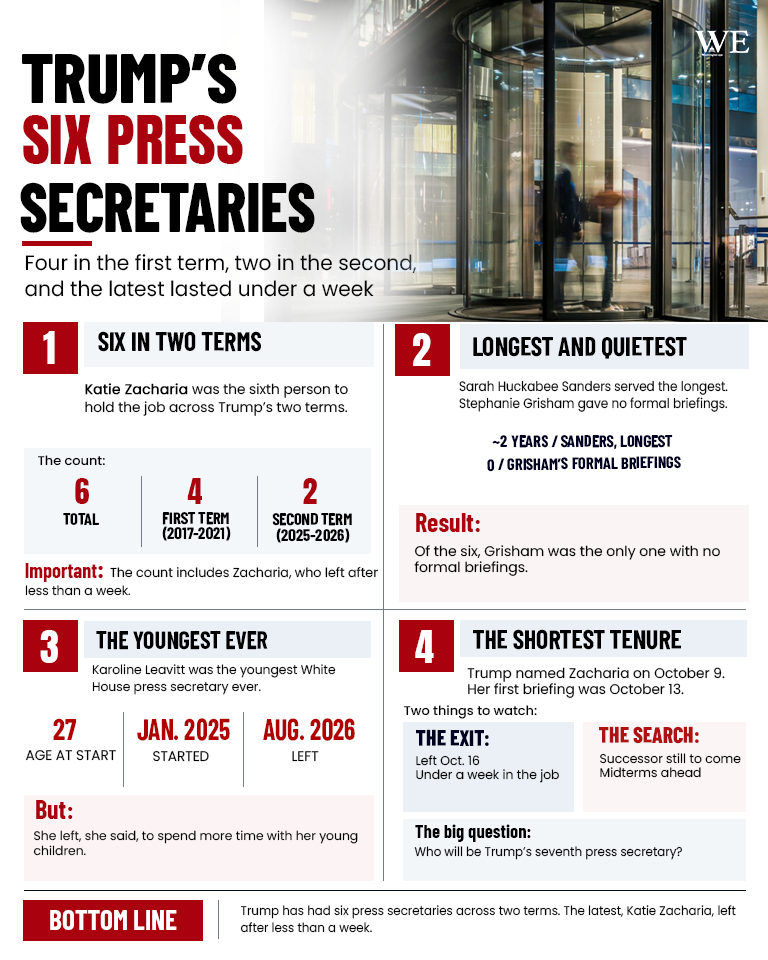
US President Donald Trump has now appointed six White House press secretaries across his two non-consecutive presidential terms, with the latest, Katie Zacharia, leaving the position after less than a week. Her departure on October 16, just days after her first official briefing, has renewed attention on the frequent changes within Trump’s communications team and the demanding role of representing one of the world’s most closely watched political administrations.
Zacharia’s departure came five days after she assumed the position on October 12, replacing Karoline Leavitt, who stepped down in August to spend more time with her family. The former communications adviser at Trump Media and Technology Group had been appointed on October 9, with Trump praising her longstanding support for his political movement. However, her brief tenure ended following criticism of her performance at the White House podium and questions surrounding her professional credentials.
The latest development means that Trump has employed six official press secretaries since first taking office in January 2017. Four served during his first administration from 2017 to 2021, while two have held the position during his second term, which began in January 2025. Only one, Sarah Huckabee Sanders, remained in the role for nearly two years, making her the longest-serving press secretary under Trump.
Trump’s first press secretary, Sean Spicer, assumed office on January 20, 2017. A former Republican National Committee communications director, Spicer quickly became a prominent figure because of his confrontational exchanges with journalists. His opening briefing included disputed claims about the size of the crowd attending Trump’s inauguration, setting the tone for an often contentious relationship between the administration and the White House press corps.
Spicer resigned in July 2017 after 182 days, following disagreements over the appointment of Anthony Scaramucci as White House communications director. He later pursued opportunities in television, political commentary and podcasting. Sarah Huckabee Sanders succeeded Spicer in July 2017 and served until July 2019.
The daughter of former Arkansas Governor Mike Huckabee, Sanders became known for defending the administration’s policies during frequently challenging press briefings. Although she initially held regular exchanges with journalists, formal briefings became increasingly infrequent toward the end of her tenure. After leaving the White House, Sanders entered electoral politics and became governor of Arkansas in January 2023.
Stephanie Grisham became Trump’s third press secretary in July 2019. Previously associated with First Lady Melania Trump’s communications team, Grisham adopted a different approach to media relations. During her approximately nine months in office, she did not conduct a traditional formal briefing from the White House podium, an unusual development for a position historically responsible for providing regular information to journalists.

Grisham left the press secretary position in April 2020 to become Melania Trump’s chief of staff. She subsequently resigned from the administration following the January 6, 2021, attack on the US Capitol and later publicly criticised Trump, including during an appearance at the 2024 Democratic National Convention.
Kayleigh McEnany succeeded Grisham in April 2020, becoming Trump’s fourth press secretary during his first term. A former political commentator and spokesperson for Trump’s re-election campaign, McEnany restored regular televised press briefings during the COVID-19 pandemic and the contentious 2020 presidential election. Her exchanges with journalists frequently involved disagreements over the administration’s handling of public health measures and election-related claims.
McEnany remained in office until January 20, 2021, when Trump’s first presidential term ended. She subsequently joined Fox News, where she continued working as a political commentator and television presenter. When Trump returned to the White House in January 2025, he appointed Karoline Leavitt as his fifth press secretary. At 27, she became the youngest person ever to hold the position, attracting considerable attention as a representative of a younger generation of conservative political communicators.
Leavitt introduced changes to the White House briefing room, including a dedicated seat for newer media organisations, independent journalists, podcasters and digital content creators. The initiative reflected the administration’s emphasis on reaching audiences through alternative media platforms alongside established news organisations.
She served for approximately 19 months before leaving on August 27, 2026, following the birth of her second child. Leavitt was also the first serving White House press secretary to take maternity leave. Her departure created a vacancy that lasted several weeks before Zacharia’s appointment in October.
Zacharia, Trump’s sixth press secretary, had previously worked as a senior communications adviser at the company operating Truth Social and held a public affairs position at the Department of Homeland Security. She delivered her first White House briefing on October 13 but left the position on October 16. A White House official confirmed that she was transitioning out of the role, making hers the shortest tenure among Trump’s six press secretaries.
The frequent turnover has drawn comparisons with previous US administrations. Former President Barack Obama employed three press secretaries across eight years, while Bill Clinton and George W. Bush each employed four. Although personnel changes are common in the demanding White House communications operation, Trump’s six appointments over his two terms illustrate the distinctive pressures surrounding his administration’s relationship with the media.
As of October 21, no permanent successor to Zacharia has been confirmed in the reports reviewed. Her departure leaves the White House facing another communications transition while questions continue over how the administration will manage press briefings and public messaging. The changing lineup also reflects broader developments in political communication, including the growing influence of social media, partisan television networks and independent digital platforms.
From Spicer’s televised confrontations to Leavitt’s outreach to online media, each press secretary has navigated a different stage of Trump’s relationship with journalists and the public. With six appointments in less than six cumulative years in office, Trump’s history of White House press secretaries illustrates how the position has evolved from a traditional government spokesperson into a highly visible and politically scrutinised role at the centre of American presidential communications.