Sagal Abdi-Wali, who arrived in Britain as a child refugee fleeing Somalia’s civil war, has made history by becoming the first Somali-born refugee woman elected to the United Kingdom’s Parliament. The Labour politician was formally sworn into the House of Commons on October 12, following her victory in a closely contested London by-election, marking a significant milestone for Britain’s Somali community and the representation of refugees in national politics.
Abdi-Wali, 42, secured the parliamentary seat of Holborn and St Pancras, previously held by former British Prime Minister Keir Starmer. Her victory came after Starmer resigned from Parliament, triggering a by-election on October 8. The contest attracted national attention because of the constituency’s political significance and the participation of Green Party leader Zack Polanski, who emerged as Labour’s principal challenger.
According to election results reported by Reuters, Abdi-Wali received 12,292 votes, defeating Polanski, who secured 8,928 votes. The Labour candidate won approximately 45% of the vote, compared with nearly 33% for the Greens, securing a majority of 3,364 votes. The result allowed Labour to retain a constituency historically associated with the party while providing Prime Minister Andy Burnham’s government with an important electoral victory.
The newly elected MP’s journey to Westminster began thousands of miles away in Somalia, where she was born during a period of growing political instability. As the country descended into civil war in the early 1990s, Abdi-Wali fled with her family and arrived in Britain at approximately seven years old. Her family eventually settled in Camden, north London, where she spent much of her childhood and later established her political career.

Growing up in a refugee household shaped her understanding of housing insecurity, social inequality and the difficulties faced by immigrant communities. Her experiences navigating life in Britain influenced her decision to become involved in community organisations and local government, eventually leading her into elected politics.
Before entering Parliament, Abdi-Wali worked extensively in Camden’s local government and voluntary sector. She served as a housing officer, volunteered with community charities and held positions as a school governor. Her involvement in neighbourhood organisations strengthened her connections with residents and helped establish her reputation as a locally rooted political representative.
In 2022, she was elected as a councillor for Camden Square, beginning her formal political career. She subsequently took responsibility for housing-related matters within Camden Council, focusing on the challenges facing tenants and families struggling with accommodation costs. In May 2026, she became the first Black woman to lead Camden Council, another significant milestone in her political journey.

Her parliamentary campaign emphasised affordable housing, homelessness, employment opportunities and public services. These issues were particularly important in Holborn and St Pancras, a central London constituency that includes communities experiencing substantial economic inequalities despite being located in one of the capital’s most prominent districts.
Following her election victory, Abdi-Wali described the result as a rejection of political division and emphasised the responsibility of elected representatives to protect opportunities for future generations. Her campaign also attracted attention because of her personal history as a refugee and her progression from local community activism to national political office.
The official swearing-in ceremony took place in the House of Commons on October 12, when Abdi-Wali took the parliamentary oath required before newly elected MPs can participate fully in parliamentary proceedings. The ceremony was recorded in the official parliamentary proceedings, confirming her entry into the legislature.
Following the ceremony, Abdi-Wali expressed excitement about meeting her parliamentary colleagues and beginning her work representing Holborn and St Pancras. Her election was welcomed by members of Britain’s Somali community, who viewed the achievement as an important moment for political visibility and participation.
Britain has one of Europe’s established Somali diaspora communities, with many families arriving during periods of conflict and displacement in Somalia. Over the decades, Somali-origin residents have contributed to British society through business, education, healthcare, community organisations and local government.
Abdi-Wali’s election reflects the increasing diversity of British political representation, although refugees and people from migrant backgrounds continue to face obstacles in accessing political opportunities. Her rise also illustrates how local government can provide a pathway into national leadership, particularly for candidates with extensive experience working directly with communities.
The victory comes at a time when immigration, asylum policies and refugee integration remain prominent subjects in British political debate. While political parties continue to disagree over migration policies, Abdi-Wali’s personal history offers an example of a former refugee entering one of the country’s most influential democratic institutions.
As she begins her parliamentary career, attention will turn to how she addresses housing affordability, homelessness and employment challenges within her constituency. Her transition from Camden Council leader to Westminster MP also creates expectations that she will bring local government experience into national policy discussions.
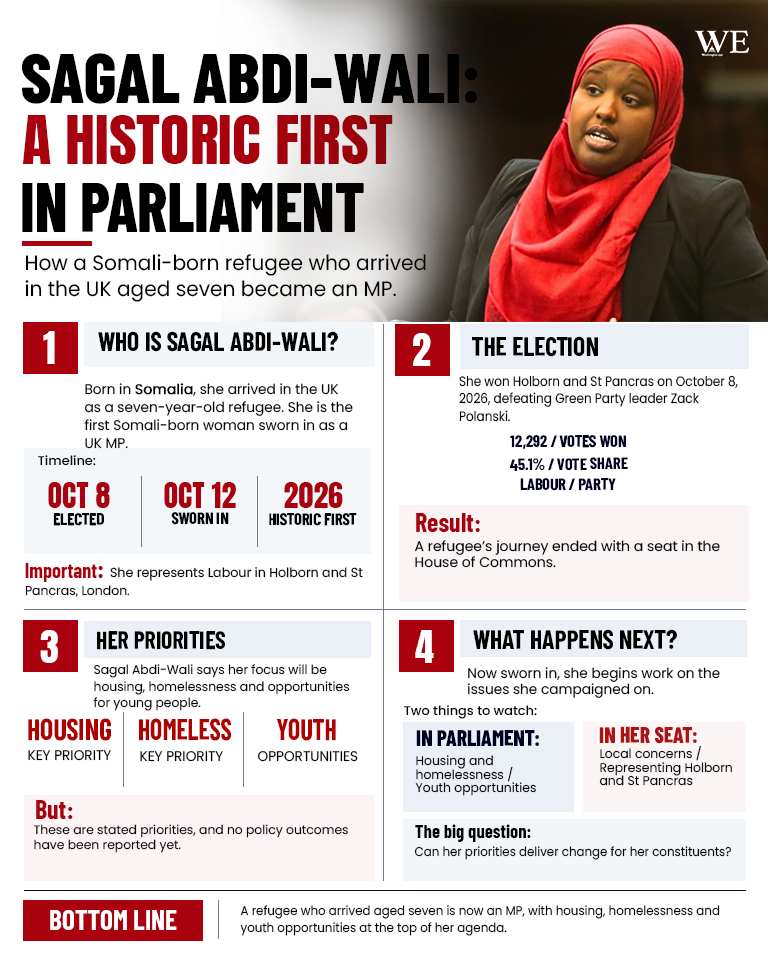
For Abdi-Wali, the swearing-in represents the culmination of a journey that began with displacement and uncertainty in Somalia. Her election marks a historic first for Somali-born refugee women in British parliamentary politics and adds a new chapter to the story of immigrant participation in the United Kingdom’s democratic institutions.