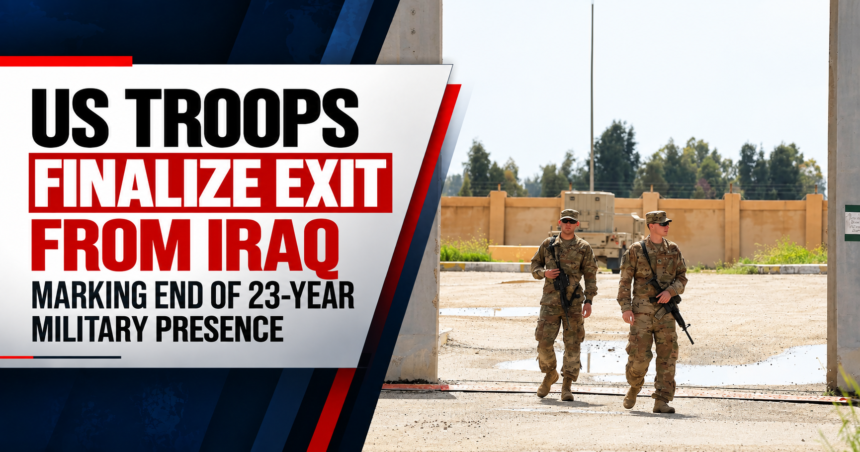
The last American troops have left Iraq, formally ending the United States-led military mission against Islamic State and closing another chapter in more than two decades of U.S. military involvement in the country.
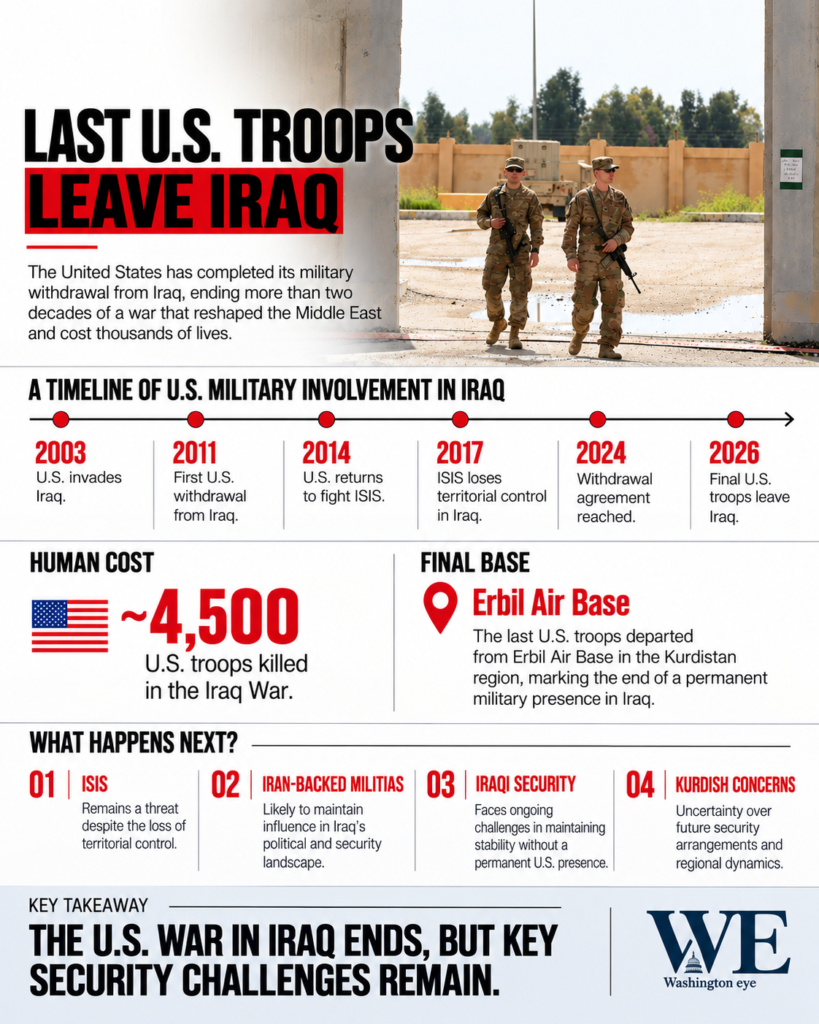
U.S. Central Command confirmed on September 30, 2026, that American forces and equipment had completed their departure from Erbil Air Base in Iraq’s Kurdistan region, the final base hosting U.S. troops. The withdrawal was carried out under a 2024 agreement between Washington and Baghdad. The departure ends the Iraq-based phase of Operation Inherent Resolve, launched in 2014 after Islamic State, also known as ISIS or ISIL, seized Mosul and large areas of northern and western Iraq.
However, it does not mean the end of the U.S. campaign against ISIS in the wider region. The coalition’s headquarters has moved to Jordan, while American and allied forces will continue counter-ISIS operations elsewhere, including in Syria. Washington and Baghdad also plan to maintain a bilateral defence relationship involving areas such as training and intelligence cooperation.
From the 2003 Invasion to the 2026 Withdrawal
The withdrawal carries enormous historical significance because U.S. military involvement in Iraq stretches back more than two decades. American and allied forces invaded Iraq in March 2003, overthrowing President Saddam Hussein. The war that followed became one of the most consequential and controversial U.S. foreign-policy decisions of the 21st century.

Approximately 4,500 U.S. service members were killed during the Iraq War, while estimates of Iraqi deaths vary considerably depending on methodology and whether indirect deaths are included. The conflict was followed by years of insurgency, sectarian violence and political instability.
American forces formally withdrew in December 2011, apparently ending the U.S. military presence. But they returned less than three years later. ISIS swept across northern Iraq in 2014, capturing Mosul and nearly a third of the country while Iraqi security forces initially collapsed in several areas. Baghdad asked for international assistance, prompting Washington to assemble an international coalition.
ISIS subsequently lost its territorial “caliphate,” with Iraq declaring victory over the group in 2017. The remaining U.S. military presence gradually shifted from direct combat toward advising, intelligence, training and support for Iraqi forces. Around 2,500 U.S. troops were still stationed in Iraq before the latest withdrawal process began. Most American and coalition forces started leaving during 2025, leaving several hundred personnel at Erbil before the final departure.
Trump and Iraq Mark the End of the Mission
President Donald Trump welcomed the withdrawal, describing the U.S. experience in Iraq as an extremely costly military undertaking and presenting the departure as a victory for both countries. The agreement itself was negotiated under President Joe Biden’s administration in 2024, but its final stages were implemented under Trump. The timetable called for the coalition military mission in Iraq to conclude by September 2026.
Iraq’s government portrayed the withdrawal as an important restoration of national sovereignty. Prime Minister Ali al-Zaidi said the country was entering a new phase in which Iraqi institutions and security forces would take primary responsibility for national defence. Baghdad also announced several days of commemorations marking what it called “Sovereignty Days.”
Iran-backed armed groups in Iraq celebrated for a different reason. Several have long demanded the complete removal of U.S. forces and portrayed their departure as a victory against foreign military presence.
ISIS, Iran and the Question of What Comes Next
The most important question is whether Iraqi forces can maintain security without American troops stationed inside the country. ISIS is vastly weaker than it was in 2014 and no longer controls major Iraqi territory. U.S. Central Command said Iraqi security forces are now capable of assuming primary responsibility and that ISIS no longer represents the systemic threat it once did.
Nevertheless, ISIS has not disappeared. Sleeper cells continue to operate, particularly in remote areas, meaning counterterrorism cooperation will remain important. A potentially larger political challenge involves Iran-backed militias. Iran has built substantial political and military influence in Iraq since 2003. Several powerful armed factions maintain close relations with Tehran, and some are incorporated into Iraq’s state security structure while also possessing significant independent political power.
Washington has pressed Baghdad to bring weapons under state control. But Iraq’s deadline for militia disarmament has reportedly been postponed until June 2027, highlighting the difficulty of the task. The withdrawal has caused particular concern in the Kurdistan region. Kurdish authorities have warned about losing U.S. military and air-defence support at a time of heightened regional tensions and threats from armed groups.
Critical View: The End of a War or Just a New Phase?
The departure is symbolically enormous, but describing it simply as the end of 23 continuous years of American military presence can be misleading. The United States already withdrew its forces once, in 2011, before returning in 2014 at Baghdad’s invitation to confront ISIS. The mission ending now is therefore specifically the 12-year anti-ISIS deployment from 2014 to 2026.
The broader legacy of U.S. involvement remains deeply contested. Supporters of the later coalition mission point to the defeat of ISIS as a territorial force and the strengthening of Iraqi security forces. Critics of the 2003 invasion point to the enormous human and financial costs, political instability and expansion of Iranian influence that followed Saddam Hussein’s removal.
The final withdrawal also creates a strategic paradox. The United States entered Iraq in 2003 partly to transform the regional security environment, yet its departure comes with Iran and Iran-aligned groups holding substantial influence inside Iraq. Reuters reported that Tehran and its allies celebrated the withdrawal as a strategic victory. For Iraq, September 30 therefore represents both an ending and a test.
After decades in which foreign armies, insurgents, ISIS and competing militias shaped the country’s security environment, responsibility now rests more heavily with Baghdad. Whether Iraq can suppress ISIS remnants, control armed factions and balance its relationships with Washington and Tehran will determine whether the American withdrawal becomes a milestone toward lasting sovereignty, or the beginning of another period of instability.