
Germany’s 2026 state election cycle has delivered major shifts across the country, weakening some of the traditional governing parties while strengthening both the Alternative for Germany (AfD) and, in Berlin, the Left Party. Five state elections held between March and September have highlighted growing voter dissatisfaction over the economy, migration, housing, public services and the direction of Chancellor Friedrich Merz’s federal government.
Elections were held in Baden-Württemberg on March 8, Rhineland-Palatinate on March 22, Saxony-Anhalt on September 6, and Berlin and Mecklenburg-Western Pomerania on September 20. Together, the contests provided one of the clearest measures of Germany’s changing political landscape since the 2025 federal election.
From Green Victory in the South to AfD Gains in the East
The election year began with a close contest in Baden-Württemberg, one of Germany’s wealthiest and most industrialised states. The Greens, led by former federal agriculture minister Cem Özdemir, finished first with 30.2%, narrowly ahead of the CDU on 29.7%. The AfD secured 18.8%, while the SPD fell to 5.5%. Turnout reached 69.6%.
The result was significant because the CDU had hoped to regain leadership of a state traditionally associated with the centre-right. Merz described the result as “bitter” but said it would not derail his federal coalition’s work. The Greens’ success was widely linked to Özdemir’s personal popularity and relatively moderate campaign profile.

Two weeks later, the political direction shifted in Rhineland-Palatinate, where the CDU ended 35 years of SPD dominance. The CDU won 31.0%, followed by the SPD with 25.9%, the AfD with 19.5% and the Greens with 7.9%. The SPD’s result represented its worst performance in the state, while the AfD more than doubled its previous share.
The most dramatic result arrived on September 6 in Saxony-Anhalt. The AfD secured 43.8% of first votes and 44.3% of second votes, becoming by far the largest party. The CDU received 17.2% of first votes and 24.0% of second votes, while the SPD, Left, Greens and BSW also entered the new parliament. Turnout reached 77.8%.
Berlin and Mecklenburg-Western Pomerania Deliver New Shock

The final election Sunday, September 20, produced sharply different winners in two eastern states. In Berlin, the Left Party emerged as the largest force with 25.7%, ahead of the CDU at 18.8%, AfD at 16.3%, Greens at 14.3% and SPD at 12.1%, according to preliminary results.
Housing was among the campaign’s most prominent issues. Left lead candidate Elif Eralp campaigned on stronger state intervention in Berlin’s housing market, including implementation of the 2021 referendum calling for the socialisation of large private housing holdings. Critics have questioned the potentially enormous financial cost, while supporters argue that stronger intervention is necessary in a city facing high rents and housing shortages.
In Mecklenburg-Western Pomerania, meanwhile, the AfD finished first with 38.2%, ahead of the SPD on 35.5%. The Left received 6.5% and the Greens 5.7%. Most strikingly, the CDU fell to 4.9%, missing the five-percent threshold and therefore failing to enter the state parliament, an unprecedented result for the party in a German state election. Turnout was 78.1%.
Merz described the CDU result as a “disaster,” but rejected suggestions that he should abandon his federal reform programme. He instead argued that Germany’s economic difficulties made reforms involving taxation, pensions and regulation more urgent.
Why the Elections Matter for Germany
The results reveal a politically fragmented Germany rather than a single nationwide swing. The Greens remained highly competitive in Baden-Württemberg, the CDU returned to first place in Rhineland-Palatinate, the Left dominated Berlin, while the AfD achieved its strongest results in Saxony-Anhalt and Mecklenburg-Western Pomerania.
Economic anxiety, migration, energy and living costs, housing, security and dissatisfaction with established parties all influenced the campaigns to varying degrees. In Berlin, polling analysis suggested dissatisfaction was particularly widespread: 45% of respondents said no party was capable of solving the city’s problems, while only 27% said federal political issues were decisive in their vote.
Pre-election surveys in Berlin had generally placed the Left around 20–23%, meaning its eventual 25.7% performance exceeded several late polls. The CDU had generally polled around 20–21%, while the AfD was around 17–18%. The broader challenge is coalition-building. Germany’s established parties have continued to reject cooperation with the AfD, meaning strong AfD results can leave the remaining parties needing broader multi-party coalitions. In Mecklenburg-Western Pomerania, for example, the SPD, Left and Greens together have sufficient support for a governing majority, while Berlin also offers several mathematically possible coalition combinations.
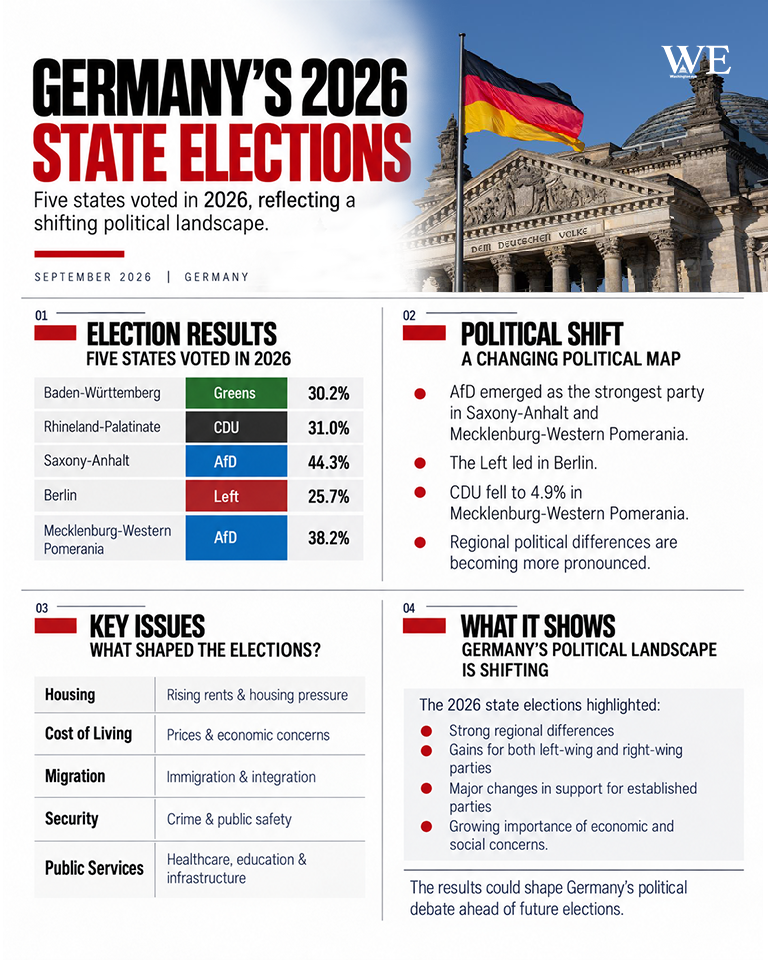
The elections therefore leave Germany with a more fragmented regional political map and greater pressure on the federal CDU-SPD government. They also underline major regional differences: no single party dominated across the five contests. Whether these state-level trends persist into the next round of elections will depend heavily on Germany’s economic performance, the implementation of federal reforms and how parties respond to voter concerns over migration, housing and public services.