

Two Chinese mathematicians have made history by winning the 2026 Fields Medal, one of the world’s most prestigious awards in mathematics and an honour frequently described as the “Nobel Prize of Mathematics.” Yu Deng and Hong Wang received the medal on July 23 at the opening ceremony of the International Congress of Mathematicians (ICM) in Philadelphia, United States. They were among four mathematicians honoured this year, alongside American mathematician John Pardon and Canadian mathematician Jacob Tsimerman.
The result represents an important milestone for Chinese mathematics. Deng and Wang are the first Chinese-born mathematicians to receive Fields Medals in the same year since Shing-Tung Yau won in 1982, according to Nature. Chinese reporting has also highlighted them as the first Chinese nationals to receive the award.
What Is the Fields Medal?

Unlike the Nobel Prizes, there is no Nobel Prize specifically for mathematics. The Fields Medal is therefore often informally called mathematics’ equivalent of a Nobel, although the two awards operate very differently. The Fields Medal is presented by the International Mathematical Union at the International Congress of Mathematicians, which is normally held every four years. It recognises exceptional mathematical achievement as well as the potential for future accomplishments. Recipients must be under 40 at the beginning of the year in which the congress takes place.
The award was first presented in 1936 and has become one of the most coveted honours in mathematics. Only a small number of mathematicians receive it at each congress, making the simultaneous recognition of Deng and Wang particularly significant. Both winners also share an educational connection: they studied mathematics at Peking University, one of China’s leading universities. Their later academic careers, however, developed internationally, particularly in the United States and Europe.
Hong Wang: Solving a Century-Old Problem
Hong Wang, born in 1991, works in areas including harmonic analysis and geometric measure theory. Her career attracted international attention after she and mathematician Joshua Zahl announced a proof of the three-dimensional Kakeya conjecture in 2025. The Kakeya problem concerns how a very thin object, mathematically represented by a line segment, can be rotated through every possible direction while occupying an extraordinarily small space. Behind that deceptively simple description lies a deep mathematical problem with connections across analysis and geometry.
The three-dimensional conjecture had resisted mathematicians for decades. Wang and Zahl’s work provided the long-awaited proof and represented a major development in the field. Wang’s award is historic in another respect. She became only the third woman to win a Fields Medal since the prize was established.

Yu Deng and Hilbert’s Sixth Problem
Yu Deng, born in 1989, has worked on mathematical problems connecting microscopic physical systems with the large-scale behaviour described by equations in physics. Together with collaborators Zaher Hani and Xiao Ma, Deng produced major work connecting systems of microscopic particles with the Boltzmann equation, which describes the statistical behaviour of gases. Their research addressed a fundamental part of Hilbert’s sixth problem, one of the famous mathematical problems proposed by German mathematician David Hilbert in 1900.
Deng’s mathematical ability was apparent early in his career. He won a gold medal at the International Mathematical Olympiad in 2006 before studying at Peking University and later transferring to the Massachusetts Institute of Technology. He subsequently completed his doctorate at Princeton University. Deng is now a professor at the University of Chicago.
A Milestone for Chinese Mathematics
The double victory has attracted significant attention in China, where mathematics, science and technological research have become major areas of investment. Chinese social-media users celebrated the result as a source of national pride, particularly because two Chinese mathematicians received the honour simultaneously and one of them was a woman.
The awards have also prompted discussion about China’s academic system. Although Deng and Wang began their university education in China, substantial parts of their advanced education and research careers took place abroad. Some online reactions therefore questioned how China could create more opportunities for leading researchers to pursue internationally competitive work within the country.
Their achievements nevertheless highlight China’s increasingly prominent position in global scientific and mathematical research. The 2026 awards also demonstrate the international nature of modern mathematics. This year’s four recipients work across institutions in the United States, Canada and France, while their backgrounds and research collaborations span multiple countries.
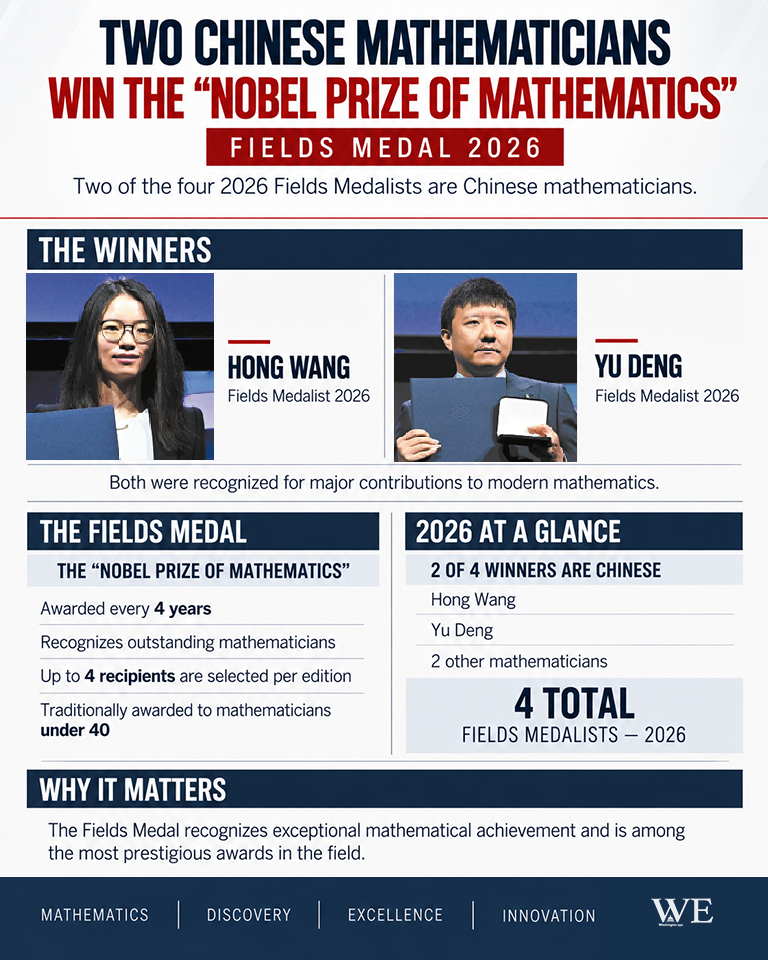
For Deng and Wang, the Fields Medal recognises years spent working on problems that are difficult even to describe outside specialist mathematics. For China, having two mathematicians recognised in the same Fields Medal class marks a symbolic moment in the country’s growing scientific ambitions. And for mathematics itself, their breakthroughs demonstrate why problems posed decades, or even more than a century, ago can continue to inspire new generations of researchers.